What is the Use of Inverter in Home
The importance of inverters in today’s time can be gauged from the frequent power cuts. Inverters have become vital appliances in modern homes, businesses, and even vehicles. Therefore, it is essential to understand the best use of an inverter. An inverter is an electronic device that converts direct current (DC) power into alternating current (AC) power. Let us know in this article about the use of inverter, its types and how to choose the right inverter as per your requirement
What is Inverter
An inverter is an electronic device that takes energy from a battery and supplies electricity to appliances at home when the power supply from outside is cut off. An inverter is an electronic device that converts direct current (DC) power into alternating current (AC) power. Now, this question arises in your mind: Who invented the inverter? Keep reading and you will know about it too.
DC power that flows in a single direction is usually obtained from batteries or solar energy, while AC power constantly changes direction.
AC power is used in homes and businesses. Electrical appliances, such as lights, fans, computers, and televisions, are designed to run on AC power.
We use inverters when AC power is not available for some reason. The inverter converts DC power stored by batteries or solar energy into AC power, which runs lights, fans, computers and TVs.
Inverter uses restore backup power, especially in areas where power cuts occur frequently.
Function of Inverter
An inverter functions in four ways.
- Converting supply mains from AC to DC: The inverter converts the AC supply into a DC supply and charges the battery.
- Converting DC to AC: First, it converts the DC power of the battery or solar panel into AC power, which is then used to run household appliances, such as fans, lights, and refrigerators.
- Providing power backup: In the event of a power Cut, the inverter operates the appliances using power from the battery.
- Maintaining stable voltage: The inverter supplies the correct voltage to appliances, enabling them to operate safely and efficiently.
To correct inverter use, we must understand how they work. Let us know it in detail below.
Inverter Working Principle
The primary function of the inverter is to convert DC power into AC power. In this process, the inverter changes the flow of DC power into a pulse (periodic) form, then converts it into the required sine wave. This process is completed in two main steps:
1. Switching
Switching is the first stage of the inverter, in which DC power is rapidly switched “on” and “off”. This process converts the power into a pulse wave.
They are controlled by a switching circuit, which times the power according to the pulse length and frequency. When DC power is converted into a pulse wave through switching, it produces a sine wave as the first output.
2. Filtering
The pulse wave of the inverter is filtered using a filter circuit. The filter circuit contains capacitors, diodes, and other filtering techniques that purify these pulse waves and convert them into a sine wave. A sine wave is the most common and highest quality form of AC power, used in household and industrial appliances.
Why are inverters important?
What does an inverter do? You already know this. Now, let’s explore why inverters are essential. The “inverter” was invented by David Prince in 1925. The Japanese electronics company Toshiba invented the inverter on a commercial scale in 1980.
Inverter use has become very important in today’s time because they provide backup power during power supply interruptions. They also perform many other valuable functions. Let us know some of the main reasons for the importance of inverters:
Advantages of Inverter
There are many advantages of using an inverter, the main ones being:
- Electricity savings: Inverters conserve electricity by maximising energy efficiency, for example, by utilising the full potential of the DC power generated by solar panels through an inverter.
-
Safety: The inverter protects against overvoltage, short circuits, and other electrical problems.
- Emergency backup: With the inverter, we can run our appliances even in emergencies. Energy is obtained from the battery as backup power, which is a good solution.
- Smart and Portable: Some inverters are portable and available in various sizes and capacities, making them easily usable anywhere.
Use of Inverter
Application of inverter are Some of the key areas where inverters are commonly used are:
1. Use of Inverter at Homes
Inverters are essential for preventing frequent power outages in homes. It is a reliable backup device that runs fans, lights and basic appliances without interruption. Modern inverters are energy-efficient, protecting even sensitive electronic equipment, such as computers, from voltage fluctuations.
A high-quality inverter, combined with a properly maintained battery, enables homeowners to continue their daily activities uninterrupted, providing them with peace of mind and a comfortable living experience during power outages.
2. Solar System
Inverter use is very important in solar energy systems. Solar panels generate direct current (DC) electricity, which the inverter converts into alternating current (AC).
This type of current can be used to run household appliances easily. This current can also be sent to the electrical grid. Solar inverters are used in solar energy for both residential and commercial setups.
3. Business and Office
The use of inverters becomes necessary in many businesses because an uninterrupted power supply is required.
Essential equipment such as computers, servers, communication systems and lighting need to be kept running without interruption. This is very important for day-to-day operations in offices and businesses.
4. industries and factories
“In many industries, inverter uses include supplying power to machinery and control systems during power outages, with large batteries or solar panels often compensating for the energy shortfall.”
The use of inverters helps in maintaining production without any interruption and reducing operational losses.
5. Transportation and Recreational Vehicles
There are also some types of inverters that are widely used in vehicles such as RVs, boats, and trucks.
They are used to power standard AC-powered devices on the go. This includes powering small appliances, charging electronic devices, and even running appliances. This makes inverters valuable for long trips and camping.
6. Telecommunication and Medical Facilities
Uninterrupted power supply is crucial for telecommunication towers and medical facilities. Hence, inverters play a vital role in this task.
In telecommunications, inverter use is essential for maintaining the continuous operation of communication systems. Similarly, in medical facilities, inverters ensure an uninterrupted power supply to critical equipment such as diagnostic machines, ventilators, and life support systems during power outages.
7. Data Centers and IT Facilities
In data centers and IT facilities, application of inverter is very important to maintain uninterrupted power supply. Critical equipment such as servers and networking devices require uninterrupted power to run smoothly.
For this, inverters play a key role in the uninterruptible power supply (UPS) system, Where even minor disruptions cause significant operational and financial losses.
In addition, inverters regulate voltage and frequency in power conditioning systems, protecting sensitive IT equipment from power fluctuations.
Back Panel of an Inverter

- 1. AC supply mains
- 2. manual/bypass switch
- 3. output supply socket
- 4. normal/UPS switch
- 5. NC/HC switch
- 6. ELS cord
- 7. battery supply wire(+Ve and -Ve)
- 8. cooling fan
- 9. name plate
Due to frequent power cut, inverter has become a vital necessity for the house hold in the present time.
At the time of this inflation, it would be very foolish to use diesel generator for frequent power cut. but this problem is solved to a great extent by the inverter at very low cost.
At present, inverter function with Bluetooth connectivity and WiFi connection feature are available in the market, which can be easily controlled.
To avoid the burden of electricity bills, there are many such inverters available in the market, which can be connected directly to the solar panel and the battery can be charged.
Types of inverters
- Pure Sine Wave Inverter: It is ideal for all devices, including computers, medical equipment, and other high-end electronics. It provides a smooth output supply without any distortion.
- Modified Sine Wave Inverters: Available at low cost, effective for most devices, but may cause problems for electronic devices.
- Square Wave Inverter: Although less commonly used these days, this type of inverter is available at a low cost for general household appliances, such as lights and fans.
- Grid-tie Inverter: These are power inverters used in renewable energy sources such as solar or wind power. These inverters supply energy to the power grid, ensuring efficient distribution of energy.
- Hybrid Inverters: These inverters operate in conjunction with both the grid and battery storage. They store solar energy in batteries. When solar power is unavailable, they draw energy from the grid to maintain a continuous power supply.
How to Buy Inverter for Home
Now, it comes to deciding which type of inverter to buy from the market. We have given complete information about this type of inverter. Let’s determine what information we need to buy an inverter.
See friends, if you buy an inverter for your home, keep in mind that you should always opt for a pure sine wave inverter. Now you may say that we lack such technical knowledge; don’t worry, you don’t need to delve into such depth.
Buy a pure sine wave inverter without thinking twice. Always remember one thing: all the electrical appliances in our home are designed to run on a pure sine wave.
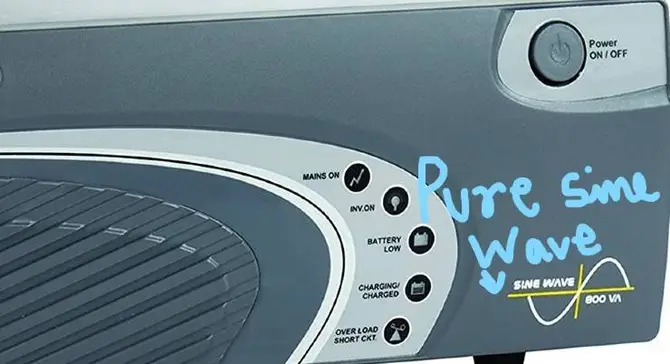
Friends, we have provided a picture of a pure sine wave inverter for your convenience, so you won’t get confused.
We and you know that if you talk about a pure sine wave in the market, then 90% of shopkeepers will ask what it is. Therefore, for convenience, we have provided you with this information.
How to Buy an Inverter as per your Requirement
To Use of inverter as per the requirement, it is necessary to calculate the power of the appliance installed in the house. It’s a simple formula.
- Mobile phone charger 5W or less
- CFL bulb(room)- 10-25W
- Incandscent lamp- 100W
- LED bulb- 5-40W
- TV- 130W
- Fan- 60-90W
- Computer- 150-200W
- Aircoolers- 250-300W
- Mixers and grinders- 300-400W
- Induction cookers- 1000-1500W
- Iron- 750W
It is a general figure for appliances. To know the exact figure, every appliance used in the home has a wattage rating written on it. The total wattage is calculated by adding the ratings of all these.
For example, let us assume the total wattage of all the appliances is 1000W. Now we have to determine the capacity of the inverter which is simply called Voltage Ampere Rating (VA).
Now we have to calculate the VA of the inverter we are going to buy. Like other machines, inverters are also not 100% efficient, so we assume the maximum VA x 80% capacity of the inverter.
Yes, one more thing, the higher the power of the inverter, the more appliances you can run simultaneously in the house.
For backup power, you will have to choose the best quality battery. One more thing, the higher the Ah value of the battery, the more backup it will give.
At present, 100Ah, 150Ah, 180Ah, 200Ah, 250Ah batteries are available in the market. It is very important to choose the right battery as per the power requirement of the house as well as from an economic point of view. Know this with a simple formula.
Let my house power reqirement 1000W
so we brought inverter capacity 1150VA
then capacity = 1150 x 0.80%
= 920
if power backup continue require three hours
then 920VA x 3hrs/12V = 230 Ah ≈ 200 Ah battery required
One thing to consider is how many devices in your home run simultaneously when it comes to direct backup connectivity.
Inverter Maintenance
Regular care and maintenance are essential to ensure that the inverter lasts for a long time. Some important tips are:
-
Proper battery care: It is essential to clean the battery terminals and check for leaks regularly.
- Overload protection: Do not overload the inverter.
-
Servicing: Get it serviced regularly by a professional technician.
- Power On-Off: It is recommended to turn off the inverter when not in use for an extended period.
Conclusion
The use of inverters is crucial for maintaining a continuous and stable power supply in the home, especially during power outages. They provide convenience, safety and flexibility in powering essential appliances and sensitive electronics. Inverters are a boon for home working setups and renewable energy sources, such as solar panels. With various types of inverters, homeowners can select the most suitable model according to their power needs and budget.
[WPSM_AC id=32714]

I am an electrical engineer and also a blogger. I write informative blog posts on topics related to electrical and electronics engineering. If you are interested in these topics, you are welcome to my site to read these articles.