ESP Working Principle in Power Plant
Every thermal power plant burns large amounts of coal, and this creates huge clouds of dust and fly ash. If that ash slips into the open air, it pollutes the surroundings and harms people’s health. This is where an Electrostatic Precipitator, or ESP, comes to the rescue. It is a pollution control device that pulls tiny dust particles out of flue gas before the gas reaches the chimney.
Think of the ESP as a powerful filter that uses electricity instead of cloth. It traps fine ash with electrical force, keeping the air around the plant much cleaner. That role makes it a key part of any coal-based plant. In this article, we will focus only on the ESP working principle, so you can clearly understand how this clever device does its job.
What Is an Electrostatic Precipitator?
So, what is electrostatic precipitator in simple words? It is a device that uses electric charge to separate and remove solid particles, such as dust and ash, from a flowing gas stream. Rather than blocking the particles with a physical mesh, it grabs them with an invisible electrical pull. This keeps the airflow smooth while still catching even very fine dust.
If you ever wonder what do electrostatic precipitators do, the answer is straightforward. They clean dirty industrial gas before it escapes into the atmosphere. That single job protects both the environment and public health.
These devices show up in many places. Beyond power plants, you will find electrostatic precipitator application in cement factories, steel mills, paper mills, and chemical plants. So where are electrostatic precipitators used most often? Anywhere a process creates large volumes of dusty exhaust gas that must be cleaned before release.
There are also a few common designs. A dry electrostatic precipitator collects dry dust on metal plates, which suits hot gases like those in coal plants. A wet electrostatic precipitator uses a water film to capture sticky or moist particles. Steam power plants usually rely on the dry type because of the heat and ash they handle.
What Is the Working Principle of ESP?
The whole device runs on one simple idea: electrostatic attraction. Opposite charges pull toward each other, and same charges push apart. An ESP applies this principle on a large scale to remove dust from a gas stream.
Here is the core concept. As dirty gas flows through the unit, the dust particles floating inside it are given an electric charge. Once a particle carries a charge, it can no longer drift freely with the gas. Instead, it feels a strong pull toward a nearby surface that holds the opposite charge.
To create this pull, the ESP builds a strong electric field inside its chamber. This field both charges the particles and steers them sideways, away from the moving gas and toward the collecting surfaces. The clean gas keeps flowing forward while the dust gets left behind. That simple push-and-pull is the heart of how do electrostatic precipitators work, and everything else is just engineering built around it.
How Does ESP Work in a Power Plant? Step-by-Step
Now let’s follow the gas on its journey through the device. Each step builds on the one before it, so the process flows smoothly from start to finish.
1. Flue Gas Enters the ESP
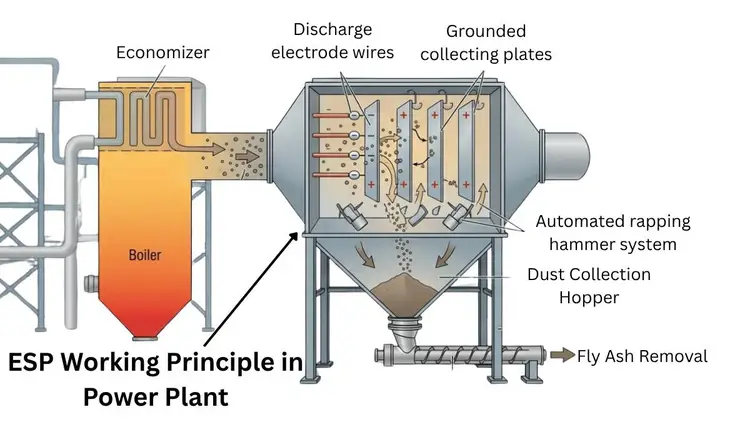
The journey begins when hot flue gas from the boiler enters the precipitator chamber. This gas is packed with fly ash. A gas distribution system spreads the flow evenly across the inlet, so every section of the unit gets a fair share of work and no part is overloaded.
2. Electric Field Is Generated
Inside the chamber sit thin discharge electrodes carrying a very high negative voltage. When the power switches on, these electrodes create a strong electric field in the gap between themselves and the collecting plates. This field is the invisible engine that powers the entire cleaning action.
3. Dust Particles Become Charged
As the gas passes through this field, the electrodes release a stream of charged ions. These ions latch onto the fly ash and dust particles riding in the gas. Within a fraction of a second, almost every particle in the stream picks up a negative charge.
4. Charged Particles Move Toward Collecting Plates
A charged particle can no longer travel quietly with the gas. The electric field tugs it sideways toward large metal collecting plates, which carry the opposite charge. Since opposite charges attract, the particles steadily peel away from the gas flow and drift toward those plates.
5. Dust Collects on the Plates
One by one, the charged particles reach the plates and cling to the surface. The layer grows thicker as more dust arrives, until a solid cake of ash builds up. At this point the gas in that zone is already much cleaner, but the work isn’t finished yet.
6. Rapping Removes the Collected Ash
The plates cannot hold dust forever, so the ash must be knocked off. This is the job of the rapping mechanism, often called the electrostatic precipitator hammer system. Small hammers strike the plates at timed intervals, sending a sharp jolt through the metal. This electrostatic precipitator cleaning step shakes the ash cake loose, and the dust slides down into a hopper at the bottom for safe disposal or reuse.
7. Clean Gas Leaves the ESP
With the dust now trapped and removed, the cleaned gas continues on its way. It flows out of the precipitator and moves toward the chimney for final release. The gas leaving the unit is far cleaner than the gas that entered, which helps the plant meet strict pollution limits.
Simple Example to Understand ESP
Here is an everyday example that makes the idea click. Take a plastic comb and rub it a few times on dry hair. Now hold it close to some tiny pieces of paper. The paper rises and clings to the comb. That little jump is static electricity at work, and an ESP uses the very same force, just scaled up to handle huge volumes of industrial gas.
In this picture, the comb acts like the charged collecting plate, and the paper bits act like the dust particles. The comb pulls the paper because they carry opposite charges. Inside the precipitator, the charged ash behaves exactly like that paper, rushing toward the plate that attracts it. Once you can see that comb pulling paper in your mind, the whole working principle suddenly feels easy.
Flow Summary of ESP Working Principle
Here is the whole process in a few quick steps:
- Flue gas from the boiler enters the electrostatic precipitator
- Dust and ash particles receive an electric charge
- The charged particles move toward the collecting plates
- Dust builds up on the plates and is knocked off during electrostatic precipitator cleaning by the rapping system
- The loosened ash falls into the hopper for safe disposal
- Clean gas exits the ESP and heads toward the chimney
This short flow shows how do electrostatic precipitators work in a clear and practical way. Each step depends on the one before it, which keeps the gas moving forward while the dust gets trapped behind.
Conclusion
The ESP working principle is simple once you break it down. Dirty gas enters the unit, the dust particles pick up a charge, the electric field pulls them onto collecting plates, and the hammer system shakes the ash into a hopper. After that, much cleaner gas flows out toward the chimney. At its core, the device just borrows the same trick as a charged comb lifting paper. For any coal-based plant, this makes the ESP a quiet workhorse that controls fly ash and protects the air around it. Modern electrostatic precipitator technology can trap a very high share of fine particles, which keeps daily operation clean and within legal limits. Of course, this performance does not last on its own. Regular electrostatic precipitator maintenance, such as checking the electrodes, cleaning the plates, and emptying the hoppers, keeps the unit running at full strength for years.
FAQ
How efficient is an ESP in a power plant?
A well-tuned ESP is incredibly good at its job. Modern electrostatic precipitator technology can capture over 99% of fine dust and ash particles. That means only a tiny fraction of the original dust ever reaches the chimney.
Can an ESP clean gases other than normal flue gas?
Yes, it can. As long as the gas carries solid or liquid particles, an ESP can pull them out. This flexibility is why you see electrostatic precipitator application in cement plants, steel mills, and chemical units, not just coal-based power plants.
What happens if the ESP fails during operation?
If the ESP stops working, all that fly ash escapes straight into the air. This can break pollution limits, dirty nearby areas, and even force the plant to slow down or shut. That is exactly why regular electrostatic precipitator maintenance is treated as a top priority.
How long does an ESP usually last?
With proper care, an ESP can run for 20 to 30 years or even longer. The plates and electrodes are built to handle heat, dust, and constant use. Routine checks and timely repairs keep the unit reliable for decades.
Can the ash collected by an ESP be reused?
Absolutely. The dry fly ash gathered by a dry electrostatic precipitator is a valuable material. It gets used in making cement, bricks, and road bases, so it rarely goes to waste.
Does an ESP use a lot of electricity?
Compared to the huge power a plant produces, an ESP uses very little. It needs only a small slice of energy to run its high-voltage system and hammers. That low power demand is one big reason this technology stays so popular.

I am an electrical engineer and also a blogger. I write informative blog posts on topics related to electrical and electronics engineering. If you are interested in these topics, you are welcome to my site to read these articles.