What Is Drift Velocity of Free Electrons in a Metal?
Every time you flip a switch, electric current flows through the wire almost instantly. But have you ever wondered what actually moves inside that wire to make it happen? The answer lies in the ‘free electrons‘ present in the metal—tiny, charged particles that respond to voltage and carry the current we rely on every day.
This is where drift velocity of free electrons in a metal becomes the key concept to understand. Drift velocity describes how these electrons move under an electric field, and it is the foundation of how electric current works in any metallic conductor. Despite being surprisingly small in magnitude, this velocity drives every circuit you can think of.
In this article, you will learn exactly what drift velocity means, how it is defined, the formula that connects it to electric current, and what factors influence it. Whether you are studying this for an exam or simply want a clear explanation, this guide walks through each idea step by step.
What Are Free Electrons in a Metal?
Before defining drift velocity, it helps to understand what free electrons in a metal actually are — because without them, there would be no drift and no current.
Metals have a regular, repeating structure called a crystal lattice. At each point in this lattice sits a positively charged ion — the nucleus of an atom along with its tightly bound inner electrons. The outermost electrons of each atom, however, are only loosely bound to their parent nuclei. In a metal, these valence electrons break free from individual atoms and are shared across the entire material. These are called free electrons, or sometimes conduction electrons.
At room temperature and with no external voltage applied, these electrons are not sitting still. They move continuously in all directions at high speeds, bouncing off lattice ions in a completely random fashion. Because the motion is random, the electrons moving left are cancelled out by those moving right, the ones going up are balanced by those going down. The result is zero net displacement and zero net current — no charge flows in any preferred direction.
This random motion is always present, but on its own it cannot produce a current. Something needs to give these electrons a preferred direction. That something is an electric field — and the average velocity the electrons gain because of that field is what we call drift velocity.
Next, let’s look at exactly how drift velocity is defined and what makes it different from the random thermal motion happening at the same time.
What Is Drift Velocity? — Definition
Drift velocity is the average velocity with which free electrons move through a metallic conductor in a direction opposite to the applied electric field. This is the definition of drift velocity in its most precise form — and the word “average” is important here.
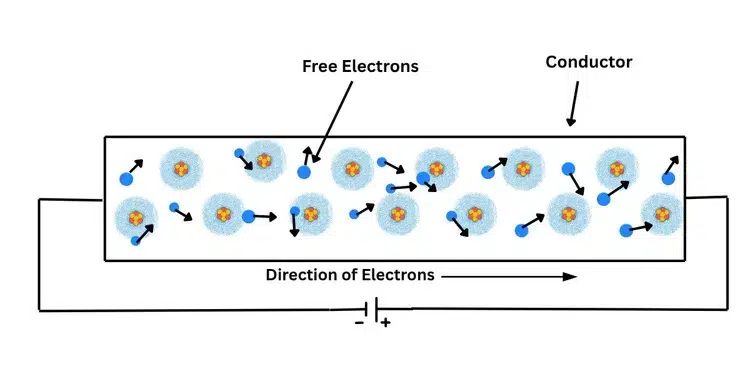
Individual electrons in a metal are constantly moving in random directions at very high speeds. Drift velocity is not the speed of any single electron. It is the net average velocity the entire group of electrons gains when an electric field is applied on top of that random motion.
This average is surprisingly small. Typical values of drift velocity in a metal fall in the range of 10⁻⁴ to 10⁻³ m/s — far slower than the random thermal velocity of electrons, which can reach 10⁵ to 10⁶ m/s. The two exist at the same time, but only the drift component contributes to electric current.
The SI unit of drift velocity is meters per second (m/s), the same as any other velocity.
Why Do Electrons Drift? The Role of the Electric Field
Electron drift does not happen on its own. It needs a cause — and that cause is an electric field acting on the free electrons inside the conductor.
Random Motion vs Directed Drift
Without any electric field, the free electrons in a metal move in completely random directions. At any given moment, an equal number of electrons move left, right, up, and down. Their velocities cancel each other out, so the net velocity is zero and no current flows.
When an electric field is applied, this random motion does not stop. The electrons still bounce around in all directions. But now, the electric field exerts a force on each electron: F = eE, where e is the charge of the electron and E is the electric field strength. This force gives every electron a small push in one direction — opposite to the field, because electrons carry a negative charge. Over time, this repeated push adds up to a small but measurable net velocity. That net velocity is the drift velocity.
How the Electric Field Is Established
The electric field inside a conductor is established the moment a battery or voltage source is connected. The battery creates a potential difference across the ends of the conductor, and this drives an electric field along its entire length almost instantly.
Once the field is set up, it acts on all free electrons in the conductor simultaneously. Each electron experiences the force F = eE and begins to drift slowly in the direction opposite to the field. This coordinated slow movement of charge is exactly what constitutes electric current in a metallic conductor. The drift is continuous as long as the field is maintained.
Drift Velocity Formula — Derivation and Explanation
Understanding the drift velocity formula connects the abstract idea of electron drift to real, measurable quantities like current, field strength, and conductor properties.
The Formula
The drift velocity formula is:
vd = eEτ / m
Here is what each term means:
- vd — drift velocity of the electrons (m/s)
- e — charge of an electron (1.6 × 10⁻¹⁹ C)
- E — electric field applied along the conductor (V/m)
- τ (tau) — relaxation time of the electrons
- m — mass of an electron (9.1 × 10⁻³¹ kg)
Relaxation time is the key term to understand here. After each collision with a lattice ion, an electron starts accelerating again due to the electric field. The relaxation time τ is the average time an electron moves freely before its next collision. A longer relaxation time means less interruption, so the electron builds up more drift velocity between collisions.
The formula shows directly that stronger electric fields, longer relaxation times, or lighter electrons all produce a higher drift velocity.
Relating Drift Velocity to Electric Current
Drift velocity connects directly to the electric current flowing through the conductor through this relation:
I = nAevd
Where:
- I — electric current (A)
- n — number density of free electrons (electrons per m³)
- A — cross-sectional area of the conductor (m²)
- e — charge of each electron (C)
- vd — drift velocity (m/s)
This equation says that the current depends on how many electrons are available, how large the conductor’s cross-section is, and how fast those electrons are drifting. Higher drift velocity means more charge passing a point per second, which means higher current — a direct, proportional relationship.
Rearranging this gives a useful working form:
vd = I / (nAe)
Physically, this version tells you what drift velocity must be to carry a given current through a specific conductor. For a thin wire with few conduction electrons, the electrons must drift faster to carry the same current compared to a thick wire with high electron density. This is the practical meaning of the drift velocity formula for free electrons.
Factors That Affect Drift Velocity
Drift velocity in a metal is not a fixed value — it changes depending on several physical conditions. Understanding these factors helps explain why different conductors carry current differently under the same applied voltage.
- Electric field strength: A stronger electric field exerts a greater force on each electron (F = eE). This increases the acceleration of electrons between collisions, raising their drift velocity directly.
- Number density of free electrons: When more free electrons are available in the conductor, each electron needs to drift less to carry the same total current. Metals with high electron density naturally distribute the current load across more charge carriers.
- Cross-sectional area of the conductor: A wider conductor spreads the same current across a larger area. As a result, the electrons in a thicker wire need less drift velocity to pass the same amount of charge per second compared to a thinner wire.
- Temperature: Higher temperatures increase the vibrations of lattice ions. This causes electrons to collide more frequently, which shortens the relaxation time. A shorter relaxation time means less time to accelerate between collisions — so drift velocity decreases as temperature rises.
- Material of the conductor: Different metals have different electron densities and relaxation times. Copper, for example, has a higher electron density than many other metals, which affects how electrons drift under the same field.
These five factors work together to determine the actual electron drift in any real conductor.
Drift Velocity vs Thermal Velocity — Why the Difference Matters
One of the most surprising facts about electron drift is just how slow it actually is compared to everything else electrons do.
The thermal velocity of electrons — the speed at which they move randomly due to heat — is enormous, typically between 10⁵ and 10⁶ m/s. Drift velocity, by contrast, is only about 10⁻⁴ to 10⁻³ m/s. That is a difference of roughly nine orders of magnitude.
Yet when you flip a light switch, the bulb turns on immediately. How?
Think of it like a pipe already packed full of water. The moment you push water in at one end, water flows out at the other end right away — you do not wait for the same water molecules to travel the full length. The same logic applies to a conductor. The wire is already full of free electrons. When the electric field is applied, it propagates through the conductor at nearly the speed of light, pushing all electrons into motion simultaneously. The effect reaches the other end almost instantly, even though individual electrons barely move.
This is why the speed of an electrical signal has nothing to do with how fast individual electrons drift.
Common Misconceptions About Drift Velocity
Some misunderstandings about drift velocity are quite common among students. Clearing these up makes the concept much easier to apply correctly.
- Misconception: Electrons race from one end of the wire to the other at high speed.
Reality: Electrons drift extremely slowly — typically a few millimeters per second or less. It would take hours for a single electron to travel one meter through a wire. - Misconception: Drift velocity equals the speed of electricity.
Reality: The electrical signal travels as the propagating electric field, which moves at close to the speed of light. Electrons themselves move slowly. The two are completely separate things. - Misconception: A higher current does not always mean that each electron is moving faster.
Reality: Current depends on both drift velocity and the number of charge carriers. Higher current can come from more electrons moving, not just from faster drift. The equation I = nAevd makes this clear — both n and vd contribute.
Solved Example — Calculating Drift Velocity
Let’s apply the formula vd = I / (nAe) to a concrete numerical problem.
Given:
- Current, I = 1.5 A
- Cross-sectional area, A = 2 × 10⁻⁶ m²
- Number density of free electrons, n = 8.5 × 10²⁸ m⁻³
- Charge of an electron, e = 1.6 × 10⁻¹⁹ C
Step 1: Multiply n, A, and e together.
n × A × e = 8.5 × 10²⁸ × 2 × 10⁻⁶ × 1.6 × 10⁻¹⁹
= 8.5 × 2 × 1.6 × 10^(28 − 6 − 19)
= 27.2 × 10³
= 2.72 × 10⁴
Step 2: Divide current by this value.
vd = 1.5 / 2.72 × 10⁴
vd ≈ 5.5 × 10⁻⁵ m/s
Observation: The result is in the range of 10⁻⁵ m/s — extremely small, as expected for drift velocity. This confirms that even a measurable current of 1.5 A is carried by electrons moving at a tiny fraction of a meter per second. The formula gives a result fully consistent with the known order of magnitude for electron drift in metals.
Conclusion
Drift velocity of free electrons in a metal is one of those concepts that seems simple on the surface but carries a lot of physics underneath. It is the small average velocity that electrons gain when an electric field is applied — and despite being measured in fractions of a millimeter per second, it is what drives every current flowing through a metallic conductor.
Understanding drift velocity gives you a clear picture of how current actually works at the electron level, why current flows instantly even though electrons move slowly, and how conductor properties like area, material, and temperature all play a role. The best way to solidify this understanding is to practice. Use the formula vd = I / (nAe) on numerical problems, vary the given quantities, and observe how the drift velocity changes. The more you apply it, the more intuitive it becomes.
FAQ
What is the SI unit of drift velocity?
The SI unit of drift velocity is meters per second (m/s), the same as any other velocity. It is typically very small in magnitude, often in the range of 10⁻⁴ to 10⁻³ m/s for common metallic conductors.
Is drift velocity the same for all electrons in a conductor?
No. Drift velocity is an average value across all free electrons. Individual electrons have different speeds and directions at any given moment because of random thermal motion. The drift is the small net velocity that emerges when you average across the entire group.
What happens to drift velocity when the length of the conductor increases?
For the same applied voltage, a longer conductor has a weaker electric field distributed across its length. A weaker field means less force on each electron, which reduces the drift velocity.
Why is drift velocity so small?
Electrons collide frequently with lattice ions inside the metal. Each collision interrupts their acceleration, keeping the net average velocity extremely low — even though the applied electric field is continuously pushing them.
Does drift velocity depend on the shape of the conductor?
It depends on cross-sectional area, not shape. For the same current, a conductor with a larger cross-sectional area requires a lower drift velocity because more electrons share the load.

I am an electrical engineer and also a blogger. I write informative blog posts on topics related to electrical and electronics engineering. If you are interested in these topics, you are welcome to my site to read these articles.