
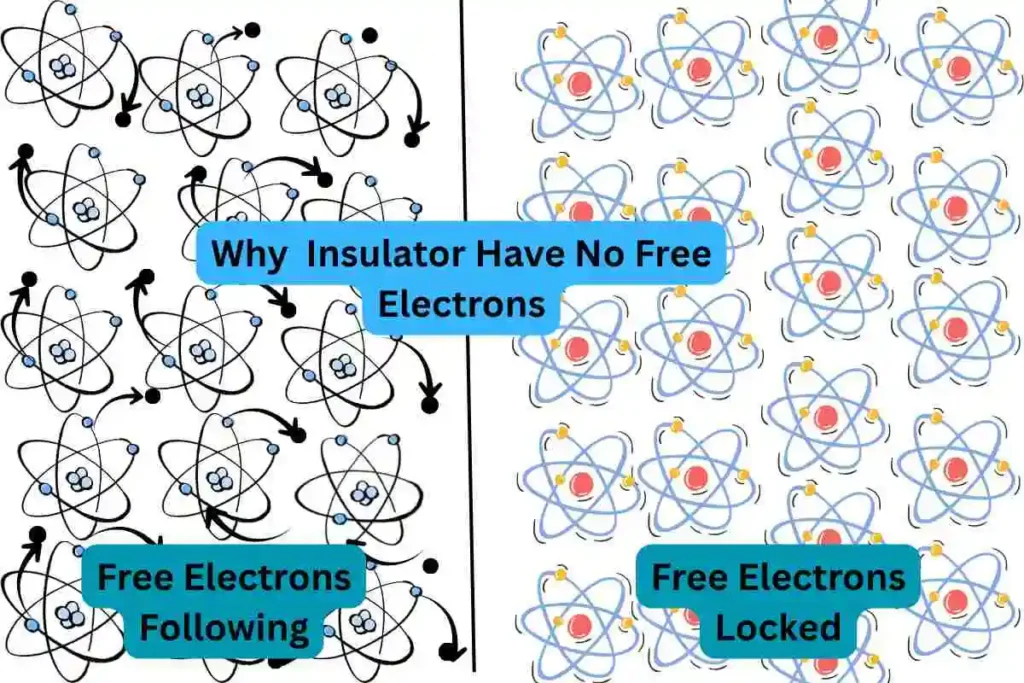
Why Do Insulators Not Have Free Electrons?
Ever noticed that electricians always wear rubber gloves? Or that every wire in your home is wrapped in plastic? These aren’t random choices — they’re based on a simple but powerful fact about how certain materials behave around electricity.
Some materials let electricity flow through them freely. Others stop it completely. But why? The answer comes down to something happening deep inside atoms: free electrons — or the lack of them. This is exactly why insulators do not have free electrons is one of the most important questions in understanding basic electrical science.
In conductors like copper, electrons move easily and carry electric current. In insulators like rubber, glass, or plastic, electrons stay locked in place and refuse to move. But what causes this difference?
Additionally, you will understand that a material’s atomic structure and band gap influence the availability of free electrons and determine whether electricity can flow through it.

What Are Free Electrons?
To understand why insulators behave the way they do, you first need to know what free electrons are and why they matter in electrical science. For a more detailed explanation, you can also read our separate article on What Are Free Electrons?.
Every atom has a nucleus at its center, surrounded by electrons arranged in layers called shells. The electrons sitting in the outermost shell are known as valence electrons. These electrons are the ones that determine how an atom interacts with other atoms — and more importantly, how it behaves electrically.
In some materials, the valence electrons are held very loosely by the nucleus. The attractive force is weak enough that these outer electrons can actually break away from their parent atom and move freely through the material. This detached electron itself is called a ‘free electron’.
These free electrons are the key to electric current. When you apply a voltage, free electrons respond immediately — they shift through the material, carrying electric charge from one point to another. This movement of charge is what we call electric current. Without free electrons acting as charge carriers, there is simply nothing to move, and no current can flow.
This is the critical dividing line between conductors and insulators. Materials that produce free electrons allow current to pass through them. Materials that don’t — like rubber or glass — keep their electrons tightly locked in place.
Why Conductors Have Free Electrons
To understand why insulators don’t have free electrons, it helps to first look at materials that do — metals.
In metallic conductors like copper, silver, and aluminum, the outermost valence electrons sit far from the nucleus. The farther an electron is from the nucleus, the weaker the attractive pull holding it in place. This weak grip means these electrons don’t stay tied to any single atom for long.
Even at room temperature, thermal energy is enough to shake these outer electrons loose. Once free, they don’t just drift — they move continuously throughout the entire material, shared across millions of atoms at once. Scientists often describe this as a “sea of free electrons” because the electrons flow around the fixed atomic cores the way water moves around rocks.
Here’s why that matters: when you apply an electric field, these free electrons in metals respond almost instantly. They shift in a coordinated direction, creating a steady flow of electric charge — in other words, electric current. To understand exactly how fast these electrons travel once a voltage is applied, take a look at the drift velocity of free electrons in metal.
This is the core difference in the conductors vs insulators comparison. Conductors produce free electrons naturally because of how loosely their atoms hold valence electrons. Insulators, as you’ll see next, have a very different atomic arrangement — one that keeps electrons locked in place.
Atomic Structure in Conductors
The atomic structure of a metallic conductor is the real reason free electrons exist in metals in the first place.
Conductor atoms — like those in copper, silver, or aluminum — typically have just 1 to 3 valence electrons in their outermost shell. A shell with so few electrons is only partially filled, which creates an unstable, loosely bound condition. The nucleus can’t hold onto these outer electrons with much force, so they don’t stay attached for long.
Once these electrons break free, they no longer belong to any single atom. Instead, they spread out and become shared across the entire material. This is what gives a metallic conductor its ability to carry current so efficiently — millions of free electrons in metals are always ready to move the moment a voltage is applied.
One of the most important differences between conductors and insulators is how the valence electrons are arranged in conductive materials, since that arrangement directly affects how easily electric current can pass through them.
Why Insulators Do Not Have Free Electrons
So why do insulators not have free electrons? The answer lies in how tightly their atoms hold onto electrons — and it’s a very different story from what happens in metals.
In materials like rubber, glass, plastic, and wood, the valence electrons in insulators are not loosely attached. They are gripped firmly by their parent atoms and have almost no freedom to move. This tight hold is the core reason why insulators do not conduct electricity — there are simply no electrons available to carry a charge from one point to another.
Tightly Bound Electrons Under Voltage
You might expect that applying a voltage would force electrons to move. But in insulators, even a steady electric field is not strong enough to break the hold that atoms have over their valence electrons. These tightly bound electrons do not respond to ordinary electric forces.
Because no electrons shift or drift, no electric current flows. That is the direct, simple answer to why insulators do not conduct electricity — there are no free charge carriers to move.
This makes insulators extremely reliable for electrical protection. The atomic structure itself prevents current from passing through, which is exactly why rubber, glass, and plastic are used to cover and shield live electrical components. Up next, we’ll look at the energy band model to see this barrier explained at a deeper level.
Tightly Bound Valence Electrons
One of the simplest reasons why electrons cannot move in insulators comes down to the structure of their outermost electron shell.
Insulator atoms — like those in rubber, glass, or plastic — typically have a full or nearly full outermost shell. A complete outer shell is chemically stable, which means the atom has no reason to give up its electrons. There is no internal pressure pushing those electrons out, and the nucleus holds them firmly in place.
These tightly bound electrons do not respond to ordinary electric fields. Even when a voltage is applied, the force isn’t strong enough to pull them away from their atoms. The valence electrons in insulators stay exactly where they are — locked to their parent atoms, unable to drift.
Because no electron movement occurs, no electric current flows. It really is that straightforward.
The Role of Covalent Bonding
In many insulators, covalent bonding is the structural reason electrons stay locked in place — and understanding it explains a lot about why electrons cannot move in insulators.
A covalent bond forms when two atoms mutually share electrons. That sounds like the electrons have some freedom, but they don’t. Those shared electrons are confined to the space directly between the two bonded atoms. They belong to that specific pair — not to the material as a whole.
This is very different from what happens in metals, where electrons roam freely across millions of atoms at once. In insulators, the tightly bound electrons in covalent bonds have no path to travel through the material. They stay anchored between fixed atom pairs, even when a voltage is applied.
This structural confinement is one of the most direct reasons covalent bonding in insulators makes them so effective at blocking electric current.
Band Gap — The Energy Barrier That Keeps Electrons Locked
Atomic bonding explains a lot about why insulators block electricity, but energy band theory takes that explanation one level deeper — and makes it even clearer.
Every material has electrons that can only exist within specific allowed energy ranges, called energy bands. Think of these bands like floors in a building. Electrons live on a particular floor and can only move to a higher floor if they have enough energy to climb the stairs.
The two most important bands are:
- Valence band — the lower energy level where electrons stay bound to their atoms
- Conduction band — a higher energy level where electrons move freely and carry electric current
Between these two bands sits an energy gap — the band gap. For an electron to become a free charge carrier, it must jump across this gap entirely. If it can’t make that jump, it stays locked in the valence band and current cannot flow.
Why This Gap Matters in Insulators
In insulators, the band gap is very large — typically greater than 5 electron volts (eV). That’s a significant energy barrier. At normal room temperature and under the voltages used in everyday electrical systems, electrons in the valence band don’t have enough energy to cross it.
They stay put. They don’t drift. They don’t carry current. This is the fundamental reason why insulators are poor conductors — not just at the atomic level, but at the energy level too.
The large band gap in insulators acts like a locked door between bound electrons and the freedom they would need to conduct electricity. Under ordinary conditions, that door stays shut.
This energy barrier is one of the most fundamental explanations for why insulators do not have free electrons. It’s not just that electrons are tightly bound at the atomic level — the energy structure of the material itself makes crossing into the conduction band practically impossible at normal operating conditions.
Conductors — No Barrier
In conductors, electrons face no energy barrier between the valence band and the conduction band — and that changes everything.
In metals, the valence band and conduction band either overlap completely or sit so close together that the gap between them is essentially zero. According to energy band theory, this means electrons don’t need any extra energy to cross over. At room temperature, thermal energy alone is enough to push electrons straight into the conduction band.
The result? Free electrons in metals are always available and always moving. The moment you apply a voltage, they respond instantly — carrying current without any resistance from an energy barrier.
Conductors vs Insulators — Key Differences
Understanding the difference between conductor and insulator becomes much clearer when you see the key properties side by side.
| Property | Conductor | Insulator |
| Free electrons | Present in large numbers | Absent under normal conditions |
| Valence electron binding | Loose — easily freed | Tight — electrons stay bound |
| Band gap | Zero or very small | Large (typically greater than 5 eV) |
| Response to electric field | Electrons drift, current flows | No drift, no current |
| Electrical conductivity | High | Very low |
| Common examples | Copper, silver, aluminum | Rubber, glass, wood, plastic |
When comparing conductors vs insulators, the difference isn’t about how many electrons a material contains — all materials have electrons. What actually matters is how tightly those electrons are held. Binding energy and band gap are the real deciding factors. Free electrons in insulators are absent not because electrons don’t exist, but because the atomic structure keeps every single one locked firmly in place. Electron count alone tells you nothing — it’s the freedom to move that determines whether current flows.
Real-Life Examples That Show Why Insulators Work
The science behind insulators becomes much easier to grasp when you look at everyday objects around you. Each of these materials is a practical electrical insulator explained through its own atomic structure.
- Rubber — Coats electrical wires in homes and appliances. Its tightly bound electrons do not respond to standard household voltages, so the wire is safe to handle even near live circuits.
- Glass — Used in disc-shaped insulators on high-voltage power lines. Its large band gap keeps electrons locked in place even under powerful electric fields, making it one of the strongest examples of insulators in electrical infrastructure.
- Plastic — Found in plug bodies, switch covers, and circuit board bases. The stable covalent structure of plastic holds every electron firmly in place, which is why insulators do not conduct electricity in these applications.
- Dry wood — A poor conductor because cellulose covalent bonds keep electrons tightly bound. Wet wood, however, can carry current — but through dissolved ions, not free electrons.
- Air — Acts as an insulator under normal conditions.. During lightning, the electric field becomes extreme enough to forcibly strip electrons from air molecules, causing a breakdown.
Every material on this list blocks electricity for the same core reason — their electrons are not free to move. That single fact explains everything.
Common Misconceptions About Insulators and Free Electrons
Students and beginners often get a few things wrong about insulators. Clearing these up makes the underlying science much easier to understand.
- Misconception: Insulators have no electrons at all.
Reality: Every atom — in any material — contains electrons. Insulators are no exception. The difference is that those electrons are tightly bound to their atoms and are not free to move. Electrons exist; they just can’t drift. - Misconception: Insulators can never conduct electricity under any circumstances.
Reality: Every insulator has a breakdown voltage. Push the electric field far beyond normal levels and electrons get forcibly stripped from their atoms. The insulator then conducts — this is called dielectric breakdown. Lightning passing through air is the most familiar real-world example. - Misconception: The difference between conductors and insulators comes down to how many electrons they have.
Reality: Electron count has nothing to do with it. What matters is how tightly those electrons are held. Binding energy and band gap determine behavior — not quantity.
Understanding these three points makes it much clearer why insulators behave the way they do at the atomic level.
Conclusion
Insulators do not have free electrons because their valence electrons are tightly held by strong covalent bonds and blocked from the conduction band by a large energy gap. Under normal temperatures and voltages, there isn’t enough energy to break those electrons free — so no charge moves, and no current flows.
This isn’t a limitation. It’s precisely what makes insulators so valuable in electrical systems. Rubber, glass, plastic, and air all do exactly what they’re designed to do — keep current where it belongs and block it everywhere else.
The main explanation comes down to three key factors.:
- Tightly bound valence electrons that won’t respond to ordinary electric fields
- Covalent bonding that pins electrons between fixed atom pairs
- A large band gap that acts as an energy barrier electrons cannot cross under normal conditions
To see the full picture of how materials handle electricity, explore how semiconductors and superconductors work — two fascinating areas where the rules shift in very different directions.
FAQ
Do insulators have any electrons?
Yes, absolutely. Every atom in an insulator contains electrons — insulators are no different from any other material in that regard. The key distinction is that these electrons are tightly bound to their parent atoms and cannot move freely through the material. Electrons exist; they simply have no freedom to drift and carry current.
What makes insulators different from conductors at the atomic level?
In conductors, valence electrons are loosely held by the nucleus and can break free easily, even at room temperature. In insulators, electrons are locked in place by strong covalent bonds and a large energy band gap. Under normal electrical conditions, there is not enough energy to free them — so no current flows.
Can an insulator become a conductor?
Yes, under extreme conditions. Every insulator has a dielectric breakdown voltage. When the applied electric field exceeds this threshold, electrons are forcibly stripped from their atoms and the material begins to conduct. Lightning traveling through air is the most familiar everyday example of this.
Why is the band gap so important for insulators?
The band gap is the energy barrier an electron must cross to move from the valence band into the conduction band, where it can carry current. In insulators, this gap is large — typically above 5 eV. Normal temperatures and voltages cannot supply that much energy, so electrons stay bound and no current flows.
How is a semiconductor different from an insulator?
Semiconductors sit between conductors and insulators. Their band gap is moderate — small enough that electrons can cross it under the right conditions, such as increased heat, exposure to light, or chemical doping. This controllable conductivity is what makes semiconductors so useful in electronic devices.

I am an electrical engineer and also a blogger. I write informative blog posts on topics related to electrical and electronics engineering. If you are interested in these topics, you are welcome to my site to read these articles.