What is Ohmic and Non Ohmic Resistance
Electrical resistance is a fundamental concept in electronics that determines how electrical current flows through a conductor. Essentially, resistance is the opposition that a material offers to the flow of electric current, converting some of the electrical energy into heat.
Without resistance, electrical circuits would not function properly, as it helps control the flow of current and protects components from damage. Not all materials resist electricity in the same way, which brings us to an important topic in electronics: what is ohmic and non ohmic resistance? Knowing how circuits work helps in better understanding.
What is Ohmic and Non Ohmic Devices
To fully grasp the broader topic of ohmic and non ohmic resistance, we must first establish a clear understanding of the ohmic variety. At its core, Ohmic resistance refers to a property of materials that strictly obey Ohm’s Law.
This fundamental principle of electronics states that the current flowing through a conductor is directly proportional to the voltage applied across it, provided the physical conditions, such as temperature, remain constant.
What is Ohmic Resistance?
An ohmic conductor is a material that maintains a constant resistance regardless of the applied voltage. It means that if you double the voltage across the component, the current flowing through it will also double. This predictability is a hallmark of linear resistance, making it much simpler for engineers to design consistent electrical circuits.
Characteristics and Voltage-Current Relationship
The most defining characteristic of an ohmic device is its linear behavior. If you were to plot a graph showing the relationship between voltage (V) on the x-axis and current (I) on the y-axis for an ohmic resistor, you would see a straight line passing through the origin. This is often referred to as the voltage-current characteristics of ohmic resistance.
This straight line indicates that the voltage-to-current (V/I) ratio remains constant. This constant ratio is the material’s resistance (R). In contrast to nonlinear components, which exhibit resistance that changes with voltage or current, an ohmic conductor provides a stable, reliable pathway for electricity.
Within the study of a material’s electrical characteristics, the voltage-current relationship is fundamentally governed by its inherent properties; high resistivity impedes the flow of charge, whereas high conductance facilitates it, defining how effectively a current is established for a given applied voltage.
This linear current-voltage relationship is crucial for ensuring that electronic devices operate safely and predictably within their specified limits.
Examples of Ohmic Conductors
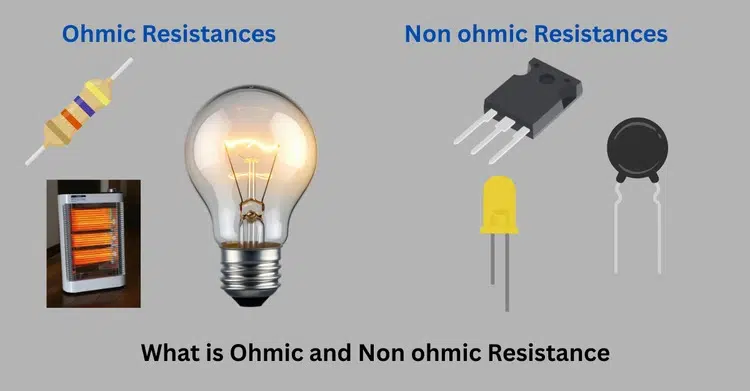
In the real world, many common materials act as ohmic conductors under normal operating conditions. Pure metals are the best examples. Silver, gold, iron, copper, and aluminum are classic examples where the principles of Ohm’s law apply almost perfectly.
- Copper: Widely used in electrical wiring because of its low resistance and excellent conductivity.
- Aluminum: Often used in power transmission lines due to its light weight and cost-effectiveness.
- Wire-wound resistors: These components are specifically manufactured to act as ideal ohmic resistors, providing precise resistance values for circuit control.
While no material is perfectly ohmic under all possible extreme conditions (since temperature changes can alter resistance), these metals are treated as standard ohmic devices in most practical electronic applications. Understanding these foundational elements is the first step before comparing the complex differences between ohmic and non ohmic resistance.
What is Non-Ohmic Resistance?
Unlike their ohmic device, a non-ohmic conductor does not follow Ohm’s Law strictly. It means that the current flowing through the material is not directly proportional to the voltage applied across it. If you doubled the voltage, the current might triple or barely increase at all, depending on the specific component.
This deviation gives rise to a unique behavior known as non-linear resistance. When you plot the relationship between voltage and current for these materials, you don’t get a straight line. Instead, the graph creates a curve, which is why we often refer to it as a non-linear current-voltage curve.
Deviating from Ohm’s Law
In a standard ohmic circuit, resistance is a constant value (R). However, in a non-ohmic device, the resistance is dynamic. For example, as the temperature of a filament lamp increases, its resistance rises, altering the current.
Because the resistance isn’t constant, we cannot use the simple V = IR formula to predict behavior across all voltage ranges. Instead, we have to look at the specific semiconductor behavior or material properties at a given operating point. This complexity is exactly what makes non-ohmic devices in electronics so powerful and versatile.
Examples of Non Ohmic Devices
To fully grasp non ohmic resistance examples, we need to look at components that control electron flow in sophisticated ways. These electronic components are the building blocks of all modern technology, from smartphones to solar panels.
- Diodes: Perhaps the most common non-ohmic resistor (though usually called a component, not a resistor), a diode acts like a one-way valve for electricity. It allows current to flow easily in one direction but blocks it almost entirely in the other. This creates a highly non-linear response.
- Light Emitting Diodes (LEDs): Like standard diodes, LEDs are non-ohmic. They require a specific forward voltage to “turn on” and start conducting current to produce light. Below this threshold, they act like an open switch.
- Transistors: These are the fundamental switches of the digital age. A transistor can change its resistance from nearly zero to infinite in response to a small control signal. This ability to switch states makes them the ultimate non-ohmic devices.
- Thermistors: These are temperature-sensitive resistors. Their resistance changes drastically with temperature, making them excellent for sensing heat but highly non-linear in their voltage-current relationship.
Differences Between Ohmic and Non Ohmic Resistance
An ohmic conductor or resistor offers a predictable, stable resistance. In contrast, a non ohmic conductor exhibits a resistance that varies with voltage or current. This distinction in resistance behavior is not just academic; it dictates how ohmic devices and non-ohmic components are used in circuit design. To understand their differences clearly, let us examine each point.
| Ohmic Resistance | Non Ohmic Resistance |
| Ohmic resistance obeys Ohm’s Law, meaning current is directly proportional to the applied voltage. | Non-ohmic resistance does not obey Ohm’s Law; current is not directly proportional to voltage. |
| In an ohmic conductor or ohmic resistor, resistance remains constant, regardless of the voltage or current flowing through it. | In a nonohmic conductor, resistance varies with changes in voltage, current, or other physical conditions, such as temperature. |
| The ohmic and non-ohmic resistor graphs for an ohmic device are straight lines, showing a linear relationship between voltage and current. | For non ohmic resistor, the graph is a curve, indicating a non-linear relationship. |
| Ohmic devices are predictable and linear, making them easy to calculate and model in simple circuits. | Non-ohmic resistance is dynamic and non-linear, with behavior that depends on the specific operating point. |
| Ohmic conductors include metals like copper, aluminum, silver, and gold, as well as standard wire-wound resistors. | Non-ohmic resistance examples include semiconductors (such as diodes and transistors), thermistors, and the filament of an incandescent bulb. |
Applications of Ohmic and Non Ohmic Resistance
To build functional and useful electronic devices, engineers rely on both linear and non-linear behaviors. Understanding the specific uses of each type allows us to appreciate how simple circuits and complex computers alike are constructed. Here is a breakdown of how these resistances are applied in the real world.
Application of Ohmic Resistance
The most common application of ohmic resistance is in standard resistors used to control current levels. For example:
- Current Limiting: Fixed resistors are used to prevent excessive current from damaging sensitive components, such as LEDs.
- Voltage Division: Ohmic resistors are essential for splitting voltage levels to power different parts of a circuit.
- Heating Elements: The heating coils in toasters, electric kettles, and electric heaters are typically made from ohmic conductors (like nichrome wire) that produce heat predictably as current passes through them.
- Transmission Lines: The wires that carry electricity to our homes (copper or aluminum) rely on ohmic properties to ensure consistent power delivery with minimal loss.
Application of Non Ohmic Resistance
While ohmic components provide stability, the magic of modern technology comes from non-linear behavior. If every component were ohmic, we wouldn’t have computers, smartphones, or digital displays. The dynamic nature of non ohmic resistance in semiconductors is what allows us to control electricity rather than guide it. Key applications where non-ohmic resistance is essential include:
- Signal Rectification: Diodes exhibit non-ohmic behavior, blocking current in one direction and allowing it in the other. This is crucial for converting AC power (from wall outlets) into DC power (for batteries and electronics).
- Switching and Amplification: Transistors are the most important electronic components in history. They utilize non-ohmic properties to switch current on and off or amplify weak signals. This switching capability is the physical basis for the binary logic (1s and 0s) used in all computing.
- Light Generation: LEDs rely on non-linear resistance to emit light efficiently only when a specific voltage threshold is crossed.
- Protection Circuits: Varistors (voltage-dependent resistors) have high resistance at low voltages and low resistance at high voltages. They are used to protect circuits from dangerous voltage spikes by shorting the excess current to the ground.
Conclusion
In conclusion, understanding the distinction between ohmic and non ohmic resistor is essential for anyone delving into electronics. Ohmic resistor provides the consistency needed for fundamental tasks like current limiting and voltage division.
In contrast, non ohmic resistance exhibits dynamic, non-linear behavior. Components like diodes and transistors leverage this changing resistance to switch, amplify, and control electrical signals, enabling everything from simple digital logic to complex computing.
Grasping the fundamental differences between ohmic and non ohmic resistance opens the door to a deeper appreciation of how electrical circuits are designed and function.
FAQ
Can a material exhibit both ohmic and non-ohmic behavior?
Yes, absolutely. A classic example is the filament in an incandescent light bulb. When the bulb is first turned on, and the filament is cool, it exhibits nearly perfect ohmic behavior. However, as it heats up, its resistance increases significantly, leading to non-ohmic behavior.
Why do semiconductors show non-ohmic resistance?
Semiconductors exhibit non-ohmic behavior due to their unique atomic structure and the way electrons move through them.
What are some real-life examples of ohmic devices?
Common ohmic devices include metallic resistors, heating elements in electric stoves, and wires made of copper or aluminum.
What are common applications for non-ohmic devices?
Non-ohmic devices are widely used in modern electronics. Examples include diodes for rectification in power supplies, LEDs for lighting and displays, varistors for surge protection, and transistors for amplification and switching in digital circuits.
Why is understanding ohmic and non-ohmic resistance important for circuit design?
Ohmic devices are chosen for stable, linear responses, while non-ohmic devices are essential for functions like signal control, logic operations, and power regulation.

I am an electrical engineer and also a blogger. I write informative blog posts on topics related to electrical and electronics engineering. If you are interested in these topics, you are welcome to my site to read these articles.