Electric Resistance: Definition, Formula, and Key Examples
Electrical resistance is a property of every material. Electrical resistance can be both useful and harmful to an electrical system. In modern electrical systems, Resistance plays a beneficial role in the operation of electric bulbs, heaters, and electric irons. On the other hand, resistance causes electrical power loss. This article will cover electrical resistance in depth.
What is Electrical Resistance in an Electric Circuit
Electrical resistance is any obstruction to the flow of electric current in a material. It is represented by “R”. Resistance in an electrical circuit affects the flow of electric current. When electric current flows through a circuit, resistance converts some of the electrical energy into heat energy. Every metal has some resistance, which prevents the current from flowing. The material with a higher number of free electrons has lower resistance, which in turn has a negligible effect on current flow.

The main reason for resistance is the collision between electrons and atoms inside a substance. When an electric current passes through a conductor, the free electrons collide with the atoms and ions of that substance. This collision slows down the speed of electrons and opposes the flow of electricity. This opposition appears in the form of resistance. Due to this opposition, electrical energy in the circuit is converted into heat energy.
Ohm’s Law, given by Georg Simon Ohm, explains the relationship between electric current, voltage, and resistance. George Ohm gave this formula during the years 1784–1854. According to Ohm’s Law,
\(I = \frac{V}{R}\)
Where
- I is the electric current in amperes (A).
- V is the voltage in volts (V)
- R is the resistance in ohms (Ω)
How is Electric Resistance Measured
The measuring unit of electrical resistance is ohm(Ω), which is its S.I. unit, and is indicated by R. It is used to control the current in the circuit and to protect the equipment. Resistance cannot be measured directly when the circuit is in operation. Therefore several ways to measure resistance:
- Ohm’s Law is used to measure electric circuit resistance
- A multimeter is an electronic instrument used to measure resistance directly.
- The Wheatstone bridge is also a device used to measure resistance.
- A potentiometer is a device used to measure resistance with high accuracy.
- Resistance is also measured with an ohmmeter.
Types of Resistance
Electrical resistance is mainly of the following types.
- Ohmic Resistance: This resistance obeys Ohm’s law like metal.
- Non-Ohmic Resistance: This resistance does not obey Ohm’s law like a diode or a transistor.
- Fixed Resistance: This type of resistance has a fixed value and cannot be changed, such as a carbon resistor.
- Variable Resistance: This resistance can be changed as per requirement, for example, a rheostat or a potentiometer.
- Contact Resistance: This resistance is created when two surfaces come in contact.
- Thermal Resistance: The value of this resistance changes with temperature. Example Thermistor.
- Magnetic Resistance: The value of this resistance changes with the influence of a magnetic field, e.g., magnetoresistive devices.
- Superconductive Resistance: These resistors exhibit zero resistance at very low temperatures.
What are Examples of High Resistance Materials
Materials with high resistance are highly resistant to electrical current. These materials are commonly used to make electrical devices, such as resistors. Some of the significant examples of materials with high resistance are:
- Nichrome: It is an alloy of nickel and chromium, which is used in heaters, toasters, and other thermal appliances.
- Tungsten: It is a metal with high resistance and a high melting point from which bulb filaments are made.
- Constantan: It is an alloy of nickel and copper. Used in thermocouples and resistive wires.
- Manganin: It is an alloy of copper, manganese, and nickel. It is used in the manufacture of precision resistors.
- Carbon: Carbon is used to make carbon resistors, which are high-resistance materials.
- Silicon: Silicon is a semiconductor material that exhibits high resistance. Electronic devices are made from it.
- Glass: It is a non-metallic, high-resistance material used in making insulators.
- Rubber: Being highly resistant to corrosion, it is used in the insulation of wires and cables.
What Factors Affect Electric Resistance
Several factors of a material influence its electrical resistance.
Length of the Conductor
- R ∝ L, where R = resistance and L = length of material, means Resistance is directly proportional to the length of the conductor.
- If the length of the conductor increases, the resistance also increases.
Cross-Sectional Area of the Conductor
- R ∝ 1/A means resistance is inversely proportional to the area of the conductor.
- As the area increases, the resistance decreases.
Material of the Conductor
- Resistance also depends on the material of the conductor.
- Good conductor materials have low resistance, while poor conductor materials have high resistance.
Temperature
- The resistance of most metals increases with increasing temperature.
- But in semiconductors and insulators, the resistance decreases as the temperature increases.
Impurities in the Conductor
- The presence of impurities in the conductor increases the resistance.
- Impurities obstruct the flow of electrons.
Magnetic Field
- If an external magnetic field is applied to a conductor, the resistance is affected.
Frequency
- At high frequencies, the resistance of the conductor increases due to skin effect.
Age of the Conductor
- Resistance may increase over time due to oxidation or other chemical processes in the conductor.
How does Temperature Affect Electric Resistance?
The effect of temperature on electrical resistance mainly depends on the nature of the conductor, semiconductor, or insulator. It can be understood from the following points:
Effect of Temperature on Metals
The resistance of pure metal increases with an increase in temperature. When the temperature increases, the atoms of the metal start vibrating more. This vibration hinders the flow of electrons, increasing the resistance in materials like copper and aluminium.
Effect of Temperature on Carbon and Insulators
The effect of temperature on carbon and insulators is opposite to that of metals. When the temperature of these materials increases, their resistance decreases. According to atomic theory, these materials do not have enough free electrons at normal temperature to conduct current. However, when the temperature increases, the ions inside these materials vibrate, causing some electrons to gain energy and become free, which in turn decreases the resistance.
Effect of Temperature on Semiconductor
Semiconductor materials exhibit high resistance at normal temperatures, but their resistance decreases rapidly as their temperature increases. It becomes a perfect insulator at absolute zero temperature.
Effect of Temperature on Alloy
Temperature has less effect on alloys than on metals. Alloys are specially designed so that their resistance does not change much with temperature. Since the atoms of different metals in alloys are arranged irregularly, the flow of electrons is already obstructed. Now, when the temperature is increased, the effect of the vibration of atoms is reduced because the obstruction is already high.
Practical Uses of electrical Resistance
Resistance often gets a bad reputation. Many people see resistance only as a force that blocks current and causes energy loss. In reality, however, electrical resistance is one of the most valuable properties in electronics and electrical engineering.
Without resistance, your phone charger, home heater, and even the humble light bulb would not work the way they do. In fact, engineers deliberately design circuits with the right amount of resistance to make devices safe, efficient, and reliable.
Let’s explore the most important practical applications of Resistance:
Current Control
Every electronic component has a safe current limit. If too much current passes through it, the component can overheat and get damaged. This is where resistors step in.
When a resistor is added to a circuit, it helps keep the current within a safe range. According to Ohm’s law, V = IR. This means that if the voltage remains constant, increasing the resistance reduces the current. This makes current control in electronics simple and predictable.
Real-world example: Think of the small LED on your TV remote or router. An LED can burn out instantly if it receives too much current. A tiny resistor connected in series keeps the current within a safe range, allowing the LED to glow steadily for years.
Voltage Division
Many circuits need different voltage levels at different points. A single battery or power supply may provide 9 volts, but one part of the circuit might only need 3 volts. Instead of using multiple power sources, engineers use a voltage division resistor setup.
In a series circuit, if multiple resistors are connected one after another, the supply voltage is shared between them. Each resistor drops a portion of the voltage based on its value. Larger resistance means a larger share of the voltage.
Real-world example: Volume controls, sensor circuits, and microcontroller inputs often rely on voltage dividers. A potentiometer, which is an adjustable resistor, uses this exact principle to set the desired voltage level smoothly.
Heat Production
Resistance also produces heat, and this is not always a problem. In many electrical appliances, producing heat is actually the main purpose. As current passes through a material that offers resistance, its electrons interact with the atoms within the material. This interaction transforms electrical energy into heat energy. This is the basic principle behind heating due to resistance.
The heat produced can be explained by Joule’s law of heating:
H = I²Rt
Here:
- H = heat produced
- I = current flowing through the material
- R = resistance of the material
- t = time for which current flows
Real-world examples:
- Electric heaters use high-resistance coils that glow red-hot to warm a room.
- Electric irons heat up their metal plate using a resistive element.
- Toasters use nichrome wire, which has high resistance, to brown your bread.
Filament Lamps
Inside a traditional bulb, there is a thin coil made of tungsten. Tungsten is chosen because it has very high resistance and an extremely high melting point of around 3400°C.
When current passes through this high-resistance filament, it heats up rapidly. It gets so hot that it starts to glow and produce visible light. This process is called incandescence.
Real-world example: Older incandescent bulbs, heating lamps, and certain specialty lights still rely on the filament lamp working principle. The bulb is filled with inert gas to slow down the filament from burning out too quickly.
Safety Devices
A fuse is a short piece of wire made from a metal with a specific resistance and a low melting point. It is connected in series with the circuit.
Under normal conditions, current flows through it without any trouble. But if a fault causes excessive current, the fuse wire heats up due to its resistance. Following the H = I²Rt principle, the extra current produces enough heat to melt the wire almost instantly.
Once the fuse melts, the circuit breaks. This stops the flow of current and protects your appliances, wiring, and home from fire or damage.
Real-world example: Every home electrical board, plug, and many appliances contain fuses. Circuit breakers work on a similar protective idea. A well-designed fuse acts as a silent guardian, sacrificing itself to save the rest of the circuit.
What is Resistivity
The value of resistance for unit length and unit area of a conductor is called resistivity. The value of resistance for unit length and unit area of a conductor is called resistivity. Resistivity is also called specific resistance. It shows how much resistance a material offers to the flow of electric current. If the resistivity of a material is high, it means that it resists more electric current. And if the resistivity is low, it allows the electric current to flow easily.
SI Unit of Resistivity
- The SI unit of resistivity is ohm – m (Ω-m).
- The CGS unit of resistivity is ohm-centimetre (Ω-cm)
Resistivity Formula
Formula of Resistivity \((\rho)=R \frac{A}{L}\)
Where:
- ρ (rho) = Resistivity of the material
- R = Resistance of the material
- A = Cross-sectional area of the material
- L = Length of the conductor
Use of resistivity
- Materials with low resistivity are used for making electrical wires.
- Materials with high resistivity are used in making heaters, toasters, etc.
- High-resistivity alloys are used to make precision resistors.
Difference Between Resistance and Resistivity
| Resistance | Resistivity |
| Electrical resistance is the ability to oppose the flow of electric current. | Resistivity, which indicates how much a material opposes the flow of electric current. |
| It is represented by R. | It is represented by ρ (rho). |
| The unit of resistance is Ohm (Ω). | The unit of resistivity is Ohm-meter (Ω m). |
| Resistance depends on the length, area, and material of the conductor. | Resistivity depends on the nature of the material and temperature. |
| Resistance affects the flow of electric current in a particular wire or device. | Resistivity determines whether a material is a good conductor or a bad conductor. |
| Resistance \((R) = \rho \frac{L}{A} \) | Resistivity \((\rho)=R \frac{A}{L}\) |
| Practically, it is useful. | It helps understand the properties of materials. |
| It changes as the temperature changes. | It also changes with changing temperatures, but the extent of the change depends on the material. |
Grouping of Resistance
Why Grouping of Resistances is Done
- Different devices and circuits require different values of resistance.
- By connecting resistors in series or parallel, the total resistance can be increased or decreased so that the voltage and current in the circuit can be easily controlled.
- The combination of resistors helps to control power consumption effectively.
- A proper combination of resistors prevents the circuit from overloading and short-circuiting.
- With the help of a combination of resistors, the voltage and current are distributed evenly in different parts of the circuit.
- Combining suitable resistance increases the efficiency and life of the equipment.
It is essential to group resistors because it keeps the voltage and current flow balanced in the circuit. Resistors are mainly combined in three ways.
Resistance in Series
When electrical resistances are connected end-to-end in such a way that the current flows through only one path, then the resistances are said to be connected in series, and such a circuit is called a resistance in series circuit.
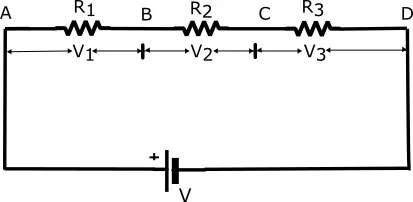
If resistors \(R_{1}, R_{2} and R_{3}\) are connected a series, as shown figure.
The total or equivalent resistance \(R = R_{1}+R_{2} +R_{3}………….+R_{n}\).
We see that in a series circuit, there is only one path for current flow. If the circuit breaks somewhere, then no current flows through the circuit. That is why series circuits are not used in domestic connections. These connections are used in the following places.
- Series resistance is used to divide the voltage.
- Resistance wires are connected in series in the heater to generate more heat.
- In a battery charger, voltage and current are controlled using a series resistance so that the battery can be charged safely.
- Series resistance is used in many motors, such as DC motors, where the resistance is used to control the starting current.
- A signal processing circuit in which signal intensity is controlled using a series of resistances.
- Series resistance is used in LED lights to control the voltage.
- Decorative lights used during festivals have bulbs connected in series.
Resistance in Parallel
When resistors are connected in such a way that the voltage across each resistor is the same and the current is divided, it is called resistance in parallel.
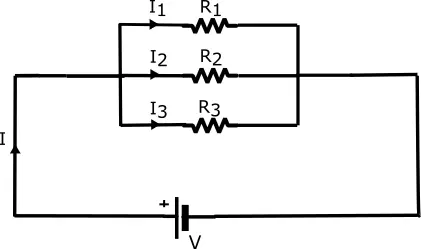
If resistors \(R_{1}, R_{2}, R_{3}\) are connected in parallel as shown in the figure, their total resistance is R.
In general, if n resistors of resistances \(R_{1}, R_{2}, R_{3}……R_{n}\) are connected in parallel, then the total or equivalent resistance R of the circuit is given by.
Parallel connection is used in homes and power wiring because in this connection, the working voltage of the load is equal to the supply voltage.
Resistance Connected in Series-Parallel.
When resistors are used together in both series and parallel combinations, it is called a mixed combination. It is used in complex circuits, such as electrical networks.
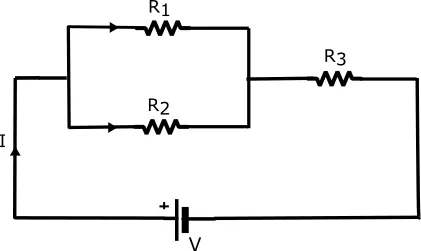
- Series-parallel resistance is used to control voltage and current, ensuring that different devices in the circuit receive the voltage and current they require.
- Series and parallel resistances are used to control the motor starting current.
- Series-parallel resistance is used in fuses and circuit breaker devices, which protect the circuit from overloading and short circuits.
- Home appliances such as fans, refrigerators, and washing machines use series-parallel resistance to give the appliances the voltage and current they require.
- Series-parallel resistances are used in complex electronic devices such as computers, televisions, and radios.
Conclusion
Electrical resistance is a fundamental element that not only controls the flow of current but also ensures the safety and stability of the circuit. The proper resistance combination (series, parallel, or mixed) is selected according to the requirements of the circuit. Resistance is used to control energy consumption, protect devices from overloading, and simplify complex circuits. It plays an indispensable role in the design and operation of electrical and electronic devices.
FAQ:
-
Why is Electric Resistance Important in Circuit
Electrical resistance is essential in a circuit because
>It controls current
>Controls power consumption
>Ensures safety
>Produces thermal energy
>Improves circuit stability
>Simplifies complex circuits -
What Happens to Electric Resistance When you Increase Wire Length
When the length of the wire is increased, the electric resistance also increases. The reason is that the formula for resistance is: \([ R = \rho \frac{L}{A} ]\)
-
What Causes Electrical Resistance
Electrical resistance is caused by:
>Type of material
>Temperature
>Length and thickness
>Collision of electrons -
What is the Unit of Electric Resistance
The unit of electric resistance is Ohm (Ω).
-
What is the Electrical Resistance of Human Body
The electrical resistance of the human body
>Dry Skin: Human body resistance is typically 100,000 ohms to 1,000,000 ohms (100 kΩ to 1 MΩ).
>Wet Skin: Human body resistance drops significantly to around 1,000 ohms to 10,000 ohms (1 kΩ to 10 kΩ).

I am an electrical engineer and also a blogger. I write informative blog posts on topics related to electrical and electronics engineering. If you are interested in these topics, you are welcome to my site to read these articles.