Slip Ring Induction Motor: Construction, Working & Uses
Ever wondered how a crane lifts tons of steel without stalling the moment it starts? The secret often lies in a slip ring induction motor, one of the most reliable heavy-duty machines in modern industry. Unlike ordinary motors that struggle under massive starting loads, this motor delivers high starting torque while keeping the starting current in check. That single trick makes it a favorite for cranes, hoists, mills, and elevators.
If you’re a student or a working technician, understanding this motor clears up a lot of confusion around three-phase machines. Let’s break it down step by step.
In this guide, you will learn:
- What a slip ring induction motor is and why it earns its name
- How its main parts are built and connected
- How it works and why external resistance matters
- Where it beats the squirrel cage motor in real applications
What Is a Slip Ring Induction Motor?
A slip ring induction motor is a three-phase induction motor whose rotor carries a proper three-phase winding connected to external resistance through slip rings and carbon brushes. This external connection lets you control starting torque and starting current with ease.
It is also called a wound rotor induction motor because its rotor is “wound” with copper coils, just like the stator — instead of using solid conductor bars. The slip rings give you access to those rotor windings from outside the machine.
In simple terms, it sits among three-phase induction motors as the controllable, high-torque option, while the squirrel-cage motor covers the simpler, low-maintenance jobs.
Construction of a Slip Ring Induction Motor
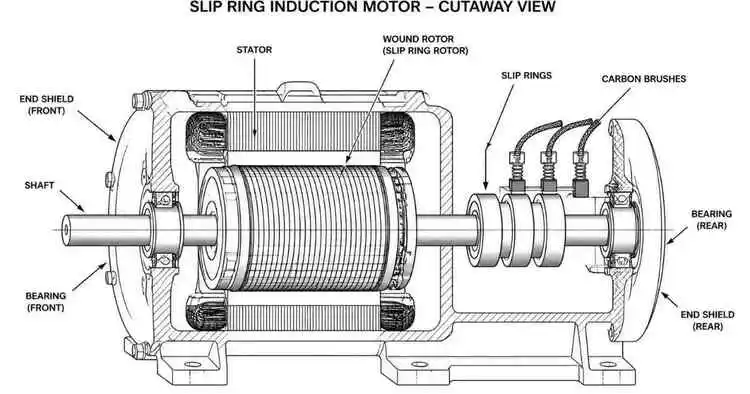
The slip ring motor construction looks similar to that of any three-phase motor from the outside, but the real difference lies inside the rotor. The machine has two main electrical parts — the stator and the wound rotor — plus a mechanical support system that keeps everything aligned and running smoothly.
Let’s look at each part closely.
Stator
The stator is the outer stationary part that generates a rotating magnetic field. This component is the same in all three-phase induction motors. It consists of three main parts:
- Frame — the outer body, usually cast iron or fabricated steel, that protects the internal parts and supports the core.
- Laminated core — thin silicon steel laminations stacked together with slots on the inner surface. Lamination cuts down eddy current losses.
- Three-phase winding — copper coils placed in the slots and fed by a three-phase alternating current supply. When energized, they create the rotating magnetic field.
Wound Rotor
Here is where the slip ring rotor stands apart. Instead of solid bars, the rotor uses a laminated slotted core carrying a three-phase copper winding, much like the stator winding.
These rotor coils are usually connected in a star arrangement. The three open ends are then brought out to the slip rings mounted on the shaft. Because of this wound design, the machine is also known as a three-phase wound motor. The winding gives the rotor higher resistance, which is the foundation of the motor’s smooth starting behavior.
Slip Rings and Brushes
Slip rings and carbon brushes are the defining features of this motor. Three slip rings sit on the shaft, insulated from it and from each other. Each ring connects to one end of the rotor’s three-phase winding.
Resting on these rings are carbon brushes held by springs. This forms the slip ring motor connection — a sliding contact that links the rotating rotor winding to a stationary external resistance bank. Through this path, you can add or remove resistance without touching the spinning rotor.
Shaft, Bearings, and End Shields
These parts form the mechanical backbone of the motor:
- Shaft — the rotating steel rod that carries the rotor core and transfers mechanical output to the load.
- Bearings support the shaft, reduce friction, and keep the rotor centered so the air gap stays uniform.
- End shields — the covers bolted to both ends of the frame. They house the bearings and seal the motor against dust and moisture.
Together, they keep the rotor spinning true and quiet over years of service.
Working Principle of a Slip Ring Induction Motor
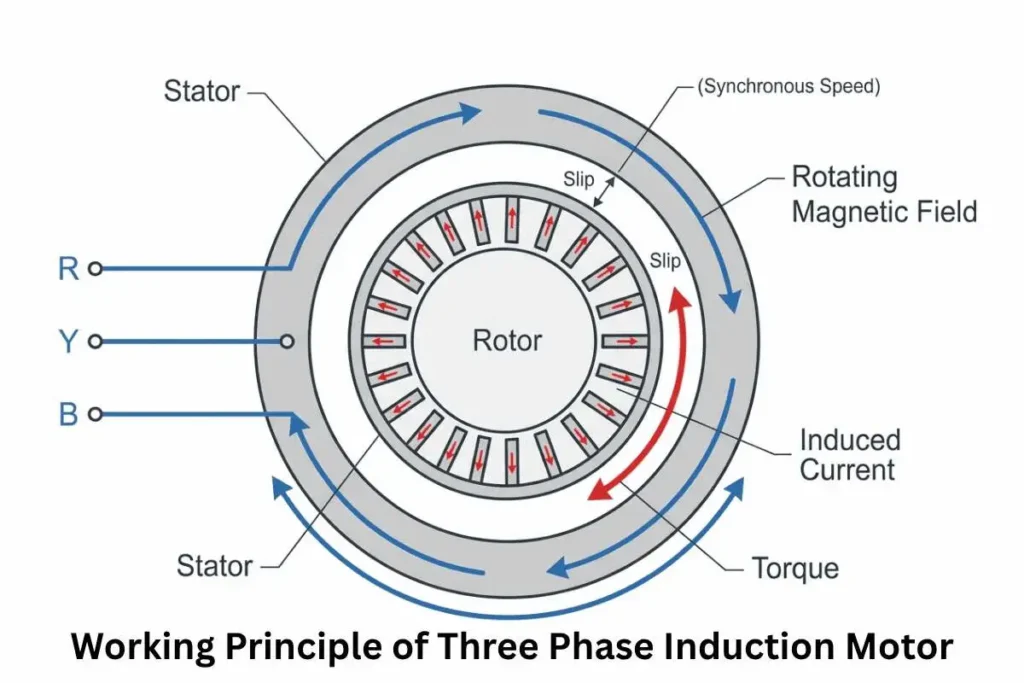
The slip ring motor’s working principle is the same basic idea that drives every three-phase induction motor — but with one clever twist that gives you control over how the motor starts. Still want to understand it better? You can always go through our detailed article on the working principle of three phase induction motor.
The Role of External Resistance
Here is the part that sets this motor apart. The rotor winding isn’t shorted inside the machine. Instead, its ends come out through the slip rings, letting you add external rotor resistance to the circuit.
At the moment of starting, extra resistance does two useful things:
- It boosts the starting torque of the induction motor by improving the power factor of the rotor circuit.
- It cuts down the heavy starting current that would otherwise slam the supply.
As the motor picks up speed, you gradually reduce this resistance. Once the rotor nears full speed, the winding is shorted out, and the motor runs like a normal induction machine.
Understanding Slip and How the Rotor Follows the Field
The rotor can never quite catch the rotating field. If it did, there would be no relative motion, no EMF, and no torque. So it always lags a little behind.
That small speed difference is called slip, and it’s what keeps torque flowing. Under heavy load, the rotor slows slightly, slip rises, and the motor draws more current to meet the demand. It’s a self-adjusting balance that runs quietly in the background every second the motor works.
Role of Slip Rings and Carbon Brushes
If the wound rotor is the heart of this machine, then the slip rings and carbon brushes are its lifeline to the outside world. Without them, all that clever resistance control simply wouldn’t be possible.
What the Slip Rings Actually Do
Three slip rings sit on the shaft, each one wired to a single end of the rotor’s three-phase winding. As the rotor spins, so do the rings — carrying the rotor current around with them.
Their job is simple but vital: they create a continuous electrical path from a moving part to a stationary one, without any wires getting tangled.
How Carbon Brushes Connect to the External Resistance Bank
Resting against each ring is a carbon brush, held firmly in place by a spring. These brushes stay still while the rings rotate beneath them, so contact never breaks.
From the brushes, wires run out to an external resistance bank. This completes the loop — rotor winding to slip ring, slip ring to brush, and brush to the outside resistors. Through this path, you can dial resistance in or out while the motor spins.
Why This External Connection Is the Motor’s Biggest Advantage
This one design choice is the reason engineers still reach for the slip ring motor on tough jobs. By feeding resistance through the brushes, you gain control that a squirrel cage motor can’t offer.
- High starting torque for loads that resist movement, like loaded cranes and mills.
- Low starting current, which protects the supply and nearby equipment.
- Smooth acceleration and a measure of speed control during operation.
It would not be an exaggeration at all to say that every vital element of this motor passes through those very small carbon brushes and rings.
Starting Method of a Slip Ring Induction Motor
Starting a big motor is where most machines struggle — and this is exactly where the slip ring motor shines. The whole slip ring motor working principle is built around one goal: to get the motor moving with strong torque while keeping the startup current low.
Rotor Resistance Starting
At the moment of startup, the rotor is standing still, and the slip is at its highest. This is when a plain motor draws a huge inrush current. The slip ring motor solves this by adding external rotor resistance into the rotor circuit through the slip rings.
Adding resistance at this stage does two important things at once:
- Boosts the starting torque of an induction motor — the extra resistance improves the rotor circuit power factor, so the rotor produces a stronger turning force right from rest.
- Cuts the starting current — the added resistance limits how much current the rotor pulls, which protects the supply line and nearby equipment.
So instead of a violent jerk at startup, you get a firm, controlled pull. That balance of high torque and low current is the motor’s signature move.
How Resistance Is Gradually Reduced
Now, they don’t let the entire resistance remain the same. — That would waste energy and slow the motor down. Instead, the resistance is removed in steps as the rotor picks up speed. Here’s the simple logic:
- Start with maximum external resistance for high torque and low current.
- Accelerate, then cut out one step of resistance as the motor speeds up.
- Repeat this step-by-step reduction as the rotor climbs toward full speed.
- Short out the rotor winding completely once the motor reaches running speed.
At that final point, the slip rings are shorted, and the motor runs like a standard induction machine — smooth, efficient, and ready to carry its load.
Why It Suits Heavy, High-Inertia Loads
Heavy loads like loaded cranes, crushers, and mills resist movement and take time to get going. A motor that starts weakly will stall or overheat under this strain. The slip ring motor avoids that by delivering maximum torque exactly when the load needs it most — at the very start.
Because you control the acceleration through resistance steps, the motor eases massive, high-inertia loads into motion without stressing the mechanical parts or the power supply. That is why it remains a go-to choice for tough industrial starts.
Advantages of a Slip Ring Induction Motor
The ‘wound rotor induction motor’ is ideal for demanding applications where standard motors fail to perform. All its advantages stem from one key feature: easily accessible rotor windings.
Here’s what makes this motor stand out:
- High starting torque with low starting current. You get powerful pull at startup without slamming the supply — a rare and valuable combination.
- Smooth speed control through rotor resistance. Adjusting the external resistance lets you fine-tune speed, giving flexibility a squirrel-cage motor can’t match.
- Handles heavy and high-inertia loads well. Cranes, hoists, and rolling mills start reliably, even under crushing loads.
- Better overload tolerance. The slip ring motor stays stable and manageable when the load spikes, which reduces the risk of sudden stalls.
For engineers dealing with heavy-duty starts, these benefits often outweigh the extra complexity.
Disadvantages of a Slip Ring Induction Motor
No machine is 100% perfect, and this one carries a few real trade-offs. Knowing them helps you decide when a slip ring motor is truly the right pick — and when a simpler motor will do the job.
- Higher cost. The wound rotor, slip rings, brushes, and external resistors make it more expensive than a squirrel cage motor of the same rating.
- Regular maintenance. The brushes and slip rings wear over time and need periodic inspection, cleaning, and replacement. That means more downtime and upkeep.
- Lower efficiency at full load. Because current passes through the rotor circuit and resistors, resistance losses drag down efficiency compared to a squirrel cage design.
- Larger and heavier build. The extra windings and hardware make the motor bulkier, so it needs more space and stronger mounting.
In short, you trade simplicity and low maintenance for control and starting power. On heavy-duty jobs, that trade is often worth it.
Applications of a Slip Ring Induction Motor
The slip ring induction motor isn’t built for everyday jobs. It earns its keep in heavy industry, where loads are massive and startups are brutal. Wherever a motor must move something huge from a dead stop, this one usually gets the call.
In real-world industry, slip ring induction motors are widely used in heavy industrial applications such as mills, mining operations, cement plants, and other high-load systems where strong starting torque and controlled acceleration are essential.
Here’s where you’ll find it working hardest:
- Cranes and hoists. Lifting heavy loads demands strong torque the instant the motor starts. The high starting torque of induction motor designs like this makes cranes and hoists move loads smoothly without jerking or stalling.
- Elevators and lifts. Passenger comfort depends on smooth acceleration. The controlled startup of a wound rotor induction motor keeps rides gentle while still carrying full loads safely.
- Conveyors and crushers. These systems start under heavy material and resist movement. The slip ring motor eases them into motion, then powers through tough loads once running.
- Compressors and large pumps. Big compressors and pumps need firm, controlled starts to protect both the machine and the supply line. This motor delivers that pull without a huge current spike.
- Rolling mills and other high-torque starts. Steel rolling mills face some of the toughest starting conditions in the industry. Here, the ability to add external rotor resistance for high starting torque is exactly what the job needs.
Across all these uses, the pattern is clear: heavy load, hard start, high torque required. That’s the slip ring motor’s home turf.
Conclusion
The slip ring induction motor solves a problem that trips up ordinary motors — starting a heavy load with strong torque while keeping the starting current under control. That single ability, made possible by its wound rotor and the slip rings and carbon brushes that connect it to external resistance, is why it still powers cranes, mills, and hoists across the world.
Yes, it costs more and needs regular upkeep. But for demanding, high-inertia jobs, the trade-off pays off in reliability and control. When you understand how the rotor windings, slip rings, and external resistance work together, the whole design starts to make perfect sense. If you want to learn more about three phase induction motors in detail, you can read our article on What is Three Phase Induction Motor.
Frequently Asked Questions
What is a slip ring induction motor?
A slip ring induction motor is a three-phase induction motor with a wound rotor connected to external resistance through slip rings and carbon brushes. This connection lets you control the starting torque and starting current from outside the machine. It is also called a wound rotor induction motor because its rotor carries copper windings instead of solid bars.
Why is external resistance used in a slip ring motor?
External resistance is added to the rotor circuit to improve how the motor starts. At startup, external rotor resistance boosts the starting torque of induction motor designs while cutting down the heavy inrush current. As the motor speeds up, the resistance is gradually removed until the rotor winding is shorted for normal running.
What is the difference between a slip ring and a squirrel cage motor?
The main difference lies in the rotor. A slip ring motor uses a wound rotor with copper coils brought out through slip rings, while a squirrel cage motor uses solid conductor bars sealed inside. This gives the slip ring type higher starting torque, lower starting current, and speed control — but at the cost of more maintenance and a higher price.
Where are slip ring induction motors used?
Ideal for heavy-duty tasks, these motors deliver strong starting torque even under heavy loads. Common examples include cranes, hoists, elevators, conveyors, crushers, compressors, large pumps, and rolling mills. Any application with a heavy, high-inertia start is a good fit for this motor.
Why do slip ring motors need maintenance?
The slip rings and carbon brushes wear down over time because of constant sliding contact. They need periodic inspection, cleaning, and occasional replacement to keep the electrical connection reliable. This upkeep is the main reason a slip ring motor needs more attention than a simple squirrel cage design.

I am an electrical engineer and also a blogger. I write informative blog posts on topics related to electrical and electronics engineering. If you are interested in these topics, you are welcome to my site to read these articles.