What are Free Electrons in Electricity
Every time you flip on a light switch or plug in your phone to charge, something remarkable happens inside the wires—billions of tiny particles spring into rapid motion and deliver electricity almost instantly. Those particles are free electrons, and they are the reason electricity works at all.
So, what exactly are ‘free electrons’? Simply put, these are electrons that have separated from their parent atoms and can move freely within a substance.
In this guide, you will learn what free electrons are and how they connect to atomic structure, why certain materials like copper conduct electricity so well, and how free electrons drive the current that powers your devices. You will also see where free electrons show up beyond metal wires — from lightning bolts to the tiny chips inside your phone.
What is a Free Electron?

To understand how electricity works, you need to start with something incredibly small — a single particle called an electron. Conduction electrons in electricity are not just a physics concept; they are the actual moving parts behind every current that flows through a wire, every light that turns on, and every device that charges on your desk.
The Basic Definition
A free electron is an electron that is not bound to any specific atom. Instead of remaining bound to a single location, it can move freely within a substance—flowing from one atom to another without any obstruction.
In a material, an electron is firmly bound to its atom; it orbits the nucleus and remains close to its home. Another electron behaves in a completely different manner, wandering through the surrounding material like a traveler with no fixed abode. It is this second electron that is known as a ‘free electron.’
An electron itself is a negatively charged particle. It is one of the three basic building blocks of an atom, along with protons and neutrons. Protons and neutrons cluster together in the atom’s nucleus at the center, while electrons surround the nucleus in layered regions called energy shells.
How Electrons Relate to Atoms
Atoms are not solid, static objects. They have structure. The nucleus sits at the center — dense, positively charged, and relatively stable. Around it, electrons occupy different energy shells, sometimes called energy levels or orbitals. Electrons in the innermost shells are held tightly by the strong pull of the nucleus. The farther out a shell is, the weaker the pull becomes.
This is where things get interesting. Electrons in the outermost shell — called valence electrons — are the least tightly held. In certain materials, the nucleus’s grip on these outer electrons is so weak that the electrons can leave their parent atom entirely. They do not remain bound to any specific atom. They become mobile electrons, able to move through the material in response to outside forces like voltage.
A material like copper has one loosely held outer electron per atom. In a chunk of copper, trillions of these electrons detach from their atoms and flow through the material as a shared pool of charge carriers. Apply a voltage, and those free electrons start moving in a directed flow — that directed flow is what we call electric current.
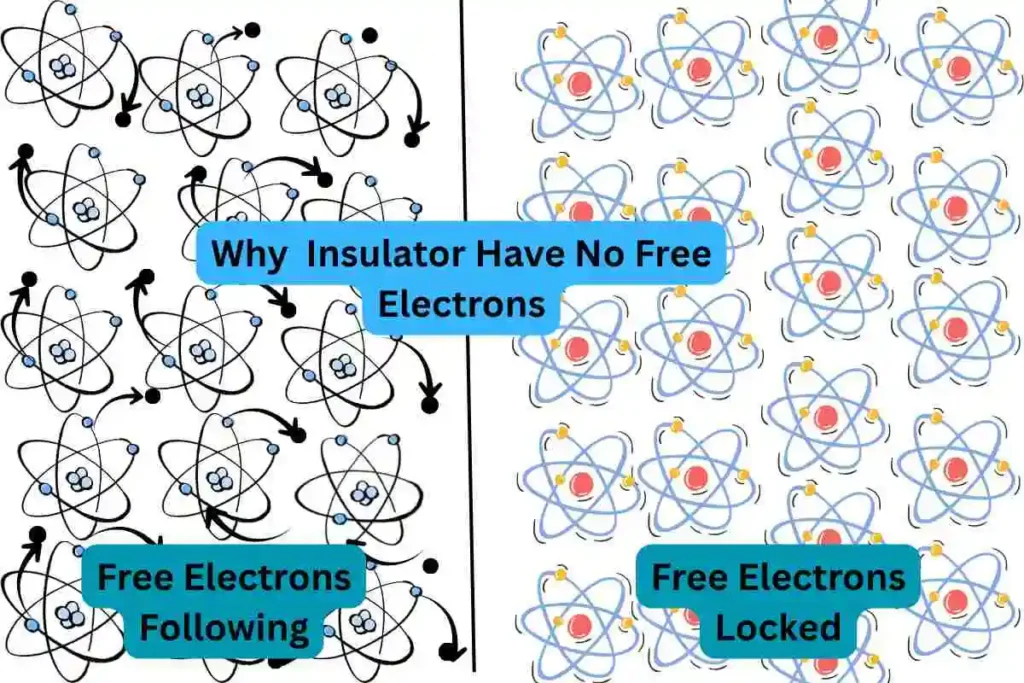
Not every material behaves this way. In insulators like rubber or glass, the electrons are held tightly in their shells and cannot break free under normal conditions.
Free Electrons vs. Bound Electrons — What is the Difference?
Not every electron inside a material behaves the same way. Some are locked in place, tightly held by the atom they belong to. Others are free to roam. Understanding this distinction is at the heart of understanding electrical conduction — and it explains why copper wire carries current effortlessly while a rubber glove stops it completely.
What are Bound Electrons?
Bound electrons are electrons that remain attached to their parent atom under normal conditions. They occupy the inner energy shells of an atom, where the pull of the positively charged nucleus is strongest. The closer an electron is to the nucleus, the harder it is to dislodge — and electrons in those inner shells rarely go anywhere on their own.
These electrons are not idle, though. Bound electrons play a central role in chemical bonding. When atoms join together to form molecules or compounds, it is the electrons in these inner and middle shells that participate in sharing or transferring charge between atoms. That is chemistry. But for electricity, bound electrons are largely irrelevant — because they do not move freely through a material. They stay put, anchored to their atom, unable to carry an electrical current from one point to another.
What Makes an Electron “Free”?
The key factor is how tightly an atom holds onto its outermost electrons. In a metal like copper, each atom has just one loosely held unbound electrons. That electron breaks away easily, joining a shared pool of charge carriers spread across the entire material. In insulators, even the outermost electrons are held firmly enough that they cannot break free under normal conditions. In semiconductors, the situation falls somewhere in between — some electrons can become free, but not nearly as many as in a metal, and their movement can be precisely controlled.
Free Electrons vs. Bound Electrons Difference
A side-by-side look helps anchor the distinction before exploring it further in context.
| Bound Electrons | Free Electrons | |
| Location in atom | Inner or middle energy shells | Outermost (valence) shell or fully detached |
| Ability to move | Remain attached to their atom | Drift freely through the material |
| Role in electricity | Do not carry current | Primary charge carriers in conductive materials |
| Role in chemistry | Participate in chemical bonding | Minimal role in bonding once detached |
| Example materials | All atoms contain them | Metals (copper, silver, aluminum), plasma |
Next, we will look at exactly where loosely bound electrons are found across different types of materials and why their presence or absence shapes the electrical properties of everything around you.
Why Free Electrons Matter in Electricity
Free electrons are more than just a physics concept—they are essential to understanding how electricity works. Electric current, voltage, conductivity, and electric resistance — all of these ideas trace back to what valence electrons are doing inside a material. This section connects those concepts in plain language so the bigger picture becomes clear.
Free Electrons as Charge Carriers
Electric current is, at its core, the flow of electric charge through a material. In solid conductors like copper or aluminum, free electrons are the particles doing that work. They are the charge carriers — the moving parts that make current possible.
The relationship between conduction electrons and current flow is direct: the more valence electrons a material has available, the greater its potential to carry an electrical current. This is why metals are such reliable conductors. A copper wire, for example, contains roughly one free electron per atom, and copper has trillions upon trillions of atoms in even a short length of wire. That adds up to an enormous pool of mobile charge just waiting to be put to work.
Materials with fewer available mobile electrons — like semiconductors — carry less current under the same conditions. Materials with almost none — like rubber or glass — carry virtually no current at all. The number of free electrons a material holds is essentially its electrical identity.
How Voltage Pushes Free Electrons
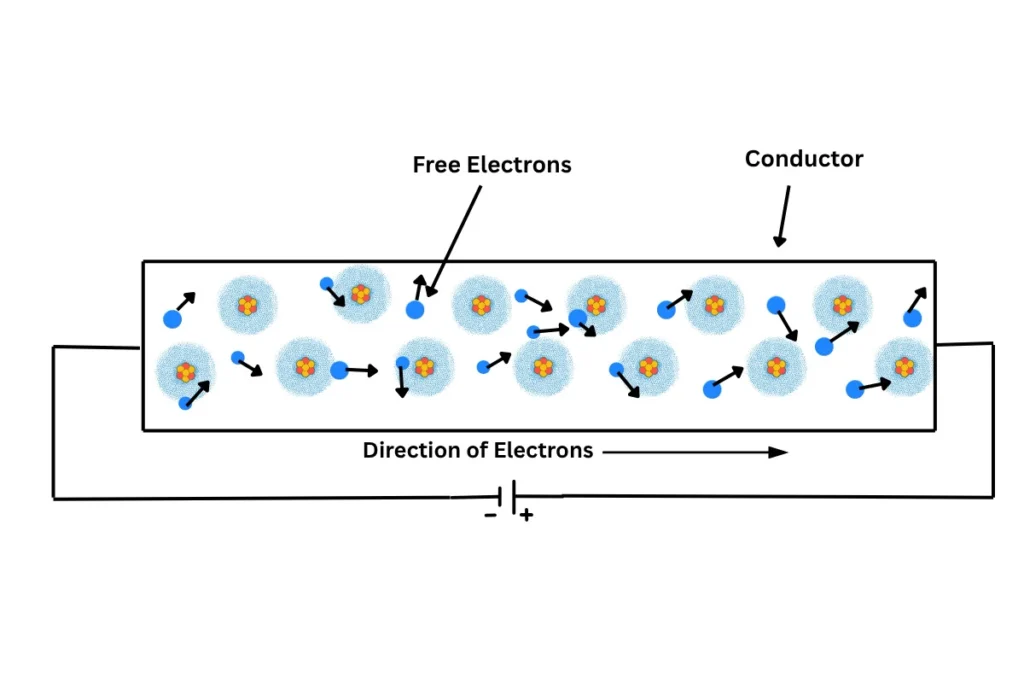
Left alone, mobile electrons in a conductor move randomly in all directions. They are in constant motion, but that motion has no net direction — so no useful current flows. What changes is the voltage.
Voltage creates a potential difference between two points — a kind of electrical pressure that pushes electron carriers from one end of a conductor to the other. A helpful analogy: think of voltage as water pressure in a pipe, and free electrons as the water molecules inside it. Without pressure, the water sits still. Apply pressure at one end, and the water flows in a consistent direction. Voltage does the same thing for free electrons in a wire — it gives them a direction, turning random thermal motion into a directed electrical current.
This is why a battery or a power source is necessary to keep current flowing. The battery maintains a voltage difference across the circuit, continuously pushing delocalized electrons through the conductor and sustaining the flow.
Resistance and What Slows Free Electrons Down
Not all materials allow electron carriers to move with equal ease. Even in good conductors, electrons encounter obstacles — atomic vibrations, impurities in the material, and structural irregularities all impede their movement. This opposition is called resistance.
A thin wire made of a less conductive material will have higher resistance than a thick copper wire, meaning fewer mobile electrons get through for the same applied voltage.
The relationship between voltage, current, and resistance is captured in one of the most useful equations in electricity — Ohm’s Law:
V = IR
If you increase voltage while resistance stays the same, more current flows — more conduction electrons move through the material. If resistance goes up, fewer electrons get through for the same voltage. The equation is simply a way of expressing what free electrons experience every time a circuit is switched on.
In practice, this means that understanding conduction electrons gives you a working mental model for how electricity behaves — why some wires carry power efficiently, why some materials block current, and why voltage and resistance are the two main levers engineers use to control how electricity flows through any circuit.
Where are Free Electrons Found?
Free electrons are not exclusive to metals. They show up across a surprisingly wide range of materials — in very different quantities and with very different behaviors. Knowing where free electrons exist, and where they do not, gives you a clearer picture of why some materials conduct electricity, and others stop it cold.
Free Electrons in Metals (Conductors)
Metals are the most familiar home for free electrons, and for good reason. In a metal, the atoms are arranged in a tightly packed structure where the outermost electrons — the valence electrons — detach from their parent atoms and form a shared pool spread across the entire material.
This structure is what makes metals like copper, silver, aluminum, and gold such strong electrical conductors. When a voltage is applied, those mobile electrons have no single atom holding them back. They move in a directed flow almost immediately. Copper is used in most electrical wiring precisely because it has one loosely held valence electron per atom — that single electron breaks free easily, and with trillions of copper atoms in a wire, the conductor has an enormous pool of mobile charge ready to carry current.
Free Electrons in Semiconductors
Semiconductors occupy the middle ground between conductors and insulators. Materials like silicon and germanium do contain conduction electrons, but far fewer than metals. Under normal conditions, most of their electrons stay bound to their atoms. That would make them poor conductors — except that their conductivity can be deliberately adjusted.
The process that makes this possible is called doping. By introducing small amounts of specific impurities into the semiconductor material, engineers can increase or decrease the number of valence electrons available for conduction.
Free Electrons in Plasma
Plasma is less familiar in everyday life, but it is actually the most abundant state of matter in the observable universe. At extremely high temperatures or under intense electromagnetic fields, electrons are stripped completely from their atoms. The result is a highly energized mix of electron carriers and positively charged ions — no atomic bonds holding anything in place.
Plasma appears in more everyday situations than most people realize. Lightning is plasma. The sun is plasma. The glow inside a fluorescent light tube is plasma. Older plasma display screens worked by exciting tiny pockets of gas into a plasma state to produce light. In all of these cases, valence electrons are moving with tremendous energy, completely detached from any atom.
Why Insulators have Almost none
At the opposite end of the spectrum are insulators. In materials like rubber, glass, and plastic, electrons are held tightly within their energy shells. The atomic attraction is strong enough that even the outermost electrons rarely break free under normal conditions. With almost no free electrons available, these materials cannot support electrical conduction.
That limitation is precisely what makes insulators so useful. The rubber coating on a copper wire keeps the current inside the conductor and prevents it from escaping into surrounding surfaces or anyone who touches it. Insulators do not fail at conducting electricity — they succeed at stopping it. Understanding conduction electrons makes it immediately clear why: no mobile electrons, no current, no conduction.
How Free Electrons Behave in Conductors vs. Insulators
The fact that some substances have free electrons while others do not is a good start. But the more useful question is: what are those electrons actually doing inside the material? The answer gives you a practical mental model for how electricity works — and why the wire in your wall carries current safely while its rubber coating keeps you from getting shocked..
Inside a Conductor — Constant Motion
Free electrons in a conductor are never truly still. Even when no voltage is applied, and nothing in the circuit is switched on, those electrons are moving. Thermal energy — the heat energy that every material carries at normal temperatures — keeps charge carriers in constant, random motion. They dart in every direction, colliding with atoms and each other, but with no net movement in any one direction. The result is a lot of activity and zero useful current.

When you apply a voltage, that changes. The electrical pressure created by the voltage source gives those randomly moving mobile electrons a consistent push in one direction. Their movement does not become orderly, but it gains a bias — a net drift toward the positive end of the circuit. That net directional drift is what we measure as electric current. The voltage does not create the motion; it directs it.
Inside an Insulator — Almost No Movement
In an insulator, the situation is fundamentally different. Electrons in materials like rubber, glass, and plastic are bound tightly to their atoms. Applying voltage does very little to move them, because the atomic attraction holding them in place is too strong to overcome under normal electrical conditions. There are simply no free electrons available to drift through the material.
This is exactly why rubber and plastic make such effective insulation for live copper wires. The copper inside carries a large current because its conduction electrons move easily. The rubber outside stops that current cold because its electrons cannot move at all. Two materials, side by side, with opposite electrical behavior — all because of the difference in how freely their electrons can move.
The Drift Velocity Surprise
Here is something that surprises most people when they first encounter it: mobile electrons in a conductor move very slowly. In a typical copper wire carrying a household current, individual electrons drift at roughly one to a few millimeters per second. At that rate, it would take hours for a single electron to travel the length of a standard extension cord.
Yet when you flip a light switch, the light comes on almost instantly. How?
Think of a long, tightly packed line of marbles in a tube. Push one marble in at one end, and a marble pops out at the other end almost immediately — even though no individual marble traveled the full length of the tube. The push propagates through the line as a wave, and the effect at the far end is almost instant.
Free electrons in a wire behave the same way. The electrical signal — the propagating wave of electromagnetic energy — travels through the wire at close to the speed of light. The individual electrons barely shift. What moves fast is not the electrons themselves, but the influence they pass along to one another. Drift velocity describes how slowly the electrons move; signal propagation speed describes how quickly the electrical effect travels through the system.
Understanding this distinction removes one of the most common misconceptions about how electricity works — and it makes the behavior of free electrons in both conductors and insulators much easier to picture accurately.
Free Electrons in Everyday Life
The science of free electrons is not confined to textbooks or laboratory equipment. It shows up every time you turn on a light, charge a device, or watch a storm roll in.
Household Wiring
The copper wires running through the walls of your home are one of the most practical examples of valence electrons at work. Every time you plug in an appliance or flip a switch, valence electrons flow through those wires from the power source to the device and back again, completing a circuit.
Batteries and Portable Devices
A battery does not store electricity in the way a tank stores water. Instead, it stores chemical energy and converts it into a voltage difference — an electrical pressure that pushes mobile electrons through a connected circuit.
When you connect a battery to a device, delocalized electrons travel from the negative terminal, through the external circuit, powering the device along the way, and return to the positive terminal. The chemical reactions inside the battery maintain that voltage difference, keeping the push going until the stored energy runs out. Every portable device you own — a phone, a laptop, a wireless speaker — relies on this movement of conduction electrons through its internal circuit to function.
LED Lights and Microchips
LED lights and microchips both rely on semiconductors, and semiconductors work precisely because engineers can control how many free electrons are available — and where they go.
In an LED, mobile electrons moving through a semiconductor junction release energy in the form of light when they drop to a lower energy state. In a microchip, billions of tiny transistors switch free electron flow on and off at extraordinary speed, allowing the chip to process information.
Lightning Strikes
Lightning is, at its most basic level, a massive and sudden movement of conduction electrons — one of the most dramatic examples nature offers.
During a storm, charge separation builds between clouds and the ground. As the potential difference grows large enough, the air between them begins to ionize. Ionization strips electrons from air molecules, creating a channel of free electrons where there would normally be none. The moment that a conductive path forms, an enormous surge of mobile electrons discharges through it in a fraction of a second, releasing the built-up electrical energy as light, heat, and sound.
From the wiring in your walls to the storm outside your window, free electrons are constantly in motion. The next section examines some of the most common misconceptions about how that motion actually works.
Common Misconceptions About Free Electrons
There are certain misconceptions regarding unbound electrons—specifically, how they actually behave. Some of these misconceptions are overly simplistic. Other misconceptions stem from outdated conventions that have persisted in textbooks.
Misconception 1: Electrons Move at the Speed of Light
This one comes up often, and it is understandable why. Electricity seems instant — flip a switch, and the light responds immediately. So it is natural to assume the electrons themselves must be moving incredibly fast.
They are not. Individual loosely bound electrons in a copper wire drift at a surprisingly slow pace — often just a few millimeters per second. At that rate, a single electron would take hours to cross the length of a standard room.
What travels fast is the electrical signal, not the electrons carrying it. When voltage is applied, the push propagates through the wire as an electromagnetic wave at close to the speed of light. The electrons barely shift position; they just pass the influence along to their neighbors almost simultaneously. Drift velocity describes how slowly individual electrons move. Signal propagation speed describes how quickly the electrical effect travels through the system. The two are very different things.
Misconception 2: Only Metals Have Free Electrons
Metals are the most obvious example of materials with free electrons, but they are far from the only ones. Semiconductors like silicon and germanium also contain conduction electrons — just in much smaller quantities and with significantly more control over their behavior. That controllability is exactly what makes semiconductors so valuable in transistors, computer chips, and solar cells.
Plasma takes it even further. In a plasma state, electrons are stripped entirely from their atoms, creating a gas of valence electrons and ions with no atomic bonds at all. Lightning, the sun, fluorescent tube lighting, and plasma displays all involve valence electrons behaving at a scale metals rarely reach.
Misconception 3: Current Flows from Negative to Positive
Technically, electrons flow from the negative terminal of a power source through the circuit to the positive terminal. That is the actual direction of electron movement in electricity.
Conventional current, however, is defined in the opposite direction — from positive to negative. This convention goes back to Benjamin Franklin’s early work in the 18th century, well before scientists understood the true nature of charge carriers. Franklin assumed positive charges were doing the moving. The assumption turned out to be wrong, but by the time the true nature of electron flow was understood, the convention was already embedded in engineering practice, circuit diagrams, and equations worldwide.
Engineers still use conventional current today because it is internally consistent and produces correct results when applied to circuit analysis.
Misconception 4: Free Electrons Are Always Moving in One Direction
When most people think about electricity, they imagine conduction electrons flowing smoothly in one direction through a wire. The reality is messier — and more interesting.
Without an applied voltage, valence electrons in a conductor are already in constant motion due to thermal energy. That motion is entirely random, with electrons darting in all directions and colliding repeatedly with atoms. No net current flows because no direction is preferred over another.
When voltage is applied, it does not stop this random motion. It adds a directional bias on top of it. mobile electrons continue moving chaotically in all directions, but now they also drift slowly toward the positive end of the circuit. The net result of that drift is what we measure as electric current. The thermal motion and the directed drift happen simultaneously — one does not replace the other.
Conclusion
Free electrons are one of the most fundamental ideas in all of electrical science — and now you have a clear picture of what they are and why they matter. They are electrons that have broken free from their parent atoms, and their ability to move through a material is precisely what makes electric current possible. Understanding free electrons gives you a working foundation for almost everything in electronics and electrical engineering — from how a battery drives current through a circuit to how a microchip processes information at billions of operations per second.
FAQ
-
What is Mobility of Free Electrons
The mobility of valence electrons is the rate at which they move under the influence of an electric field. It gives the relationship between the speed of the electrons and the intensity of the electric field. Higher mobility means electrons can flow more easily and quickly, leading to improved conductivity.
-
What is Thermal Speed of Valence Electrons in a Conductor
The thermal speed of free electrons in a conductor refers to the random speed resulting from their thermal energy. This speed is about (105) to (106) m/s. However, it is random and does not contribute to the electric current as it has no definite direction.
-
What is Number of Density of Valence Electrons
The number density of Valence electrons refers to the number of free electrons present per unit volume in a substance. It is measured by (n = \frac{N}{V}), where (N) is the total number of electrons and (V) is the volume. This density is high in metals, which makes them good conductors of electricity.
-
What is the Source of Free Valence Electrons
The source of free electrons is the atomic structure of metals and semiconductors. In metals, the valence electrons are released from bonding due to the weak attraction of the nucleus, while in semiconductors, temperature or light energy can release them.
-
Are Free Electrons the Same as Valence Electrons?
Valence electrons are the source of free electrons in metals, but not all valence electrons are free — it depends on the material.
-
Can Free Electrons Exist in a Vacuum?
Yes — electron beams in cathode ray tubes and particle accelerators are made of free electrons traveling through a vacuum.
-
Do Free Electrons have Mass?
Yes — the electron rest mass is approximately 9.11 × 10⁻³¹ kg, extremely small but measurable.
-
Why don’t Free Electrons Escape from a Metal Wire?
A surface energy barrier (called the work function) keeps them inside unless they receive enough external energy.
-
Are Free Electrons Related to Heat Conduction in Metals?
Yes — free electrons carry thermal energy as well as electrical energy, which is why good electrical conductors are almost always good heat conductors too.

I am an electrical engineer and also a blogger. I write informative blog posts on topics related to electrical and electronics engineering. If you are interested in these topics, you are welcome to my site to read these articles.