Oil Vs Air Circuit Breakers: Core Differences
Electrical systems rely on circuit breakers as their primary line of defense. When a fault occurs, these devices instantly interrupt the current flow, protecting expensive equipment and preventing severe electrical fires. However, choosing the right protection means understanding the specific technologies available.
Engineers and facility managers frequently weigh the oil circuit breaker vs. the air circuit breaker for different power applications. While both devices serve the same security purpose, they do so in completely different ways. From how they extinguish dangerous electrical arcs to their long-term upkeep, the variations are significant.
Understanding these core differences is essential for designing safe, efficient, and cost-effective power grids. This guide explores exactly how these two breaker types differ in design, operation, and overall performance..
Oil Vs Air Circuit Breakers: Working Principle
The most fundamental difference between these two devices lies in how they operate when a fault occurs. When a breaker’s contacts separate under high voltage, an intense electrical arc forms. The breaker must destroy this arc quickly.
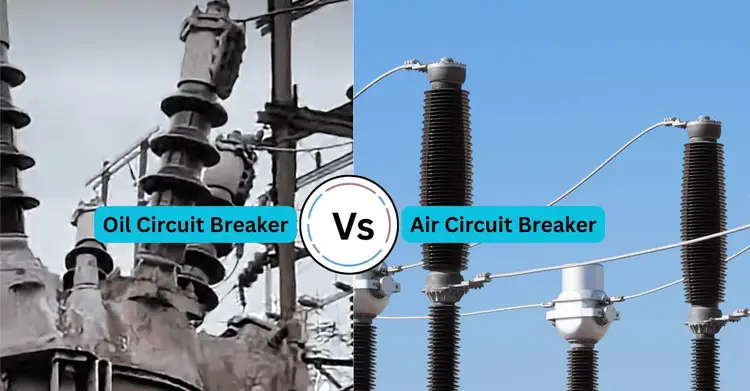
Oil Circuit Breaker Working
The working principle of an oil circuit breaker revolves around vaporizing liquid. When the contacts pull apart inside the breaker, the immense heat of the electrical arc instantly vaporizes the surrounding insulating oil. This reaction creates a high-pressure hydrogen gas bubble. The gas bubble surrounding the arc rapidly cools it. As the alternating current crosses zero, the gas bubble aggressively forces fresh oil back into the gap, breaking the circuit.
Air Circuit Breaker Working
Conversely, the working principle of air circuit breaker technology relies on atmospheric manipulation. When the contacts separate, the arc forms in the open air. Because air is a weaker insulator than oil, the breaker pushes the arc upward into a specialized component called an arc chute. The arc chute uses magnetic fields and thermal drafts to stretch, split, and cool the arc across a series of metal splitter plates. By lengthening and slicing the arc into smaller segments, the breaker increases the electrical resistance until the voltage can no longer sustain it.
The Arc Quenching Medium Factor
The material a breaker uses to extinguish an electrical fire heavily influences its performance limits. This is known as the arc quenching medium.
Quenching Medium Used in Oil Breaker
An oil circuit breaker uses specialized mineral oil as its arc-quenching medium. Transformer oil is a highly effective dielectric insulator. It resists electrical breakdown roughly 2.5 times better than standard air. This allows oil breakers to handle high-voltage loads over a relatively short distance between the internal contacts. However, the arcing process fundamentally changes the oil. Every time the breaker trips, the heat burns a small amount of the fluid, leaving behind carbon particles that slowly destroy the oil’s insulating properties.
Quenching Medium Used in Air Breaker
An air circuit breaker uses standard ambient air as its arc-quenching medium. Some industrial variants use compressed air, but most rely on ambient air. Because it uses the open atmosphere, the air is completely free and infinite. More importantly, the arcing process does not permanently degrade the air. The surrounding atmosphere naturally circulates and refreshes itself immediately after a fault. The medium never leaves behind carbon residue, nor does it lose its dielectric strength over multiple uses.
Design and Construction Contrasts
Because they utilize completely different materials to extinguish electrical arcs, the physical build of these breakers varies drastically.
Design and Construction of Oil Breaker
Oil circuit breakers feature heavy, enclosed, and rugged designs. They require thick-walled steel tanks to hold massive volumes of oil safely. These steel tanks must also be strong enough to withstand the violent pressure spikes created by the hydrogen gas bubbles during a fault interruption. Because of this reliance on large liquid volumes, oil breakers are exceptionally heavy and bulky. You will almost exclusively find them installed outdoors on reinforced concrete pads in large electrical substations.
Design and Construction of Air Breaker
Air circuit breakers look completely different. They feature an open, blocky construction focused on airflow. Because they do not need to hold pressurized liquids, they completely lack heavy steel tanks. Instead, their defining structural feature is the large arc chute assembly mounted directly above the main contacts. While air breakers are lighter than their oil counterparts, they often require a larger vertical footprint to house the arc chutes properly. You typically find them installed indoors, neatly organized inside metal-clad switchgear cabinets.
Circuit Breaker Maintenance Variances
Labor costs and system downtime depend entirely on your equipment’s upkeep needs. Circuit breaker maintenance highlights a massive divide between these two technologies.
Oil Circuit Breaker Maintenance
Oil breakers require a demanding, frequent, and messy maintenance schedule. Because the arcing process carbonizes the oil, maintenance teams must constantly monitor the fluid quality. Technicians must frequently draw oil samples, test the dielectric strength, and use specialized equipment to filter out carbon sludge. Eventually, the entire tank must be drained and refilled with fresh oil. Furthermore, workers must open the heavy steel tanks to inspect internal contacts and replace degraded rubber gaskets to prevent leaks.
Air Circuit Breaker Maintenance
Air breakers offer a much simpler and cleaner maintenance routine. Without messy fluids to manage, facility teams save countless hours of labor. Routine maintenance generally involves conducting visual inspections of the arc chutes, blowing out accumulated dust, and checking the mechanical linkages for proper lubrication. Because the main contacts are exposed to the air, technicians can easily inspect, clean, or replace them if they show signs of wear.
Safety and Environmental Impact
Modern infrastructure planning prioritizes environmental protection and worker safety. These two breakers offer highly contrasting risk profiles.
Oil Circuit Breaker Environment and Safety
Oil breakers present significant safety and environmental hazards. Mineral oil is highly flammable. If a breaker fails to clear a severe fault, the intense heat may ignite the oil, leading to large explosions and devastating substation fires. Additionally, aging seals can crack, allowing toxic oil to leak into the surrounding soil and groundwater. This creates severe environmental contamination that requires expensive, federally mandated cleanup operations.
Air Circuit Breaker Environment and Safety
Air breakers provide a much safer alternative. They contain zero flammable liquids, eliminating the risk of internal fires or explosions. They also pose absolutely no threat to the local environment, as no fluid can leak into the ground. When an air breaker reaches the end of its lifecycle, facilities can easily and safely recycle its metal and plastic components without dealing with hazardous-waste protocols.
Cost Comparisons Over Time
When comparing an oil circuit breaker vs. an air circuit breaker, financial planning must look beyond the initial purchase price to understand the total cost of ownership.
Oil Circuit Breaker Purche Cost
Historically, oil breakers carry a lower initial purchase price. The internal mechanisms are relatively straightforward, and the technology has been standardized for decades. However, the long-term operational costs are exceptionally high. Over a 20-year lifespan, the costs of purchasing replacement transformer oil, employing skilled technicians for intricate fluid maintenance, and ensuring adherence to environmental regulations make oil breakers a significantly expensive asset.
Air Breaker Purchage Cost
Air breakers typically demand a higher upfront investment. Producing precise arc chutes and intricate magnetic blow-out coils demands advanced engineering and costly materials. Despite this higher sticker price, air breakers save facilities substantial money in the long run. The complete lack of consumable oil, combined with drastically reduced labor hours for circuit breaker maintenance, makes the air breaker’s total cost of ownership significantly lower.
Conclusion
Understanding the differences between an oil circuit breaker and an air circuit breaker empowers you to build safer, more reliable electrical systems. While oil breakers leverage a powerful dielectric medium to withstand extreme outdoor voltages, they entail significant maintenance burdens and substantial environmental risks. Air breakers contrast this by using atmospheric air to provide a clean, safe, and low-maintenance solution perfect for indoor switchgear applications.
To take the next step in optimizing your power distribution system, audit your current facility layout. Evaluate your indoor space availability, review your annual maintenance budget, and consult with a certified electrical engineer to determine which specific breaker technology aligns with your long-term operational goals.
FAQ
What is the primary difference between oil and air circuit breakers?
Oil uses liquid insulation, while air relies on compressed air for arc extinguishing.
Which breaker type is more environmentally friendly?
Air circuit breakers are more eco-friendly as they avoid oil disposal issues.
How does arc quenching differ in oil and air breakers?
Oil vaporizes to quench arcs, while air uses high-pressure blasts.
Which breaker is better for high-voltage applications?
Oil breakers are often preferred for higher voltage levels due to better insulation.
What are the maintenance needs of oil vs air breakers?
Oil breakers require regular oil replacement, while air breakers need compressor upkeep.
Which breaker type is safer to operate?
Air breakers are safer as they eliminate fire risks associated with oil.
How do installation costs compare?
Air breakers are generally more cost-effective to install than oil breakers.
Which breaker type is more compact?
Air breakers are usually more compact, making them suitable for space-constrained setups.
What industries commonly use oil and air breakers?
Oil breakers are used in older systems, while air breakers are common in modern industrial setups.

I am an electrical engineer and also a blogger. I write informative blog posts on topics related to electrical and electronics engineering. If you are interested in these topics, you are welcome to my site to read these articles.