
What Is Power Factor? Types, Unity, Lagging, and Leading Explained
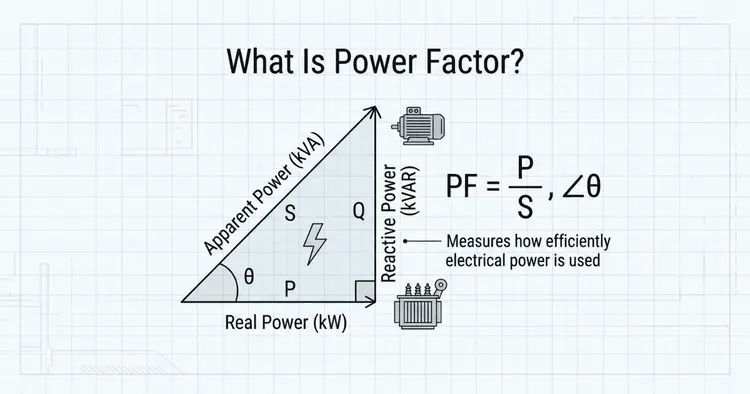
Power factor measures how efficiently electrical power is being used. It shows how much energy in your electrical system is being used to do actual work and how much energy is being wasted. High power factor leads to efficient use of electrical energy, while low power factor leads to inefficient use. In this article, we will discuss in detail what power factor is, its types, differences, importance, and how it is calculated.
What is Power Factor
Power factor is a measure of how effectively an electrical system converts incoming power into useful output. It is defined as the ratio of real power to apparent power, expressed as a number between 0 and 1. A higher power factor means the system is more efficient at utilising the supplied power. A lower number signals less efficient power usage and wasted capacity.
To understand power factor, you first need to know the three types of power in any AC electrical system.
Real Power (kW) is the power that does the actual work. It runs your machines, lights, and equipment to produce productive work. Real power is also called actual power, active power, or working power. This is the portion of energy that delivers real value.
Reactive Power (kVAR) is the power required by certain equipment, such as motors and transformers, to build the magnetic fields they need to operate. It energizes this equipment but performs no productive work on its own. Reactive power is necessary, yet it draws extra capacity from the supply.
Apparent Power (kVA) is the total power delivered through the mains. It is the vector sum of real power and reactive power, and it is also known as demand. Apparent power represents everything the source must supply to meet the load.
Power factor connects these values. It expresses the ratio of real power to apparent power, giving you a direct measure of energy efficiency. The closer this ratio sits to 1, the more of the delivered power goes toward useful work.
The ideal power factor is unity, or 1.0. At unity, all the energy supplied by the source is consumed by the load, with no waste. Any value below 1 means extra power is needed to complete the same task, which lowers overall efficiency. The size of the phase angle between voltage and current determines how far the power factor falls from this ideal.
Power Factor Formula
In the phasor diagram image, there is a triangle between apparent power and true power, which is called the power factor triangle COD.

Then Cos Φ = OC/OD
= True power / Apparent power
= Kw/ kVA
It is called the formula of power factor or power factor formula in alternating current. The above study shows that the power factor is a numerical measurement that is between 0 and 1. If the value of the power factor is 1 in a circuit, then the entire energy is used in that circuit. If the power factor is less than 1, then the energy is not used properly in the circuit, and the energy is wasted without being used, and the burden of the electricity bill increases on us.
Types of Power Factor
Power factor comes in three types: unity power factor, lagging power factor, and leading power factor. Each type depends on how the current and voltage behave in a power system. The difference comes down to the type of load connected to the circuit and how it handles energy.
Here is a clear breakdown of all three.
Unity Power Factor
A unity power factor happens when the current and voltage stay perfectly in phase. At this point, the power factor equals 1, and the system runs at its best.
Here, the reactive power is zero, so real power equals apparent power. Every bit of supplied energy does useful work, with nothing wasted. This makes unity the ideal condition for any electrical system.
You find unity power factor in purely resistive loads. Common examples include heaters and incandescent bulbs, which draw only active power.
Lagging Power Factor
A lagging power factor occurs when the current lags behind the voltage. This is the most common condition in industrial setups, and it comes from inductive loads.
Inductive loads store energy in a magnetic field and resist sudden changes in current. This delay pushes the current behind the voltage, which lowers the power factor to a value between 0 and 1.
Induction motors, transformers, and fluorescent tubes all create a lagging power factor. Because these loads run in most factories and buildings, lagging conditions show up almost everywhere.
Leading Power Factor
A leading power factor occurs when the current leads the voltage. This condition comes from capacitive loads in the power system.
Capacitive loads store energy in an electric field and release energy back into the circuit as the voltage changes. This action pushes the current ahead of the voltage, giving a power factor between 0 and 1. Capacitor banks and synchronous motors are typical sources of a leading power factor. You often see this condition in systems that use capacitors to correct a lagging power factor.
How to Calculate Power Factor
Power factor uses one simple formula:
Power Factor (PF) = True Power (P) ÷ Apparent Power (S)
True power is the useful power your equipment actually consumes. Apparent power is the total power the supply delivers. The ratio between them gives you the power factor of the circuit.
The Power Triangle and Phase Angle
The power triangle shows this relationship in a clear geometric form. True power and apparent power sit as the adjacent side and the hypotenuse of a right triangle. Reactive power forms the third side, covering the absorbed and returned power that never does useful work.
The angle inside this triangle carries real meaning. It represents the ratio between dissipated power and the power stored and returned by the load. It also matches the angle of the circuit’s impedance when written in polar form.
Because true power and apparent power form the adjacent side and the hypotenuse, the power factor also equals the cosine of the phase angle. Both methods give the same result:
PF = P ÷ S = cos θ
A Worked Example
Here is a quick calculation. Suppose a circuit has:
- Real power (P) = 200 W
- Apparent power (S) = 400 VA
Apply the formula:
PF = 200 ÷ 400 = 0.5
This circuit runs at a power factor of 0.5. Only half of the delivered power does useful work. The rest is consumed as reactive power and never reaches the load as productive output.
A value close to 1 means the system uses most of its supplied power well. A low value, like 0.5, signals wasted capacity and higher current draw.
Power Factor Is a Unitless Quantity One point matters here. Power factor is a ratio, so it has no units. Like all ratio measurements, it is a unitless quantity — a single number between 0 and 1 that tells you how efficiently your electrical system uses the power it receives.
Why is Power Factor Important
Power factor measures the efficiency and energy consumption of the electrical system. Power factor tells us how much of the electrical energy is being used in actual work and how much is being wasted.
Importance of Power Factor
- The closer the power factor is to 1, the better the energy is used. When the power factor is low, the maximum energy of the power supply is wasted. It can lead to an uncontrollable increase in the electricity bill. Therefore, energy can be saved by Power Factor Improvement.
- Low power factor puts extra load on motors and transformers. It causes the equipment to heat up, reducing its lifespan. With the right power factor, the equipment works properly for a long time, and its efficiency also increases.
- Most electricity companies impose additional charges on consumers with a low power factor. By improving the power factor, you can avoid extra charges and reduce your electricity bill.
- With the correct power factor, the current flow in the circuit is controlled, and there is no additional stress on the transmission line. It makes load management easier and increases the overall energy efficiency of the system.
Difference Between Unity, Lagging, and Leading Power Factor
The difference between unity, lagging, and leading power factor depends on the phase relationship between current and voltage in an electrical system. When current and voltage stay in phase, the power factor is unity. When current lags behind the voltage, the system has a lagging power factor.
When current leads the voltage, it has a leading power factor. In simple terms, unity power factor shows ideal power use, lagging power factor is usually caused by inductive loads, and leading power factor is usually caused by capacitive loads.
| Basis of Comparison | Unity Power Factor | Lagging Power Factor | Leading Power Factor |
| Type of Load | Resistive load | Inductive load | Capacitive load |
| Reactive Power | No reactive power | Load absorbs reactive power | Load supplies reactive power |
| Energy Behavior | Most efficient use of supplied power | Part of the power circulates without doing useful work | Excess capacitive effect pushes current ahead |
| Practical Use | Ideal target | Most common in industrial plants | Usually appears during correction or in capacitive networks |
| Common Examples | Heaters, incandescent lamps | Induction motors, transformers, reactors | Capacitor banks, over-corrected systems, synchronous condensers |
| Power Factor Value | Equal to 1 | Between 0 and 1 | Between 0 and 1 |
| Meaning | Current and voltage are in phase | Current lags behind voltage | Current leads voltage |
| Effect on System | Best operating condition | Higher current, higher losses, lower efficiency | Can improve lagging PF, but too much can cause instability |
How To Identify Unity, Lagging, and Leading Power Factor
Identifying the type of power factor tells you how your electrical system is using its supplied power. It shows whether the system runs efficiently, draws extra current, or carries too much capacitive effect. This helps you spot problems early, size correction equipment correctly, and reduce energy waste.
The method is simple. You check one thing above all: the phase relationship between current and voltage. From there, the load type and meter readings confirm the result.
Identify Unity Power Factor
A unity power factor means current and voltage are in phase. The power factor reads exactly 1. Reactive power is zero, so real power equals apparent power.
Signs to look for:
- The load is a resistive load, such as heaters or incandescent lamps.
- A power factor meter shows a value of 1.0.
- On an oscilloscope, the current and voltage waveforms rise and fall together, with no phase angle between them.
Identify Lagging Power Factor
A lagging power factor means the current lags voltage. The power factor reads less than 1. This is the most common condition in industrial systems.
Signs to look for:
- The system runs an inductive load, such as induction motors, transformers, or fluorescent ballasts.
- A power factor meter shows a value below 1 marked “lag.”
- On an oscilloscope, the current waveform trails the voltage waveform by a measurable phase angle.
Identify Leading Power Factor
A leading power factor means the current leads voltage. The power factor also reads less than 1. This condition points to strong capacitive behavior.
Signs to look for:
- The system runs a capacitive load, such as capacitor banks or an over-corrected circuit.
- A power factor meter shows a value below 1 marked “lead.”
- On an oscilloscope, the current waveform rises ahead of the voltage waveform.
On-Site Identification Methods
Three practical methods confirm the power factor type on any site.
- Use a power factor meter. It gives a direct reading and shows whether the value is unity, lagging, or leading.
- Read the waveforms on an oscilloscope. Compare the current and voltage traces to measure the phase angle and its direction.
- Check the connected load. Resistive loads point to unity, inductive loads point to lagging, and capacitive loads point to leading.
Quick Identification Checklist
Use this simple logic to identify the power factor in seconds:
- Current and voltage in phase, PF = 1 → unity power factor (resistive load)
- Current lags voltage, PF < 1 → lagging power factor (inductive load)
- Current leads voltage, PF < 1 → leading power factor (capacitive load)
Start with the phase angle, confirm with a power factor meter, then match it to the load type. These three checks identify unity, lagging, and leading power factor with confidence.
Conclusion
Understanding power factor is essential for both individuals and businesses looking to optimize their electrical systems. Power factor, which measures how effectively you are using electrical power, can significantly impact energy efficiency and cost savings. A low power factor indicates that more current is needed to provide the same amount of useful power, which increases energy losses and leads to higher utility bills. Ultimately, managing power factor not only results in economic benefits but also improves active energy utilization by reducing energy losses, even if you are managing a large-scale industrial operation.
FAQ
What is Significant of Power Factor
Power Factor is a measure of the efficiency of an electrical system. It is the ratio of actual power (W) to total power (VA). A high power factor saves energy, while a low power factor leads to greater energy losses and increased costs.
What is the Range of Power Factor
The power factor ranges from 0 to 1. 1 means maximum efficiency, and 0 means poor efficiency.
Why Power Factor is 0.8
A power factor of 0.8 is typically caused by industrial equipment, as motors and transformers often exhibit high reactive power. They indicate a discrepancy between the actual power and the total power, resulting in a power factor of approximately 0.8.
Power Factor is Zero in Which Circuit
Power factor is zero (0) when the circuit has only reactive loads (such as inductors or capacitors) and no real power (energy doing actual work). In this case, a 90-degree phase shift exists between the voltage and current in the circuit, resulting in a power factor of zero.

I am an electrical engineer and also a blogger. I write informative blog posts on topics related to electrical and electronics engineering. If you are interested in these topics, you are welcome to my site to read these articles.

Thank you for sharing such a well-structured and easy-to-digest post. It’s not always easy to find content that strikes the right balance between informative and engaging, but this piece really delivered. I appreciated how each section built on the last without overwhelming the reader. Even though I’ve come across similar topics before, the way you presented the information here made it more approachable. I’ll definitely be returning to this as a reference point. It’s the kind of post that’s genuinely helpful no matter your level of experience with the subject. Looking forward to reading more of your work—keep it up! profis-vor-ort.de