1 Ton Vs 1.5 Ton AC: Which One Should You Buy in 2026?
Most people spend hours comparing brands, star ratings, and features before buying an AC — but skip the one decision that affects their comfort and electricity bill the most: choosing the right tonnage.
Pick a 1-ton AC for a room that needs 1.5 tons, and it’ll run nonstop without ever truly cooling the space. Go the other way, and you’re paying more upfront — and possibly more every month — for capacity you don’t need.
This guide breaks down the 1-ton vs 1.5-ton Air Conditioner comparison across room size, cooling performance, power consumption, and total cost of ownership. It also factors in the updated 2026 BEE energy standards, which have shifted how these two capacities compare on running costs.
By the end, you’ll know exactly which option suits your room, climate, and budget.
What Is AC Tonnage? Understand 1 Ton and 1.5 Ton AC Capacity
Before you compare brands, inverter technology, or star ratings, you need to get one thing right — the tonnage. Choose the wrong Air Conditioner capacity, and no amount of premium features will save you from a sweaty room or a shocking electricity bill. This section explains what 1 ton and 1.5 ton actually mean, and why getting this decision wrong costs you more than most buyers expect.
What Does 1 Ton and 1.5 Ton Mean in an Air Conditioner?
The “ton” in an AC has nothing to do with weight. In simple terms, it measures cooling capacity — how much heat an AC can pull out of a room in an hour.
This term traces back to a historical benchmark — the amount of heat required to melt one ton of ice over the course of 24 hours. Today, it’s expressed in BTU per hour (British Thermal Units):
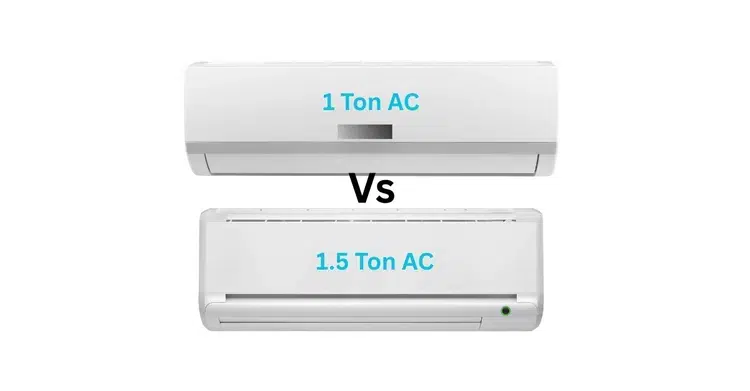
- 1 ton AC = 12,000 BTU/hour
- 1.5 ton AC = 18,000 BTU/hour
That 6,000 BTU/hour difference is significant. A 1.5 ton AC removes 50% more heat per hour than a 1 ton unit. This directly affects how fast your room cools, how comfortable it feels, and how hard the compressor has to work.
When it comes to AC cooling capacity, tonnage is the single most important spec — more than brand, more than remote features, more than color or design. Everything else is secondary. If the tonnage doesn’t match your room’s cooling requirement, the AC will underperform no matter how advanced it is.
Why the Wrong AC Tonnage Costs You More in the Long Run
Picking the wrong size — even by half a ton — creates two very different sets of problems, depending on which way you go wrong.
If your AC is too small (undersized):
A 1-ton AC installed in a room that needs 1.5 tons will run almost continuously trying to reach the set temperature. It rarely gets there. The result?
- Your room never cools down properly, especially on hot afternoons
- The compressor works overtime, wearing out faster
- Your electricity bill rises because the unit runs longer hours without achieving the target cooling
This is one of the most common AC buying mistakes — choosing a smaller unit to save money upfront, only to pay more every month.
If your AC is too large (oversized):
A 1.5 ton AC in a small room that only needs 1 ton cools the air too quickly and shuts off before completing a full cooling cycle. This is called short-cycling, and it causes real problems:
- The room temperature drops fast but rises again quickly, creating an uncomfortable on-off pattern.
- Humidity control suffers — the AC doesn’t run long enough to pull moisture out of the air, leaving the room feeling damp and clammy even when the temperature reads low.
- You pay more upfront for capacity you don’t actually use
Both situations hurt your comfort and your wallet. The right AC tonnage isn’t about bigger being better — it’s about matching the AC’s cooling capacity to your actual room requirements.
Next, let’s look at a direct side-by-side comparison of 1 ton vs 1.5 ton AC specs so you can see exactly how the two options stack up.
1 ton vs 1.5 ton AC room size: which is right for your space?
Room size is the starting point for every AC buying decision. Get this wrong, and it doesn’t matter how good the brand is or how many stars it carries — the AC will either struggle to keep up or cycle on and off before it finishes the job. This section will help you choose the right AC capacity based on your room size, and will also provide clear solutions for complex intermediate cases.
Ideal Room Size for a 1 Ton AC
A 1 ton AC works best in rooms between 100 and 120 square feet. At this size, 12,000 BTU/hour of cooling capacity is enough to maintain a comfortable temperature without the compressor running nonstop.
Rooms that typically fall in this range:
- Small bedrooms used by one person
- Compact home offices where only one person works
- Single-occupancy rooms in apartments or PGs
- Small study rooms or children’s rooms
These spaces don’t generate much internal heat, and a 1-ton AC can handle them efficiently — especially during nighttime use when outdoor temperatures drop.
One factor most buyers overlook: ceiling height. Standard calculations assume a ceiling height of around 9–10 feet. Even when the floor area stays the same, taller ceilings — around 11 to 12 feet — mean there’s more air in the room to cool. In that case, the AC has to work harder. An 110 sq ft room with a 12-foot ceiling can behave more like a 130 sq ft room in cooling terms, so if your ceilings are higher than average, factor that in before settling on 1 ton.
Ideal Room Size for a 1.5 Ton Air Conditioner
A 1.5 ton AC is suited for rooms between 150 and 180 square feet. With 18,000 BTU/hour of cooling capacity, it can handle larger spaces, more occupants, and higher heat loads without breaking a sweat.
Rooms where a 1.5 ton AC makes sense:
- Master bedrooms shared by two people
- Medium-sized living rooms used by families
- Family rooms or dining areas with regular foot traffic
- Home offices with multiple devices running simultaneously
Larger rooms don’t just have more air to cool — they also tend to accumulate more heat. More people means more body heat. More windows mean more sunlight exposure. More appliances mean more internal heat generation. A 1.5 ton AC handles all of this, whereas a 1-ton unit would fall short.
This is why room size for AC selection isn’t purely a square footage calculation. A 160 sq ft room with large west-facing windows and two people in it has a higher heat load than its floor area suggests. The 1.5 ton capacity gives you the buffer you need to stay comfortable even on peak summer days.
1 Ton vs 1.5 Ton for Mid-Size Rooms — How to Decide
The hardest decision comes when your room falls in the 120–150 sq ft range — too large for a 1 ton AC to work efficiently, but seemingly small enough to make a 1.5 ton feel like overkill. This is the gray zone where most buyers get stuck.
Here’s a practical rule of thumb:
- If your room is 120–135 sq ft with standard ceilings, low sunlight, and 1–2 occupants → a 1 ton AC can manage, but expect it to work harder on hot days
- If your room is 135–150 sq ft, or has any of the following → go with 1.5 ton:
- East or west-facing windows with direct afternoon sun
- Ceiling height above 10 feet
- More than two regular occupants
- Multiple heat-generating appliances (TV, computers, etc.)
- Top floor or terrace-facing room that heats up quickly
When in doubt between the two capacities, lean toward 1.5 ton. An AC that’s slightly larger than needed still works well — especially if it’s an inverter model that adjusts its output automatically. An AC that’s too small, on the other hand, will run continuously and still leave you uncomfortable.
1 ton vs 1.5 ton AC cooling performance: which one cools better?
Tonnage doesn’t just determine how cold your room gets — it determines how fast, how consistently, and how comfortably it gets there. In this section, you will understand in detail the actual cooling differences between 1-ton and 1.5-ton ACs, so that you know exactly what to expect before making a purchase.

Cooling Speed Comparison: 1 Ton vs 1.5 Ton Air Conditioner
The most immediate difference you’ll notice is how quickly each AC brings the room temperature down.
A 1-ton Air Conditioner removes 12,000 BTU of heat per hour. In a 100–120 sq ft room, that’s enough to cool the space within 15–20 minutes under normal conditions. Put that same unit in a 150 sq ft room, and the cooling time stretches noticeably — the AC works harder, runs longer, and still may not reach the set temperature on a hot afternoon.
A 1.5 ton AC, removing 18,000 BTU per hour, cools a 150–180 sq ft room in roughly the same 15–20 minute window. The difference in real use is clear:
- Right-sized AC: Room cools quickly, compressor cycles normally, temperature holds steady
- Undersized AC: Room takes much longer to cool, compressor barely gets a break, and on peak summer days it simply can’t keep up
For buyers wondering which AC cools better — the answer isn’t always “the bigger one.” It’s the one matched correctly to the room. A 1 ton AC in a small room will outperform a 1.5 ton Air Conditioner in the same space every time in terms of efficiency and comfort.
Humidity Control and Comfort: 1 Ton vs 1.5 Ton
Cooling performance isn’t only about temperature — humidity plays an equally important role in how comfortable a room actually feels.
As an AC cools the air, it also pulls moisture out of it. This dehumidification process is what makes a 24°C room feel genuinely comfortable rather than just cool and damp. The problem is, dehumidification only happens when the AC runs long enough to complete a full cooling cycle.
This is where oversized ACs create a hidden comfort problem. When a 1.5 ton AC is installed in a room that only needs 1 ton of cooling, it cools the air temperature too quickly and shuts off before completing the dehumidification process. This is called short-cycling, and it leaves the room feeling:
- Cooler in temperature but still sticky and humid
- Uncomfortable even when the thermometer says it should be fine
- Prone to temperature swings as the unit turns on and off repeatedly
A properly sized Air Conditioner — whether 1 ton or 1.5 ton — runs in longer, steadier cycles that remove both heat and moisture effectively. For buyers in humid climates, this matters even more. Getting the tonnage right is directly tied to the quality of air comfort, not just the number on the thermostat.
1 Ton AC Performance vs 1.5 Ton AC in High Heat Load Rooms
Room size alone doesn’t define how much cooling a space actually needs. Heat load — the total amount of heat a room generates and absorbs — can push a room’s cooling requirement well beyond what square footage suggests.
Factors that significantly increase heat load include:
- High occupancy: Each person adds body heat to the room. A room with 3–4 people generates noticeably more heat than one with a single occupant
- Electronics and appliances: TVs, computers, gaming setups, and even LED lighting all release heat into the room
- Direct sunlight exposure: Rooms with east or west-facing windows receive intense afternoon sun. This can raise indoor temperatures by several degrees over a short period
- Top-floor or terrace-adjacent rooms: These absorb heat from above throughout the day, making them significantly hotter than ground-floor rooms of the same size
In rooms with one or more of these factors, a 1 ton Air Conditioner starts to struggle even if the floor area falls within its recommended range. You’ll notice it running almost continuously without maintaining a stable temperature — a clear sign the cooling demand has exceeded its capacity.
Quick rule: If your room is 120+ sq ft and has direct sunlight, multiple occupants, or significant electronics — a 1.5 ton AC isn’t oversized. It’s appropriate.
Next, we’ll look at how these two capacities compare on electricity consumption, because cooling performance and running costs go hand in hand when making the right choice.
1 Ton vs 1.5 Ton AC Electricity Consumption — What Will You Actually Pay to Run It?
Choosing the right AC capacity from the start helps you avoid spending more than you need to. Running it in the right-sized room is what saves you money every month. This section breaks down the actual power consumption difference between a 1-ton and 1.5-ton AC — and shows you how to estimate what each option will cost you over a full summer season.
Power Consumption of 1 Ton AC vs 1.5 Ton AC (Watts and Units Per Hour)
The gap in electricity consumption between these two capacities is real, but it’s not always as large as people assume.
A 1-ton split AC typically draws between 800 and 1,200 watts, consuming roughly 0.8 to 1.2 units per hour under normal operating conditions. A 1.5-ton split AC draws more — around 1,200 to 1,700 watts, or roughly 1.2 to 1.7 units per hour.
That looks like a significant difference on paper. But here’s what most buyers miss:
- A right-sized 1.5-ton inverter AC in a 150 sq ft room will cycle efficiently and may average only 1.2–1.3 units per hour in practice.
- An undersized 1 ton AC in the same room will run almost continuously, pushing its consumption to the higher end — sometimes matching or exceeding what a properly matched 1.5 ton unit would use.
The common mistake is comparing peak wattage instead of real-world usage. Match the tonnage to the room first. The consumption numbers follow from that.
How 2026 BEE star ratings influence 1 ton vs 1.5 ton AC power consumption
The BEE star rating on an AC label is your most reliable shortcut for comparing running costs — but only if you understand how the 2026 norms have shifted the goalposts.
Under the updated 2026 BEE standards, the ISEER (Indian Seasonal Energy Efficiency Ratio) thresholds have been made stricter:
- 3-star split AC: ISEER 4.0 to 4.99
- 5-star split AC: ISEER 5.6 and above
This matters because a 3-star Air Conditioner bought in 2026 is actually more efficient than a 3-star model from a few years ago. The bar has been raised. So if you’re comparing an older label to a new one, the star number alone won’t tell the full story — always check the ISEER value directly.
The BEE label also shows annual kWh consumption, calculated on the basis of 1,600 hours of operation per year. Use that number to compare any two models side by side. Lower kWh always means lower running cost, regardless of tonnage.
Now here’s a scenario worth knowing: a 5-star 1.5 ton AC can cost less to run than a 3-star 1 ton AC — if the 1 ton unit is undersized for the room and runs non-stop trying to keep up. An efficient larger AC that cycles properly will almost always beat an inefficient smaller one that never gets a break.
Annual Electricity Cost Estimate — 1 Ton AC vs 1.5 Ton AC
Let’s put this into real numbers using a simple, practical calculation.
Assumptions:
- Usage: 8 hours per day, 6 months per year (roughly 1,440 hours)
- Electricity tariff: ₹7 per unit (a common mid-range rate across Indian cities, though your local rate may be ₹6 to ₹8 per unit or more)
| AC Type | Approx. Units/Hour | Units in 1,440 Hours | Estimated Annual Cost (₹7/unit) |
| 1 Ton (3-star) | ~1.0–1.2 | ~1,440–1,728 | ~₹10,080–₹12,096 |
| 1 Ton (5-star) | ~0.8–1.0 | ~1,152–1,440 | ~₹8,064–₹10,080 |
| 1.5 Ton (3-star) | ~1.5–1.7 | ~2,160–2,448 | ~₹15,120–₹17,136 |
| 1.5 Ton (5-star) | ~1.2–1.35 | ~1,728–1,944 | ~₹12,096–₹13,608 |
A few things stand out from these estimates:
- The star rating gap within the same tonnage is often larger than the tonnage gap itself
- A 5-star 1.5 ton AC can cost roughly ₹2,000–₹4,000 less per year than a 3-star 1.5 ton model
- Your actual bill will depend on your local electricity tariff, usage hours, room insulation, and how well-matched the AC is to your space.
Next, we’ll look at how your city’s climate and your room’s heat load can shift this decision further.
How climate and heat load affect your 1 ton vs 1.5 ton AC choice
Room size tells you where to start, but climate and heat load tell you where to land. Two rooms with identical square footage can have very different cooling demands depending on where you live, how your room is built, and what’s happening inside it. Ignoring these factors is one of the most common reasons buyers end up with the wrong Air Conditioner tonnage.
How Your City’s Climate Affects 1 Ton vs 1.5 Ton AC Selection
The climate outside your window directly shapes how hard your AC has to work — and that affects which capacity you actually need.
Hot and humid regions (Mumbai, Chennai, Kolkata, Kochi) create a double burden for your AC. The unit has to remove both heat and moisture from the air. High humidity makes a room feel warmer than the thermometer shows, which means the AC needs to run longer and work harder to reach genuine comfort.
Buyers in these cities often find that a 1 ton AC struggles even in rooms that technically fall within its recommended square footage range. The extra capacity of a 1.5 ton Air Conditioner isn’t just about cooling faster — it’s about handling the moisture load effectively.
Dry heat climates (Rajasthan, parts of Gujarat, interior Andhra Pradesh) push temperatures very high but with low humidity. Here, the cooling load is intense in peak summer but drops more predictably with the thermostat. Room size and sunlight exposure become the dominant factors rather than dehumidification.
Moderate-temperature cities (Bengaluru, Pune, parts of Himachal Pradesh) have milder summers, and a 1 ton AC can comfortably handle a standard bedroom. Buyers in these areas don’t need to default to 1.5 ton unless room size or heat load factors push them there.
Quick rule: If you live in a high-humidity city and your room is anywhere near the borderline range (120–150 sq ft), go with 1.5 ton. The climate alone justifies it.
Heat load factors most AC buyers overlook beyond room size
Floor area is just one piece of the cooling puzzle. The total heat load of a room — how much heat it gains from all sources — is what really determines the right AC capacity.
These are the factors most buyers overlook:
- Sunlight exposure: East and west-facing rooms receive direct sunlight for several hours each day. This raises indoor temperatures significantly, often by 3–5°C above what a north-facing room of the same size would reach. A west-facing bedroom that catches afternoon sun has a meaningfully higher heat load than its floor area implies.
- Floor level: Top-floor and terrace-adjacent rooms absorb radiant heat from the roof throughout the day. By afternoon, they can run 4–6°C hotter than ground-floor rooms — even with the same dimensions. If your room is on the top floor, treat it as a larger room for Air Conditioner sizing purposes.
- Window size and glass area: Large windows let in more heat. Single-pane glass transfers heat far more readily than double-pane. Rooms with floor-to-ceiling windows or multiple large windows have higher heat gain, even with curtains.
- Insulation quality: Poor wall insulation or thin concrete walls with no false ceiling allow outdoor heat to seep in continuously. Well-insulated rooms hold cooler air longer and reduce the AC’s workload.
- Number of occupants: Each person in the room adds roughly 100 watts of heat. A bedroom shared by two adults has a noticeably higher heat load than a single-occupancy room of the same size.
- Electronics and appliances: A TV, desktop computer, gaming setup, or multiple devices running all release heat simultaneously into the room. This is easy to underestimate but worth factoring in.
Simple Heat Load Calculation to Choose Between 1 Ton and 1.5 Ton AC
You don’t need a professional engineer to estimate whether your room needs 1 ton or 1.5 ton. This simple method gives you a reliable answer in a few minutes.
Step 1 — Start with your room area (length × width in sq ft)
Use this as your baseline:
- Up to 120 sq ft → Start with 1 ton
- 120–150 sq ft → Gray zone; proceed to the next steps
- 150+ sq ft → Start with 1.5 ton
Step 2 — Add adjustment points for heat load factors
Give yourself one point for each of the following that applies to your room:
- Top floor or roof-adjacent room.
- East or west-facing with direct sunlight for 3+ hours daily.
- Large windows or minimal window shading.
- Poor insulation or thin concrete walls.
- 3 or more regular occupants.
- Multiple heat-generating devices (TV, computer, etc.)
- Located in a hot and humid city (Mumbai, Chennai, Kolkata, etc.)
Step 3 — Apply the result
- 0–1 points: Your baseline tonnage from Step 1 is likely sufficient
- 2–3 points: Move up one capacity band (if you were considering 1 ton, go with 1.5 ton)
- 4+ points: 1.5 ton is the right call, even for smaller rooms — and ensure it’s a 3-star or higher inverter model for running cost efficiency
This method won’t replace a formal load calculation, but it covers the real-world factors that standard room-size charts ignore. If your room scores 2 or more points on this list, don’t let a slightly lower price tag push you toward undersizing the AC.
Next, we’ll look at how your actual usage pattern — how often and how long you run the AC — affects which capacity makes more sense for your situation.
1 Ton vs 1.5 Ton AC Price and Total Cost of Ownership in 2026
The sticker price is what most buyers look at first. But the real cost of an AC plays out over years — through electricity bills, service visits, and how well the unit holds up when it’s working within its limits. Here’s the full financial picture for 1 ton vs 1.5 ton AC in 2026.
1 Ton vs 1.5 Ton AC Price Difference in 2026 (Split and Window Types)
Across both split and window AC types, the 1.5 ton variant typically costs more than the 1 ton version of the same brand and star rating. The gap varies by model and features, but here’s what you can generally expect:
- Split ACs: A 1.5 ton inverter split Air Conditioner usually costs ₹3,000–₹8,000 more than an equivalent 1 ton model from the same brand
- Window ACs: The price difference is somewhat smaller, often in the ₹2,000–₹5,000 range for comparable models
You get better cooling, better humidity control, and a unit that isn’t straining to keep up. If your room is genuinely small (under 120 sq ft, low heat load), paying more for 1.5 ton means spending extra for capacity you’ll never use.
Installation and Maintenance Cost: 1 Ton AC vs 1.5 Ton AC
Installation costs for both capacities are broadly similar when you’re looking at a standard single-split setup. Most installers charge a flat rate for the basic job regardless of whether it’s 1 ton or 1.5 ton. That said, a few differences are worth knowing:
- Copper piping and fittings are the same for both.
- A 1.5 ton AC has a slightly bigger outdoor unit, so in some cases you may need to adjust the wall bracket or housing space.
- Gas refill costs tend to be marginally higher for a 1.5 ton unit since it holds more refrigerant.
Annual maintenance charges, filter cleaning, and servicing costs are essentially the same across both capacities. The bigger maintenance difference isn’t between 1 ton and 1.5 ton — it’s between a correctly sized AC and an undersized one. An AC that runs continuously because it’s too small for the room wears out faster, needs gas refills sooner, and may require compressor repairs earlier than expected.
Pros and Cons of 1 Ton vs 1.5 Ton AC
Understanding the strengths and limitations of each option puts you in a better position to choose wisely — whether you’re browsing prices online or weighing advice from salespeople who may not always have your best interests in mind.
1 Ton AC Pros and Cons
Pros:
- Lower purchase price — makes it more accessible for budget-conscious buyers.
- Lower per-hour power consumption — uses less electricity when correctly matched to a small room.
- Ideal for small rooms — delivers efficient, comfortable cooling in spaces up to 120 sq ft
- Compact outdoor unit — easier to place on narrow balconies or smaller wall brackets.
- Better for occasional use — if you run the Air Conditioner for only 3–4 hours a day in a small room, the 1 ton AC gives you exactly what you need at the lowest cost.
Cons:
- Struggles in large or high heat load rooms — runs continuously without achieving target temperature, leading to discomfort and higher bills.
- Limited in extreme heat — in peak summer conditions (45°C+), a borderline-sized 1 ton unit falls behind quickly.
- Weaker humidity control — in humid climates, it may not have enough capacity to dehumidify effectively.
- May need earlier replacement if undersized — compressor stress from running non-stop shortens the unit’s useful lifespan.
1.5 Ton AC Pros and Cons
Pros:
- Handles larger rooms and high heat loads — cools 150–180 sq ft spaces comfortably and manages rooms with direct sunlight, multiple occupants, or multiple electronics.
- Better dehumidification — runs in longer, steadier cycles that remove moisture effectively, which matters significantly in humid cities.
- More comfortable in peak summers — has the capacity buffer needed to reach and hold target temperatures even on the hottest afternoons.
- Future-proof — if you’re installing an Air Conditioner in a room you plan to use for 10+ years, the extra capacity gives you flexibility as heat patterns change.
Cons:
- Higher upfront cost — typically ₹3,000–₹8,000 more than a comparable 1 ton model.
- Unnecessary power draw in too-small rooms — if used in a room under 100 sq ft, it short-cycles, leaving the room humid and wasting electricity.
- Slightly larger footprint — the outdoor unit is bigger, which may not suit all installation spaces.
Now that you’ve seen the price, running costs, and the key pros and cons, it’s time to match all of that to your own buyer profile. In the upcoming section, it will become clear exactly who should buy a 1-ton AC in 2026—and who should opt directly for a 1.5-ton AC.
Who Should Buy a 1 Ton AC in 2026?
A 1 ton AC isn’t just the budget option — for the right buyer, it’s genuinely the better choice. Here’s how to know if you’re that buyer.
You’re a good fit for a 1 ton Air Conditioner if:
- Your room is 120 sq ft or smaller. A bedroom, home office, or single-occupancy room in this range is exactly what a 1 ton unit is built for. It cools the space efficiently without short-cycling or overshooting.
- You live in a moderate-climate city. Places like Bengaluru, Pune, or hill towns where peak summer temperatures stay relatively mild don’t demand the extra capacity that 1.5 ton brings. In situations like these, a 1 ton AC keeps the room cool without any trouble.
- You’re a light or occasional user. If you run the AC mainly at night for sleeping, or for just a few hours in the evening, a 1 ton unit is more than enough — and costs less to run per session.
- Your room has low heat load. North-facing room, standard ceiling height, one occupant, no direct afternoon sun, minimal electronics? That’s a low heat load environment, and a 1 ton AC will work at its efficient best.
- You’re budget-focused and your room genuinely qualifies. If your room is small and the conditions are right, a 1 ton AC isn’t a compromise — it’s the correct call. You save on purchase price and on every electricity bill for the next 10 years.
The key word throughout is “right-sized.” A 1 ton AC in the right room outperforms a 1.5 ton in the same room on comfort, efficiency, and long-term cost. It’s only when buyers stretch it beyond its range that the problems start.
Who Should Buy a 1.5 Ton AC in 2026?
A 1.5 ton Air Conditioner is the right choice when your room, climate, or usage pattern demands more than a 1 ton unit can reliably deliver. Here’s who genuinely needs it — and why the extra investment makes sense.
A 1.5 ton AC is the right fit if:
- Your room is between 150 and 180 sq ft. Master bedrooms, medium living rooms, and family rooms fall in this range. A 1 ton unit will struggle here, especially in summer afternoons.
- You live in a hot or humid city. Buyers in Mumbai, Chennai, Kolkata, or Hyderabad face a dual cooling challenge — high temperature and high humidity. The 1.5 ton unit handles both more effectively, and its longer operating cycles mean better dehumidification, which is what actually makes a humid room feel comfortable.
- You have 2 or more regular occupants. Each person adds heat to the room. Couples and families using a bedroom together will notice the difference, especially on peak summer days.
- Your room has a high heat load. West-facing windows, top-floor location, poor insulation, or a room full of electronics — any two or more of these factors push a borderline room into 1.5 ton territory.
- You use the AC heavily or all day. If you work from home, run the AC through the afternoon, or keep it on for extended hours, a properly sized 1.5 ton inverter AC will handle the sustained demand without straining — and a higher star rating means the extra running hours don’t hit your electricity bill as hard as you might expect.
Over 5 to 10 years, a correctly matched 1.5 ton AC in a medium or large room typically recovers its higher upfront cost through better comfort, fewer compressor issues, and lower electricity consumption compared to an undersized 1 ton unit working overtime in the same space.
Common 1 Ton vs 1.5 Ton AC Buying Mistakes to Avoid in 2026
Most AC buying regrets come down to a few preventable errors. Here are the ones that show up most often — and how to avoid them.
- Choosing based on price without checking room size or heat load.
- Assuming bigger always means better cooling.
- Ignoring heat load factors like sunlight exposure and insulation.
- Skipping star rating comparisons when estimating running costs.
- Following brand or neighbor recommendations without assessing your own room.
Still deciding which AC truly fits your home? Our guide on Which Types of AC is Best for Home clears up the confusion and makes the choice feel simple.
Conclusion
Choosing between a 1-ton and 1.5-ton AC comes down to one core principle: match the capacity to your actual needs, not your budget alone.
A 1-ton AC is the right choice for small rooms up to 120 sq ft, low-heat-load environments, and moderate climates where cooling demand stays manageable. A 1.5 ton AC makes more sense for medium-sized rooms, humid or hot cities, homes with multiple occupants, and anyone who runs their Air Conditioner for extended hours daily.
Before you buy, take ten minutes to assess your room size, note any heat load factors like sunlight exposure or floor level, and check the BEE label’s ISEER value — not just the star count. These three steps will point you to the right capacity more reliably than price, brand, or anyone else’s recommendation.
Buy the AC that fits your room. Everything else follows from that.
FAQ
-
What is the right room size for a 1 ton AC?
A 1 ton AC works best in rooms up to 120 sq ft. It’s ideal for small bedrooms, compact home offices, and single-occupancy spaces with standard ceiling height and low heat load.
-
What room size needs a 1.5 ton AC?
A 1.5 ton AC suits rooms between 150 and 180 sq ft. It handles master bedrooms, medium living rooms, and spaces with higher heat load from sunlight, multiple occupants, or electronics.
-
Which AC uses less electricity — 1 ton or 1.5 ton?
A 1 ton AC consumes about 0.8–1.2 units per hour, while a 1.5 ton uses roughly 1.2–1.7 units per hour. However, an undersized 1 ton AC running continuously can match or exceed the consumption of a correctly sized 1.5 ton unit.
-
Is 1.5 ton AC better than 1 ton for cooling?
Not always. The better cooling Air Conditioner is the one matched to your room size and heat load. A 1.5 ton AC in a small room short-cycles and leaves humidity behind, while a correctly sized 1 ton AC will cool more efficiently.
-
Which AC is better for humid cities like Mumbai or Chennai?
A 1.5 ton AC is generally the better choice in high-humidity cities. It runs longer cycles that remove moisture effectively, making the room feel genuinely comfortable — not just cool in temperature.
-
Does a higher star rating matter more than tonnage?
Both matter, but star rating directly affects your monthly bill. Under 2026 BEE norms, a 5-star AC can save thousands of rupees annually compared to a 3-star model of the same capacity. Always check the ISEER value on the BEE label before buying.
-
Should I buy 1.5 ton AC for a 130 sq ft room?
It depends on your heat load. If the room is on the top floor, west-facing, has multiple occupants, or you live in a hot or humid city, a 1.5 ton AC is the smarter pick. For a cool, shaded room with one occupant, a 1 ton AC is sufficient.
-
Does the wrong AC tonnage increase electricity bills?
Yes. An undersized AC runs non-stop trying to cool a room it can’t handle, which spikes your electricity consumption. An oversized AC short-cycles and wastes energy too. Correct tonnage for your room gives you the lowest real-world running cost.

I am an electrical engineer and also a blogger. I write informative blog posts on topics related to electrical and electronics engineering. If you are interested in these topics, you are welcome to my site to read these articles.