
What Are Electric Power Distribution Lines?
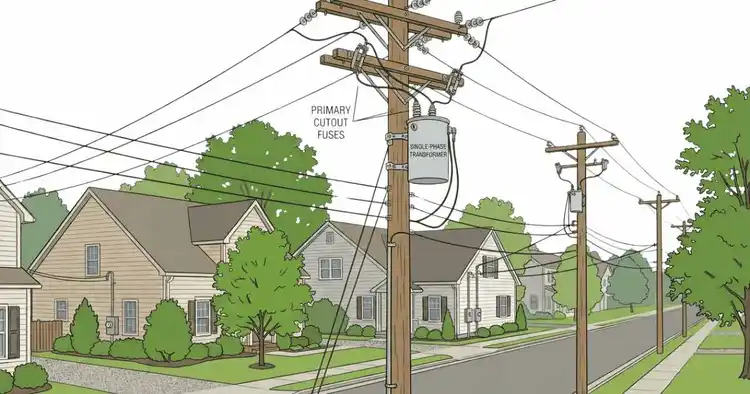
Electric power distribution lines are the wires you see running along streets, poles, and rooftops, carrying electricity from substations straight to your home, office, or factory. It is the final stage of the power system, right after high-voltage transmission, and they deliver power at the safe, usable voltages your appliances actually need.
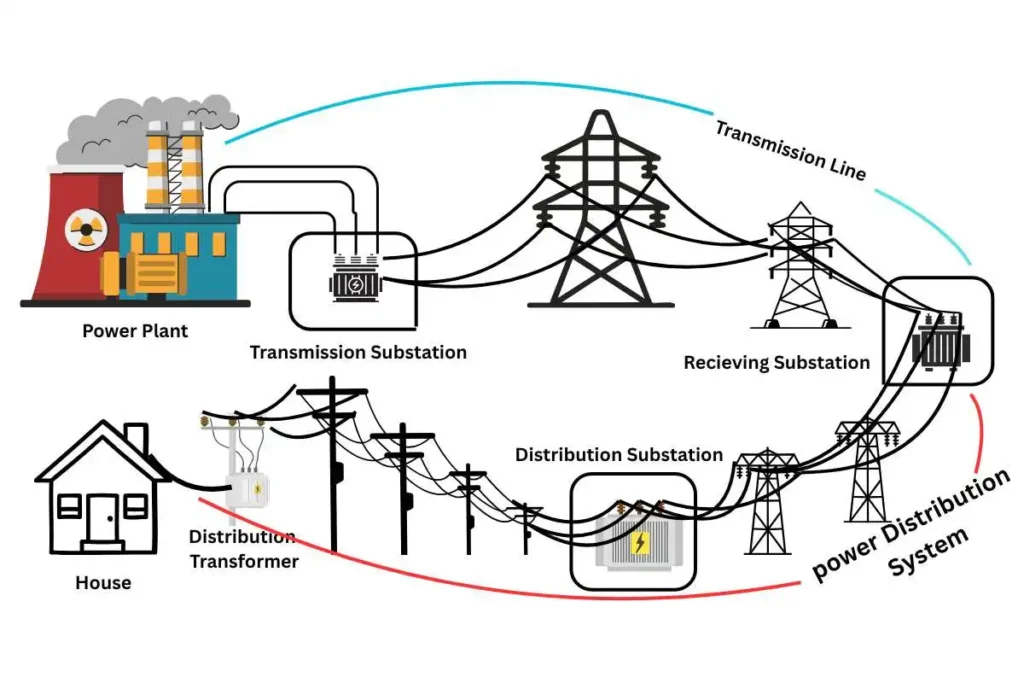
Think of them as the last mile of the electricity journey. Different types of power plants generate it, transmission lines move it across long distances at very high voltage, and distribution lines bring it down to a level you can plug into. Without them, electricity would never reach your switchboard.
As an electrical engineer, I’ve worked with these lines in both city and rural setups, so I’ll keep the explanation practical and jargon-free. You’ll see how they actually carry power from the substation to your meter, not just the textbook theory.
In this guide, we’ll cover what distribution lines are, the different types based on voltage and installation, the voltage levels they operate at, and the key functions they perform. By the end, you’ll clearly understand how power reaches you and why these lines matter so much.
Electric Power Distribution Lines Definition
Electric power distribution lines are the conductors that carry electricity from distribution substations or distribution transformers to end consumers at usable voltage levels. In simple terms, they are the wires that deliver power to homes, shops, offices, and industries.
These lines operate at much lower voltages than transmission lines. Primary distribution lines usually carry voltages between 33 kV and 11 kV. In contrast, secondary distribution lines deliver power at 440 V (three-phase) and 230 V (single-phase), which is exactly what your household appliances run on.
A distribution line connects the substation to a distribution transformer, and from there, smaller lines carry electricity to your premises. Whether overhead on poles or buried underground, their job stays the same: deliver safe, steady, usable power to every consumer.
How Distribution Lines Work
Distribution lines work by carrying electricity from the substation and stepping it down in stages until it reaches a voltage your home can use safely. Here’s how that flow actually happens, stage by stage.
- Power arrives at the distribution substation. The substation receives high-voltage electricity from transmission lines, often around 132 kV. A step-down transformer here reduces it to about 11 kV for local distribution.
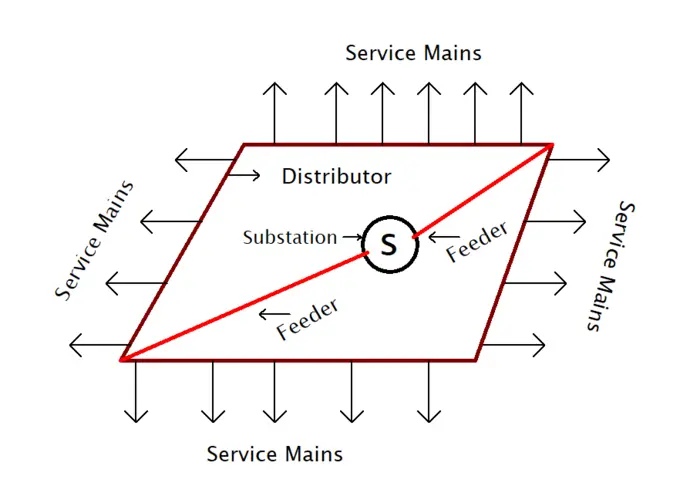
- Feeders carry power onward. From the substation, a feeder line carries this 11 kV power toward neighborhoods and load points. No consumer connects directly to a feeder; it simply transports bulk power to where it’s needed.
- Distribution transformers step the voltage down again. The feeder feeds a distribution transformer, which lowers the voltage from 11 kV to 440 V or 230 V. This is the point where electricity becomes safe for everyday use.
- Distributors spread the power. From the transformer, a distributor line runs along streets and lanes, supplying multiple consumers along its length.
- Service mains reach your meter. Finally, a service main taps off the distributor and carries power directly to your home or building’s meter.
So the full path is simple to remember: substation → feeder → distribution transformer → distributor → service mains → consumer. At each stage, the voltage drops closer to the level your appliances need, which keeps the supply both safe and efficient.
Difference Between Transmission Lines and Distribution Lines
People often mix up transmission and distribution lines, but they do very different jobs. Transmission lines move large amounts of power across long distances at extremely high voltage. Distribution lines take that power, step it down, and deliver it locally to consumers.
Here’s a side-by-side comparison:
| Factor | Transmission Lines | Distribution Lines |
| Voltage Level | Very high (132 kV, 220 kV, 400 kV and above) | Lower (33 kV, 11 kV, 440 V, 230 V) |
| Purpose | Carry bulk power over long distances | Deliver usable power to end consumers |
| Distance Covered | Long, intercity and interstate | Short, within towns and localities |
| Line Type | Large towers with thick conductors | Poles and smaller conductors, or underground cables |
| Consumer Connection | No direct consumer connection | Connects directly to homes, shops, and factories |
| Current Capacity | Handles very high power loads | Handles smaller, local loads |
In short, transmission lines are like highways that move power in bulk across great distances. Distribution lines are the local roads that branch off and bring that power right to your door at a voltage you can safely use. Both work together, but distribution lines are the ones that complete the journey to you.
Types of Electric Power Distribution Lines
Distribution lines aren’t all the same. Engineers classify them based on three simple factors: the voltage they carry, how they’re installed, and the type of current that flows through them.
Here’s how that breaks down:
- By voltage level: Primary distribution lines (higher voltage) and secondary distribution lines (lower, usable voltage).
- By installation method: Overhead lines (mounted on poles) and underground lines (buried cables).
- By current type: AC distribution (the standard worldwide) and DC distribution (used in specific applications).
Each type plays a defined role in moving power closer to your switchboard. Let’s start with the two that matter most for understanding how electricity reaches you: primary and secondary distribution lines.
Primary Distribution Lines
Primary distribution lines carry electricity from the distribution substation to the distribution transformer. They operate at medium voltage, usually between 33 kV and 11 kV, which is too high to use directly but ideal for moving power efficiently across a locality.

Think of these as the trunk lines of your neighborhood. They don’t connect to your home directly. Instead, they feed the distribution transformers scattered across an area, which then step the voltage down to a safe level for consumers.
The conductors that carry this primary power are called feeders, and they come in a few different layouts depending on how much reliability the area needs:
- Radial feeder: The simplest and cheapest setup. Power flows in one direction from the substation outward. If a fault occurs anywhere along the line, everyone downstream loses supply. Common in rural and low-density areas.
- Parallel feeder: Two feeders run side by side to the same load. If one feeder fails, the other maintains the power supply.. More reliable, but more expensive.
- Loop feeder: The feeder forms a closed ring so that power can reach a point from two directions. A fault in one section can be isolated without cutting the supply to the whole loop. Popular in urban areas.
- Interconnected feeder: Multiple feeders link to more than one substation. This gives the highest reliability, since power can be rerouted if any single source fails.
Why does this matter? The feeder layout directly decides how often you face outages. Cities with critical loads lean on loop and interconnected feeders, while cost-sensitive rural networks often stick with radial feeders. Choosing the right configuration is a real balancing act between reliability and budget.
Secondary Distribution Lines
Secondary distribution lines carry power from the distribution transformer straight to consumers. This is the final stretch of the journey, and it runs at the low voltages your appliances actually use: 440 V for three-phase loads and 230 V for single-phase loads.
This is where electricity finally becomes safe to plug into. The distribution transformer steps the 11 kV primary voltage down, and these secondary lines then spread that usable power along streets and lanes to individual buildings.
Secondary lines are built for smaller, everyday loads, such as:
- Residential connections: Lights, fans, refrigerators, ACs, and other household appliances run on the 230 V single-phase supply.
- Small commercial premises: Shops, offices, and small workshops typically draw from the same low-voltage network.
- Light three-phase loads: Small motors, pumps, and machinery use the 440 V three-phase supply.
Because these lines handle the consumer end, they’re designed with voltage drop in mind. Run a secondary line too long, and the voltage at the far end sags, which dims lights and strains motors. That’s why distribution transformers are placed close to the loads they serve, keeping these final lines short and the supply steady.
Overhead Vs Underground Distribution Lines
Once you know what distribution lines do, the next practical question is how they’re installed. There are two options: overhead lines strung on poles, or underground cables buried in the soil. Each has clear strengths and trade-offs.
Overhead lines are the familiar wires you see on poles along roads. They’re cheaper, faster to install, and easy to inspect, since any fault is visible from the ground. Underground lines run as insulated cables beneath the surface. They cost far more to lay but stay protected from storms, falling branches, and accidental contact.
Here’s how the two stack up side by side:
| Factor | Overhead Lines | Underground Lines |
| Installation | Quick and simple; poles and conductors | Slow and complex; trenching and insulated cables |
| Cost | Low upfront cost | High upfront cost (often several times more) |
| Maintenance | Easy; faults are visible and quick to fix | Difficult; locating and repairing faults takes longer |
| Weather Resistance | Vulnerable to storms, wind, and lightning | Highly resistant; shielded from most weather |
| Aesthetics | Visible wires and poles clutter the view | Hidden; cleaner streetscape |
| Reliability | More outages from weather and external damage | Fewer faults; very reliable supply |
| Fault Repair Time | Fast, since faults are easy to spot | Slower, as cables must be dug up and located |
| Lifespan | Shorter; exposed to the elements | Longer; protected environment |
When is each preferred?
Choose overhead lines when budget matters most, for rural areas, open countryside, and locations where quick installation and easy maintenance outweigh appearance. They remain the default choice across most of the world for good reason.
Choose underground lines for dense city centers, residential colonies, commercial hubs, and areas where reliability and a clean look justify the higher cost. They’re also the smart pick in regions prone to severe storms, where overhead lines fail often.
In practice, most networks blend both. Engineers run overhead lines where cost and access drive the decision, and switch to underground cables where weather, safety, or aesthetics demand it. The right choice always comes down to balancing budget against the reliability and appearance the area truly needs.
AC and DC Distribution Lines
Distribution lines carry power in one of two forms: alternating current (AC) or direct current (DC). The difference lies in how the current flows. In AC, the current reverses direction many times per second. In DC, it flows steadily in one direction without changing.
Almost every distribution network you see today runs on AC. The reason is simple: AC voltage is easy to step up or down using transformers, which makes moving and adjusting power far cheaper and more efficient. DC distribution exists, but it’s limited to specific uses like traction systems, certain industrial setups, and data centers.
Before electricity reaches distribution lines, transformers play a critical role in stepping voltage up and down across the grid, and you can explore that process in detail in our guide on the role of transformer in power transmission.
AC Distribution
AC distribution splits into two stages based on voltage.
- Primary distribution: Carries medium voltage, usually 33 kV, 11 kV, and sometimes 66 kV, from the substation to distribution transformers. Feeders handle this stage, and they’re typically designed for a 1–2 MVA load. Common feeder layouts include the radial feeder (simple and low-cost, used in rural areas) and the loop feeder (forms a ring so faults can be isolated, popular in cities).
- Secondary distribution: Also called the low-voltage system. It delivers 400 V for three-phase loads and 220 V for single-phase loads, stepped down by distribution transformers. This stage suits everyday loads like lights, fans, and small appliances.
DC Distribution
In a DC distribution system, current flows in a constant direction and never reverses. There are three main types:
- 2-Wire DC System: The simplest setup, using one positive and one negative conductor.
- 3-Wire DC System: Adds a neutral wire between two outer conductors, allowing two voltage levels from the same supply.
- Ring Main DC System: Conductors form a closed loop, so power can reach a load from two directions, improving reliability.
Why AC Dominates Modern Grids
AC wins for one big reason: transformers. They let engineers raise voltage for efficient long-distance transport and lower it again for safe local use, all with minimal loss. AC machines and generators are also cheaper and simpler to maintain. DC simply can’t match this flexibility at the distribution level, which is why AC remains the global standard.
For a deeper look at how transformers transfer electrical energy between circuits, check this guide on the working principle of transformer.
Components Used in Distribution Lines
A distribution line isn’t just wires and poles. Several components work together to move power safely and keep the supply steady. Here’s what each one does.
Distribution Substation
The substation is the starting point of the distribution network. It receives high-voltage power from transmission lines, often around 132 kV, and uses a step-down transformer to reduce it to 11 kV or below for local distribution. It also houses switchgear, busbars, protection relays, and metering devices.
Distribution Transformer
This is another step-down transformer that takes the 11 kV primary voltage and lowers it to 440 V or 230 V for consumers. You’ll spot it mounted on poles in rural areas or placed in underground vaults in towns. It’s the link between the feeder and your home supply.
Feeder
The feeder is the conductor that carries power from the substation to distribution transformers or distribution points. No consumer connects directly to it. It’s sized by its current-carrying capacity to handle bulk load.
Distributor
The distributor is the line from which service connections tap off to supply consumers. It runs along streets and lanes, and it’s designed around voltage drop to keep supply steady along its length.
Service Mains
The service main is the short conductor that connects the distributor to the consumer’s meter. It’s the final link that brings power into your home or business.
Switchgear
Switchgear controls and protects the network. It includes circuit breakers, isolators, Electric fuse, and protective relays that switch power on or off and cut the supply during faults like short circuits or earth faults. This protects both equipment and people.
Capacitors and Reactors
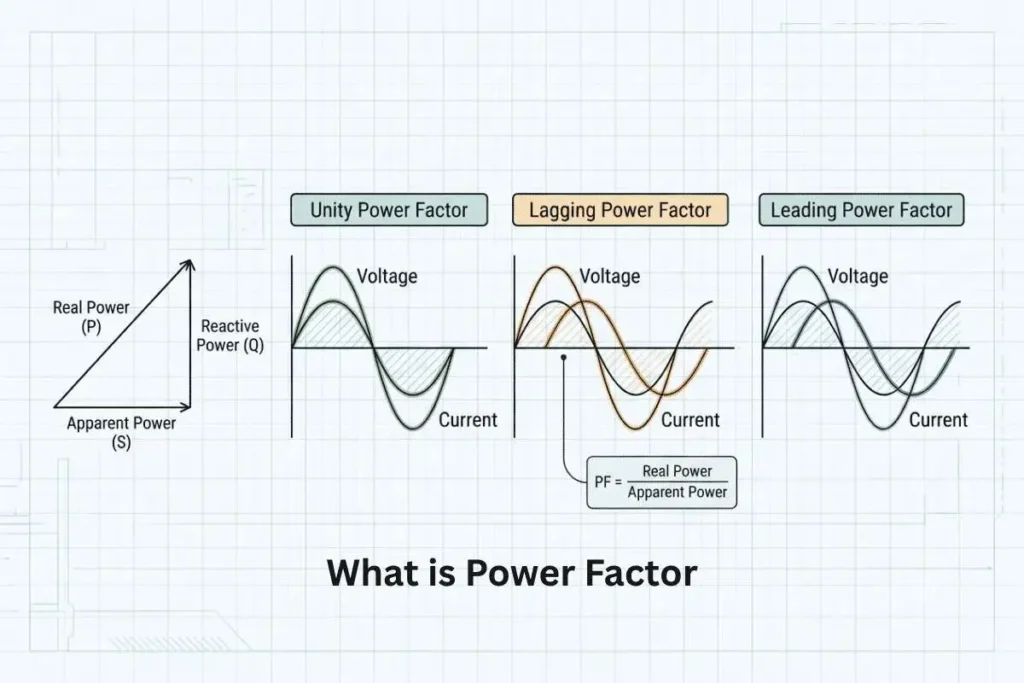
These improve the power factor and help hold the voltage steady. Capacitors supply reactive power to reduce losses, while reactors absorb excess reactive power. Together they keep the system efficient.
Voltage Regulators
Voltage regulators stabilize the supply voltage along the line. They correct the dips and rises that come from changing loads, so consumers receive a steady, correct voltage and appliances stay protected.
Here’s a quick summary:
| Component | Main Purpose |
| Distribution Substation | Steps down transmission voltage for local supply |
| Distribution Transformer | Lowers 11 kV to 440/230 V for consumers |
| Feeder | Carries bulk power to transformers and load points |
| Distributor | Supplies power along streets to multiple consumers |
| Service Mains | Connects the distributor to the consumer meter |
| Switchgear | Switches and protects the system during faults |
| Capacitors & Reactors | Improve power factor and maintain voltage |
| Voltage Regulators | Stabilize voltage and reduce losses |
Functions of Electric Power Distribution Lines
Distribution lines do more than just carry electricity. They perform several key functions that keep your supply safe, steady, and reliable.
- Power delivery: Their core job is to transmit electricity from the substation to every home, office, factory, and shop on time and without interruption.
- Voltage control: They maintain a steady voltage so consumers get the correct level. Voltage regulators step in to smooth out fluctuations that could damage appliances.
- Load balancing: The network balances demand and supply across areas, preventing any one section from overloading.
- Safety and fault protection: Switchgear and circuit breakers detect faults like short circuits and earth faults, then isolate them quickly to protect equipment and people.
- Real-time monitoring: Modern networks use smart grid and IoT technology to track power flow and control the system in real time, spotting issues before they grow.
- Energy efficiency: Distribution lines are designed to minimize losses, so more of the generated power actually reaches consumers.
Importance of Distribution Lines
Distribution lines form the final stage of the power supply chain, and their value goes well beyond simply moving electricity.
- Electricity availability: Without them, power can’t reach consumers. They complete the journey from the power plant to your switchboard.
- Economic growth: Reliable power keeps industries running, supports businesses, and drives development in both cities and small towns.
- Rural and urban supply: They extend electricity to remote villages and dense city centers alike, supporting better education, healthcare, and daily living.
- Renewable energy integration: Distribution networks connect rooftop solar, wind farms, and other clean sources to the grid, making greener power practical at scale.
- Reliability: A well-designed distribution system reduces outages, isolates faults fast, and keeps supply continuous, which matters for homes, hospitals, and factories alike.
Conclusion
Electric power distribution lines are the part of the power system that finally delivers electricity to homes, offices, shops, and industries at usable voltage levels. From primary and secondary lines to overhead and underground systems, each part plays a key role in making the power supply safe, reliable, and efficient.
In simple terms, these lines complete the journey of electricity from the substation to the consumer. As power demand grows and grids become smarter, electric power distribution lines will continue to remain one of the most important parts of a modern electrical network.
FAQ
-
What are electric power distribution lines?
Electric power distribution lines are the conductors that carry electricity from distribution substations or transformers to end consumers at usable voltages. They’re the final link that delivers power to homes, shops, offices, and industries through wires, poles, and cables.
-
What is the difference between transmission and distribution lines?
Transmission lines carry bulk power over long distances at very high voltages (132 kV and above). Distribution lines take that power, step it down, and deliver it locally at lower voltages like 11 kV, 440 V, and 230 V. Transmission lines act like highways, while distribution lines are the local roads to your door.
-
What are primary and secondary distribution lines?
Primary distribution lines carry medium voltage (33 kV to 11 kV) from the substation to distribution transformers. Secondary distribution lines then carry the stepped-down voltage (440 V and 230 V) from the transformer directly to consumers.
-
What are feeder, distributor and service mains?
A feeder carries bulk power from the substation to distribution points, with no direct consumer connections. A distributor runs along streets and supplies many consumers along its length. A service main is the short line that connects the distributor to a single consumer’s meter.
-
What voltage do distribution lines carry?
Primary distribution lines carry 33 kV to 11 kV. Secondary distribution lines deliver 440 V for three-phase loads and 230 V for single-phase household supply, which is what your appliances use.
-
What is the difference between overhead and underground distribution lines?
Overhead lines run on poles, cost less, install quickly, and are easy to repair, but they’re exposed to weather. Underground lines use buried insulated cables that cost more but resist storms, last longer, and look cleaner.
-
What are AC and DC distribution systems?
In an AC system, current reverses direction many times per second, which makes voltage easy to change with transformers. In a DC system, current flows steadily in one direction. AC dominates distribution because of this flexibility, while DC is used in specialized applications.
-
Why are distribution transformers used?
Distribution transformers step the primary voltage of 11 kV down to 440 V or 230 V, the safe, usable level for homes and businesses. Without them, the voltage reaching consumers would be far too high to use safely.

I am an electrical engineer and also a blogger. I write informative blog posts on topics related to electrical and electronics engineering. If you are interested in these topics, you are welcome to my site to read these articles.
This post was very eye-opening.