
What is the Function of Economizer in Thermal Power Plant
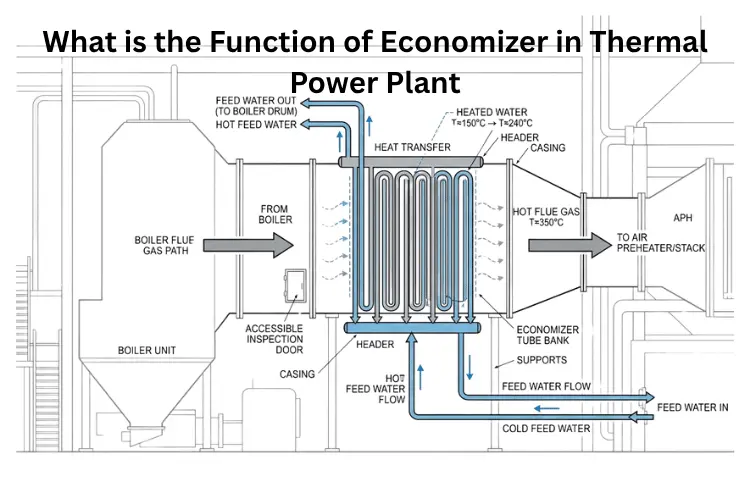
The function of an economizer in a thermal power plant is simple — it recovers waste heat from hot flue gases and uses that heat to preheat boiler feed water. Less heat wasted. More fuel saved.
Here’s the problem it solves. Boiler flue gases leave at 300°C–400°C. Without an economizer, that heat goes directly out through the chimney and is completely wasted. Every degree of that heat is fuel you paid for, gone.
The economizer stops that loss. It grabs the heat from the flue gas and feeds it back into the water before it reaches the boiler. Result? Lower fuel bills, higher efficiency, faster steam.
In this article, you’ll read every function this device performs — waste heat recovery, feed water preheating, efficiency gains, fuel savings, and boiler protection.
What is an Economizer in a Thermal Power Plant?
An economizer is a heat recovery device built into the boiler’s flue gas path. Picture a set of metal tube banks. Feedwater flows inside the tubes — hot flue gases pass over them on the way to the chimney. That contact transfers heat from the gas to the water.
The result is flue gas heat recovery in action. The water gets warmer before it enters the boiler, and the heat stays inside the plant instead of escaping. As a boiler component, the economizer’s whole job is boiler feed water heating using heat that would otherwise be wasted.
How Does an Economizer Work? (Brief Working Principle)
The economizer works on one simple idea — counter-flow heat exchange. Feed water flows one way, hot flue gases flow the opposite way. Because they move in opposite directions, the heat transfer stays strong from one end to the other. The hottest gas meets the warmest water, the coolest gas meets the coldest water — and that gap keeps pulling heat across the whole length.
Here is how the economizer process works in a thermal power plant, step by step:
- Feed water enters the tubes — a pump pushes water into the economizer tubes, usually from the bottom.
- Hot flue gases pass over the tubes — gases leaving the boiler travel across the outside of those tubes on their way to the chimney.
- Heat transfers — heat moves from the gas through the tube wall and into the water.
- Water temperature climbs — the feed water heats up before it ever reaches the boiler drum.
That heat transfer is the whole game. It’s what makes every function of the economizer possible.
Main Functions of Economizer in Thermal Power Plant
The economizer performs five distinct functions — each one builds on the heat it pulls from flue gas.
1. Waste Heat Recovery
This is the economizer’s primary job — flue gas heat recovery.
Boiler flue gases leave hot. Without an economizer, that heat shoots straight up the chimney and disappears—pure loss. You burned fuel to create that heat, and then you let it escape.
The economizer stops that. It captures the heat from the flue gas before it exits and keeps it inside the plant. The heat doesn’t leave— it goes back to work heating your feedwater. That’s the foundation every other function is built on.
2. Feed Water Preheating
The second function is feed water preheating — warming the water before it enters the boiler drum.
Feedwater usually enters at around 100°C. The economizer pushes it up to roughly 120°C–150°C using recovered flue gas heat. The payoff is direct: the boiler starts with warmer water, so it does less work to turn that water into steam.
Think of it this way. The boiler isn’t starting from scratch — half the heating job is already done. That boiler feed water heating means faster steam and a lighter load on the furnace.
3. Boiler Efficiency Improvement
Preheating feeds straight into boiler efficiency improvement.
The rule is steady: every 6°C rise in feed water temperature lifts boiler efficiency by about 1%. A working economizer typically raises feed water by 20°C–50°C — and that adds up to a 4%–5% gain in overall efficiency.
What does 4%–5% mean for you? Same coal in, more output out. You generate more steam from the same amount of fuel — and that steam generation efficiency translates into more power per ton of coal.
4. Fuel Consumption Reduction
More efficiency means less fuel. That’s fuel saving in boiler operation, plain and simple.
When water reaches the boiler already preheated, the furnace burns less fuel per unit of steam. In typical plants, that’s a 5%–8% fuel saving.
Stack the outcomes:
- Lower fuel use — 5%–8% less coal burned for the same steam.
- Lower running cost — less fuel means a smaller fuel bill, month after month.
- Lower emissions — burn less coal, release less CO₂.
That’s energy saving in thermal power plant operation working three ways at once — cost, fuel, and environment.
5. Protection of Boiler Components from Thermal Shock
The fifth function protects the boiler itself — through thermal shock reduction in boiler operation.
Cold water hitting a hot boiler drum is a problem. The sudden temperature gap stresses the metal — and repeated stress shortens part life. Over time, that means cracks, repairs, and downtime. Since repeated thermal stress and corrosion can shorten tube life, it is useful to understand boiler tube failure causes and prevention as well.
Preheated water narrows that gap. The water entering the drum is already close to boiler temperature, so the metal faces far less shock. The result is direct — longer component life and lower maintenance cost.
A small device. Five functions. Every one of them earns its keep.
Practical Importance and Benefits of the Economizer
Add up all five functions, and the economizer pays for itself in one currency — savings you can measure.
Here’s what a working economizer delivers:
- Fuel saving of 5%–8% — less coal burned for the same steam output, month after month.
- Boiler efficiency improvement of 4%–5% — same fuel in, more power out. That’s a direct lift in plant performance.
- Lower operating cost — burn less fuel, pay a smaller fuel bill. The savings stack up every single billing cycle.
- Reduced CO₂ emissions — less coal combustion means fewer emissions released into the air.
- Faster steam generation — preheated water hits the boiler closer to its target temperature, so steam forms quicker. Higher steam generation efficiency, less furnace strain.
That’s energy saving in thermal power plant operation working on every front at once — cost, fuel, output, and environment. A small component, tucked into the flue gas path, returning direct and measurable savings on every ton of coal you burn.
Conclusion
The core function of the economizer is to use waste heat from flue gases to improve boiler efficiency throughout the operation.
It does this through five functions working together: heat recovery from flue gas, feed water preheating, efficiency gain, fuel reduction, and protection of boiler components from thermal shock. The bottom line is simple. The economizer is a small device — but it pays you back in fuel savings, every day the plant runs.
FAQ
-
What are the different types of economizers used in thermal power plants?
There are two main types: bare tube and finned tube. Bare tube handles dirty flue gas better and needs less cleaning, while finned tube recovers more heat in the same space. Pick finned tube for clean fuel, bare tube for dusty fuel.
-
What is the difference between an economizer and an air preheater?
An economizer heats your boiler feed water, while an air preheater heats the combustion air. Flue gas usually passes through the economizer first, then the air preheater. Working together, they recover most of the heat from the gas before it leaves the chimney.
-
What causes economizer corrosion, and how do you prevent it?
Corrosion happens when flue gas cools below the acid dew point and forms sulfuric acid on the tubes. To prevent it, keep tube surfaces warm enough and use low-sulfur fuel. Corrosion-resistant materials in the cold-end zone also help.
-
What is soot blowing, and why does an economizer need it?
Soot blowing clears ash off the tubes using jets of steam or air. Ash buildup blocks heat transfer and cuts your recovery. Run it on schedule so the tubes stay clean and efficient.
-
What are the warning signs that an economizer is failing?
Watch for hotter flue gas leaving the unit, cooler feed water, or tube leaks. Higher fuel use for the same steam is another red flag. If you see these, inspect the economizer before the problem grows.
-
What is an economizer bypass, and when is it used?
A bypass is a duct that lets flue gas skip the economizer. You use it during cold start-up and low load to keep the tubes warm and avoid acid economizer corrosion. It trades a little heat recovery for longer tube life.
-
How long does an economizer last, and when should you replace it?
A well-maintained economizer lasts about 15–25 years, depending on your fuel and water quality. Replace it when you see repeated leaks, heavy cold-end corrosion, or recovery that cleaning can’t fix. A planned swap costs less than constant repairs.

I am an electrical engineer and also a blogger. I write informative blog posts on topics related to electrical and electronics engineering. If you are interested in these topics, you are welcome to my site to read these articles.
Your writing has a way of resonating with me on a deep level. I appreciate the honesty and authenticity you bring to every post. Thank you for sharing your journey with us.