Different Types of Fault in Busbar
Busbars hold critical importance in substations because all incoming and outgoing electricity converges at this single point. If a minor component, such as a feeder, fails, it might affect only a limited area. But if a busbar fails, the consequences are severe: entire substations can go offline, resulting in widespread power outages and posing safety risks to personnel.
As you already know what a busbar in substation and its type is from earlier discussions, in this article, you will learn about the types of busbar faults, their causes, and potential consequences.
Types of Busbar Faults
Electrical faults can occur anywhere in a power system, but when they strike the busbar, the consequences are severe. To protect these vital nodes, engineers must first understand the specific types of electrical faults that can threaten them. Protection schemes rely on this knowledge to react swiftly and accurately.
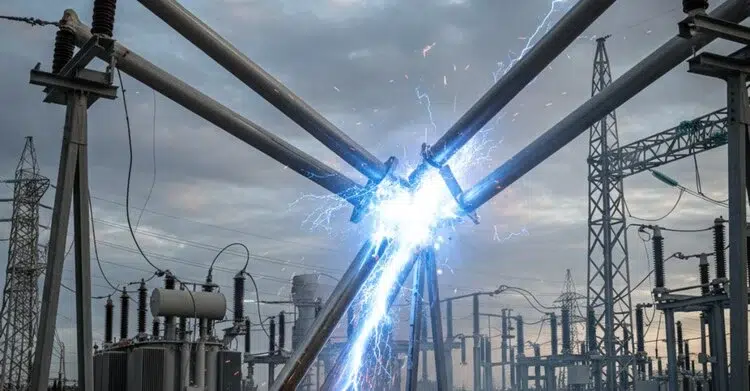
In real-world power systems, two distinct categories of faults are critical for engineers and operators to recognise: internal and external faults. Internal faults, also known as bus zone faults, originate within the busbar protection zone itself—the area the protective scheme is specifically designed to guard. These faults require immediate action, as they can directly threaten the safety of the busbar, connected equipment, and overall system stability.
On the other hand, external faults—often referred to as through faults—occur outside the defined busbar protection zone, typically on feeder circuits or transformers connected to the busbar. While the busbar remains physically unaffected, it still carries the intense short-circuit current associated with these faults, placing additional mechanical and thermal stress on the system. The core difference between these two lies not only in their location but also in how the protection system must respond.
Understanding and distinguishing between internal and external faults is essential to ensuring that only the faulty section is isolated, maintaining continuity of the rest of the network, and avoiding unnecessary outages.
Internal Faults (Bus Zone Faults)
Internal faults, often called bus zone faults, happen directly on the busbar itself or within the strictly defined protective zone surrounding it. The boundary of this zone is typically defined by the location of the current transformers (CTs) connected to the incoming and outgoing circuits.
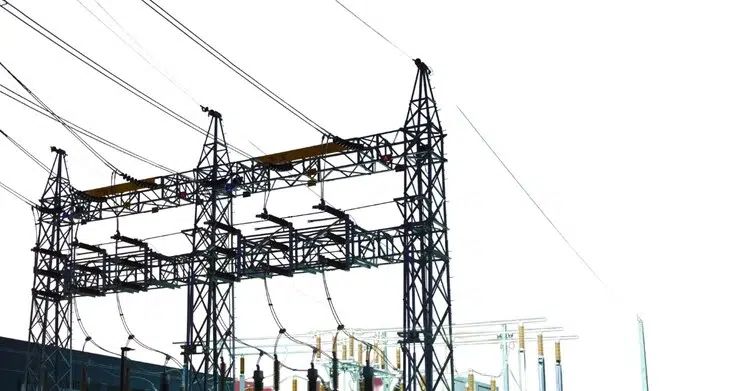
When a fault strikes inside busbar internal fault zone, the protection system must act instantly to isolate the entire busbar and prevent catastrophic equipment damage. Internal faults are classified by phase and ground connections.
Single Phase-to-Ground Fault (L-G)
The single-phase-to-ground fault (L-G) is the most common type of fault you will see in power systems, accounting for the vast majority of all electrical disruptions. It occurs when one of the three-phase conductors makes physical or electrical contact with ground.
On a busbar, an L-G fault usually happens due to insulation breakdown. A cracked porcelain insulator, heavy moisture buildup, or a sudden lightning strike can create a path for the current to arc from the busbar directly to the grounded supporting structure. While less severe than multi-phase faults, an L-G fault still generates massive short-circuit currents that require immediate clearing.
Phase-to-Phase Fault (L-L)
A phase-to-phase fault (L-L) occurs when two energised conductors touch each other or arc across the air gap separating them. Unlike the L-G fault, this disruption does not involve the ground.
These faults often occur due to mechanical failures or foreign objects. For example, high winds might blow a tree branch across two open busbar phases, or an animal might bridge the gap between two conductors. The resulting short circuit creates an intense arc flash. Because the electric current does not flow to the ground, earth-fault protection relays will not detect an L-L fault, requiring dedicated phase-fault protection schemes.
Double Phase-to-Ground Fault (L-L-G)
A double-phase-to-ground fault (L-L-G) is a highly destructive event in which two phases connect and simultaneously make contact with ground.
You can think of this as a combination of the previous two fault types. It often starts as a simple L-L or L-G fault. The intense heat and ionised air generated by the initial arc can easily bridge the gap to a third conductor or to ground, escalating the fault. L-L-G faults cause severe asymmetry in the power system, leading to dangerous voltage imbalances that can damage connected generators and transformers.
Three-Phase Fault (L-L-L / L-L-L-G)
A three-phase fault involves all three conductors shorting together (L-L-L) and potentially grounding as well (L-L-L-G). This is the rarest type of busbar fault, but it is also the most dangerous. Because it involves all three phases, we call it a symmetrical fault. The system remains balanced, but the fault current reaches its absolute maximum. A three-phase fault places immense thermal and mechanical stress on the busbar.
If the protection system does not clear a three-phase fault in milliseconds, the resulting magnetic forces can physically bend or shatter the solid metal busbars and destroy the surrounding switchgear.
External Faults (Through Faults)
External faults, also known as through faults, happen outside the designated busbar protection zone. These disruptions occur downstream on the connected feeder lines, transmission cables, or power transformers.
When a feeder line experiences a short circuit down the street, the fault current still flows through the substation busbar to reach the fault location. The busbar itself is perfectly healthy, but it is carrying a massive, abnormal amount of current to feed the external problem.
The busbar must withstand the mechanical and thermal stresses imposed by this through-fault current until the downstream breaker safely isolates the fault.
The Role of Secondary Circuits and LSI Protection
To achieve this selectivity, modern circuit breakers and protection relays use advanced coordination strategies. Engineers carefully calibrate the LSI (Long-time, Short-time, and Instantaneous) protection settings on downstream breakers. This ensures that the specific feeder breaker closest to an external fault trips first.
Meanwhile, the busbar protection relay continuously monitors secondary currents from the current transformers (CTs) on each connected line. By applying Kirchhoff’s Current Law to these secondary circuits, the relay calculates the net current entering and leaving the busbar. During normal operation or an external through fault, the current entering the bus equals the current leaving it. The sum of the secondary currents is zero. If an internal fault occurs, current rushes into the busbar but does not leave it, causing the relay to detect a massive discrepancy and issue an instantaneous trip command.
Main Causes of Busbar Fault
Busbar faults don’t happen in a vacuum. While we’ve classified the different types of faults, from L-G to three-phase, it’s crucial to understand the real-world conditions that trigger them. These events are rarely spontaneous; they result from gradual degradation, external influences, or human error.
Understanding these root causes is fundamental for any technician or engineer. It informs maintenance schedules, substation design, and the very logic programmed into protective relays. A fault is the symptom, but the cause is where prevention truly begins. Let us examine the reasons for busbar failure.
Insulation Failure
The single most common cause of a busbar fault is insulation failure. Busbars operate at extremely high voltages and rely on insulating materials—typically porcelain, glass, or modern polymers—to contain that electrical energy. When this insulation is compromised, a path is created for the fault current to flow to ground or to another phase, resulting in a devastating short circuit.
Several factors contribute to insulation breakdown:
Aging and Deterioration
Insulating materials don’t last forever. Over decades of service, they are exposed to constant thermal cycling (heating and cooling) and high electrical stress. This continuous pressure slowly degrades their dielectric properties. The material can become brittle, develop micro-cracks, and ultimately lose its ability to withstand the system voltage. Periodic insulation resistance testing is critical for identifying and replacing aging components before they fail catastrophically.
Moisture and Contamination
The surface of an insulator is just as important as its internal structure. In outdoor substations, insulators are exposed to rain, humidity, dust, industrial pollution, and salt spray in coastal areas. This grime can form a conductive layer on the insulator’s surface, especially when damp. This contamination reduces the “creepage distance”—the path an electrical arc must travel. A sufficiently contaminated surface can easily flash over, initiating a phase-to-ground fault.
Mechanical Stress
Insulators are rigid and can be brittle. They are subject to significant mechanical forces, from the immense weight of the busbars to the violent vibrations caused by the operation of large circuit breakers. An earthquake or even nearby construction work can introduce mechanical shock. This stress can cause insulators to crack or shatter, leading to an immediate and severe electrical fault.
Foreign Objects Bridging Components
Sometimes, a fault is caused by something that simply doesn’t belong there. When a foreign object creates an unintended electrical connection between energised parts or between an energised part and a grounded structure, a short circuit is inevitable.
Animal Intrusion
Substations can inadvertently attract wildlife. Snakes, squirrels, birds, and other animals seeking warmth or shelter can climb onto busbar structures. If an animal simultaneously touches an energised busbar and a grounded metal frame, its body forms a direct path for current, triggering a single-phase-to-ground fault. While seemingly minor, these events are a common source of outages.
Tools and Maintenance Equipment
Maintenance activities within a live substation carry immense risk. A dropped wrench, a misplaced ladder, or a testing lead that makes accidental contact can instantly cause a phase-to-phase or phase-to-ground fault. Strict safety protocols and “clearance” procedures are designed to prevent these very scenarios, but mistakes can still happen. The resulting arc flash poses a severe danger to personnel.
Environmental and External Factors
Power systems must be built to withstand the forces of nature. However, extreme environmental events can push equipment beyond its design limits, leading to busbar faults.
Lightning Strikes and Switching Surges
A direct lightning strike to a substation is a catastrophic event, introducing millions of volts into the system. This extreme overvoltage can easily puncture or flash over even healthy insulators, causing a fault. Similarly, routine switching operations elsewhere in the power grid can create transient overvoltages (switching surges) that travel along the lines and stress the busbar insulation, sometimes pushing a weakened insulator to the point of failure.
Earthquakes and Mechanical Shock
In seismically active regions, substation structures must be designed to withstand ground movement. A significant earthquake can damage foundations, crack insulators, or cause busbars to physically swing into contact with other components. This can initiate the most severe types of faults, such as double phase-to-ground or three-phase faults.
Human and Operational Errors
Unfortunately, human error remains a significant factor in busbar faults. The complexity of substation operations means that a single incorrect action can have system-wide consequences.
Incorrect Switching Operations
Improperly executing a switching sequence can lead to disaster. For example, energizing a section of busbar while it is still connected to a maintenance ground will create an immediate and massive fault. This is why protection systems must be carefully designed. The LSI protection settings on feeder breakers are coordinated with the main busbar protection, but they cannot prevent a fault caused by closing the wrong disconnector into a live system.
Maintenance-Related Mistakes
Errors during maintenance can introduce latent problems. Forgetting to reconnect a secondary circuit from a current transformer after testing could blind the differential protection scheme, leaving the busbar unprotected. Similarly, improperly torqued bolts can lead to overheating and eventual failure. These seemingly small mistakes compromise the integrity of the entire system and can directly lead to a fault or prevent the protection system from clearing one.
Conclusion
As the central nodes of electrical substations, busbars carry immense responsibility. When a disruption strikes these critical intersections, the consequences ripple across the entire power grid. Throughout this guide, we explored the distinct nature of busbar faults, categorising them into internal bus zone faults and external through faults. Whether you are dealing with a common single-phase-to-ground (L-G) fault, a phase-to-phase (L-L) arc, a double-phase-to-ground (L-L-G) event, or a catastrophic three-phase symmetrical fault, each incident presents unique challenges to the system.
Recognising these specific fault signatures and their root causes forms the absolute foundation for building effective defence mechanisms. By utilising advanced differential protection and carefully calibrated LSI settings, secondary circuits can swiftly distinguish between a genuine internal bus fault and a massive external through fault.
FAQ
-
What is the main difference between internal and external busbar faults?
Internal faults, or bus zone faults, occur directly on the busbar or within its strictly defined protective zone. External faults happen outside this zone, typically on connected downstream feeders or power transformers. A protection system must trip all connected breakers to isolate an internal fault, but it should allow downstream breakers to handle external faults while keeping the main busbar active.
-
Why are single phase-to-ground (L-G) faults the most common type of busbar fault?
Single-phase-to-ground faults occur frequently because they require only one point of failure. When environmental factors such as moisture, heavy dust, or lightning degrade the insulation, the electrical current can easily arc from a single-phase conductor directly to the grounded support structure.
-
How do phase-to-phase (L-L) faults differ from phase-to-ground faults?
Phase-to-phase faults happen when two energised conductors touch or arc across an air gap, without ever making contact with the ground. Because the current does not flow to the earth, standard earth-fault protection relays will not detect L-L faults. Engineers must use dedicated phase-fault protection schemes to identify and clear them.
-
How do current transformers help detect busbar faults?
Current transformers (CTs) continuously monitor the flow of electricity on every line connected to the busbar. They step down the high primary current and send a safe, proportional signal through a secondary circuit to the protection relay. The relay uses these secondary currents to calculate if the total energy entering the busbar equals the energy leaving it.
-
Why is relay stability critical for busbar protection schemes?
When a massive external fault occurs, the extreme current can cause current transformers to saturate. This saturation distorts signals sent through the secondary circuit, leading the relay to believe an internal fault is occurring. Relay stability is the protection system’s ability to ignore these distorted signals and prevent an unnecessary, system-wide blackout.

I am an electrical engineer and also a blogger. I write informative blog posts on topics related to electrical and electronics engineering. If you are interested in these topics, you are welcome to my site to read these articles.