Why Is a Condenser Used in a Steam Power Plant?
The condenser is one of the most underrated components in a steam power plant, yet it plays a pivotal role in how well the entire facility performs. When people think about power generation, they picture the boiler or the spinning turbine. The condenser in a steam power plant quietly does its job in the background, but its impact is huge. For engineering students, plant operators, and energy professionals, this matters a great deal. Even a small drop in condenser performance can cost a plant significant money and waste valuable efficiency. This article explains clearly why a condenser is used, focusing on its purpose, function, and role within the steam cycle.
Here’s what you’ll read:
- What a condenser actually does.
- How it creates a powerful vacuum.
- How it boosts overall plant efficiency.
- Why it’s essential to the closed steam loop.
What Is a Condenser in a Steam Power Plant?
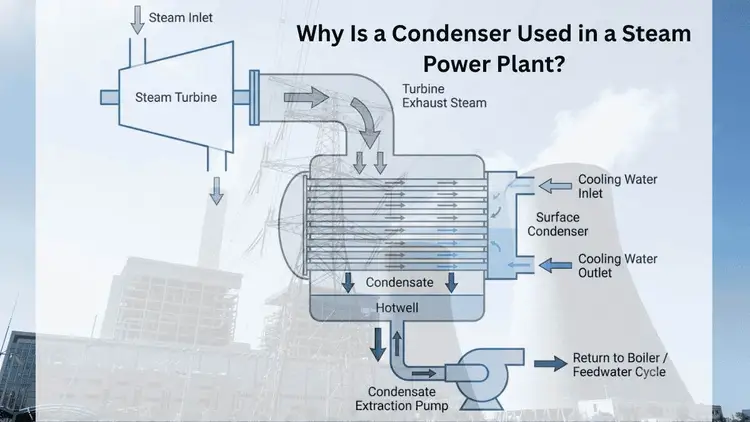
A condenser in a steam power plant is a heat exchanger that converts exhaust steam from the turbine back into liquid water, which is called condensate or steam condensate. In simple words, it takes the used steam leaving the turbine and cools it until it becomes water again.
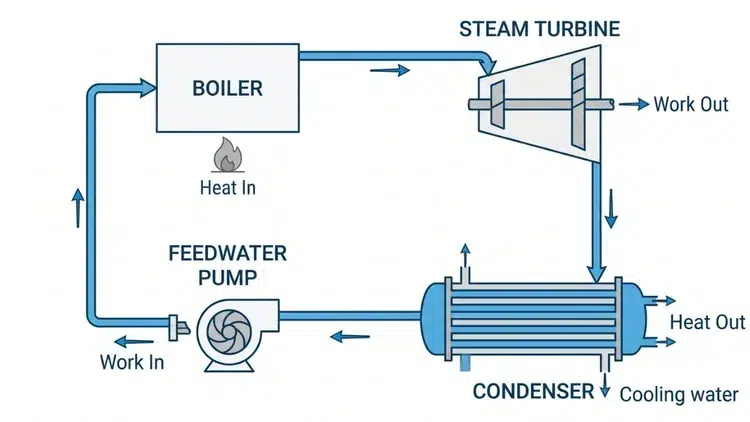
In the steam cycle, the condenser is placed right after the turbine exhaust. Once the steam expands through the turbine and transfers its energy, it enters the condenser. There, heat is removed from the steam, and steam condensation takes place. This process turns the low-pressure vapor into condensed steam in liquid form, which can be collected and sent back into the cycle.
Why Is a Condenser Used in a Steam Power Plant?
Reason 1: To Create a Vacuum and Lower Turbine Backpressure
One major purpose of condenser in steam power plant operation is to create a vacuum at the turbine exhaust. When steam is cooled and condensed, its volume drops sharply. This large reduction in volume creates a very low-pressure zone, or vacuum, inside the condenser.
This low-pressure condition helps pull more steam through the turbine. In simple terms, the turbine can do more work when the exhaust pressure is low. Thermodynamic data shows that reducing turbine exhaust pressure from atmospheric pressure, about 14.7 psia, to around 1 psia can increase turbine work output by roughly 32%.
That is why the function of a condenser in a steam power plant is closely linked to performance. Lower exhaust pressure means the turbine can extract more energy from the same amount of steam. This is one of the strongest answers to the question: Why Is Condenser Used in a Steam Power Plant?
Reason 2: To Increase Overall Plant Efficiency
Another key used of a condenser in steam power plant systems is improving overall thermal efficiency. This is connected to the Carnot principle, which says efficiency increases when the heat-rejection temperature, or TL, goes down. In simple form, the relation is:
η = 1 – TL/TH
The condenser lowers this low-temperature side of the cycle by removing heat from exhaust steam. As a result, the Rankine cycle becomes more efficient. This is why a steam condenser in a thermal power plant directly affects how much useful power the plant can generate.
Even a small gain matters. For example, if condenser performance improves by just 2%, the plant can save a significant amount in fuel and operating cost. In contrast, when condenser pressure increases from 1 psia to 2 psia, the plant delivers less power output. This clearly shows the direct connection between condenser steam performance and plant efficiency.
Reason 3: To Recover and Recycle Pure Feedwater
A steam condenser is also used to recover exhaust steam as clean water. When the turbine exhaust is cooled, the steam becomes condensate, which can be reused as boiler feedwater. This supports the closed-loop operation of the plant.
This has a big practical benefit. The plant does not need to replace large quantities of treated water continuously. That lowers water treatment cost and reduces make-up water demand. The recovered steam condensate can be collected in systems such as a steam condensate tank, steam condensate receiver, or steam boiler condensate return tank, depending on the plant setup.
Another advantage is water quality. Recycled condensate is usually high-purity water, which helps protect boiler tubes from scaling, fouling, and corrosion. So, when someone asks what a condenser in a steam power plant is used for, one clear answer is: it helps recover valuable pure water and send it back into the system.
Reason 4: To Reduce Pumping Energy in the Cycle
The condenser also reduces the energy needed to complete the steam cycle. Water is almost incompressible, while steam is a compressible vapor. Because of this, it takes far less energy to pump liquid water back to boiler pressure than to compress exhaust steam directly.
This is a very practical reason why a condenser for steam turbine systems is necessary. After steam condensing takes place, the liquid can be moved with a feedwater pump using relatively little power. If a plant tried to send turbine exhaust vapor straight back to the boiler without condensing it first, the energy required would be extremely high and uneconomical.
So, the purpose of condenser in steam power plant operation is not only to cool steam, but also to make the entire cycle practical, efficient, and cost-effective.
How the Condenser Works Within the Steam Cycle (Quick Overview)
To understand why a condenser is used in a steam power plant, it helps to see its role in the actual steam cycle. The process is simple, but each step supports plant efficiency and smooth operation.
First, turbine exhaust steam leaves the turbine after doing its work. This low-pressure exhaust enters the condenser in a steam power plant, where the cooling process begins. Inside the condenser, cooling water absorbs the latent heat from the exhaust steam. As heat is removed, steam condensation takes place, and the vapor changes into liquid water.
This condensed water, or steam condensate, collects at the bottom of the condenser. From there, a condensate extraction pump moves it forward so it can re-enter the feedwater system and eventually go back to the boiler. This closed-loop process helps save treated water, improve efficiency, and support continuous operation.
Another important part of the system is the air extraction pump. Its job is to remove non-condensable gases such as air from the condenser. If these gases remain inside, they reduce heat transfer and weaken the vacuum. By removing them, the pump helps the steam condenser maintain low backpressure and perform properly.
In short, every step in this sequence supports the main function of a condenser in a steam power plant: improve turbine performance, recover water, and make the cycle more efficient. A condenser helps improve the performance of a steam power plant, but even then a lot of energy is still lost in the system. That is one important reason why the overall efficiency of a steam power plant remains low. If you want to understand this better, you can read our article on why steam power plant efficiency is low.
The Condenser’s Essential Role
A condenser has a vital impact on how efficiently a steam power plant performs. Its job goes far beyond simply cooling steam. It helps create a vacuum at the turbine exhaust, improves overall plant efficiency, recovers pure feedwater for reuse, and reduces the energy needed to pump water back into the boiler. These four functions make it clear why a condenser is an essential part of a steam power plant.
Because of these benefits, the condenser is essential for making a plant more efficient, economical, and sustainable. A properly working steam condenser in thermal power plant systems helps increase power output, reduce fuel waste, and support stable long-term operation.
The key takeaway is simple: condenser performance should never be ignored. Even small losses in vacuum, cooling efficiency, or condensate recovery can directly affect plant output and operating cost. If you want to understand this topic in more depth, you can next explore a related article on types of condensers or condenser performance monitoring.
Conclusion:
A condenser is one of the most important components in a steam power plant because it supports the cycle in several practical ways. It creates a vacuum at the turbine exhaust, improves overall plant efficiency, recovers pure feedwater for reuse, and reduces the energy needed to return water to the boiler. These are the main reasons why a condenser is used in a steam power plant.
Without an efficient condenser in a steam power plant, the system would lose performance, waste more energy, and require more treated water. That is why the condenser is essential for making the plant efficient, economical, and sustainable. The most important takeaway is that condenser performance must be maintained carefully. Even a small drop in vacuum or heat transfer efficiency can reduce plant output and increase operating cost. If you want to understand this topic better, the next useful step is to explore condenser types or condenser performance monitoring.
FAQ
-
Does every steam power plant need a condenser?
Not every plant uses a condenser the same way, but most large power plants do. Condensing plants rely on it to keep the steam cycle closed, recover water, and lift efficiency. Some plants run in non-condensing mode for industrial process steam, but they usually generate power less efficiently. So for high-output electricity generation, a condenser is almost always part of the design.
-
Why is low turbine backpressure so important?
Low backpressure lets steam expand more fully inside the turbine. The more the steam expands, the more work it can do on the turbine blades. A strong condenser vacuum keeps this exhaust pressure low, so the turbine pulls extra energy out of the same steam flow. Lose that vacuum, and you instantly lose useful power.
-
How does condenser performance affect fuel consumption?
When a condenser underperforms, the turbine extracts less work from each unit of steam. To keep the same output, the plant has to burn more fuel. That means a weak condenser quietly raises your fuel bill. Even a small slip in performance can add up to large fuel costs over a year of continuous operation.
-
What are the common signs of poor condenser performance?
Watch for a few clear warning signs:
a) Rising turbine backpressure
b) Falling condenser vacuum
c) Higher turbine exhaust temperature
d) A drop in plant output under the same load
e) Unusually warm cooling water at the outlet
Any of these can point to fouling, air leaks, or cooling problems inside the steam condenser. -
How do air leaks affect a steam condenser?
Air leaks let non-condensable gases slip into the condenser shell. These gases act like a blanket over the tubes, blocking heat transfer and slowing down steam condensation. As they build up, the vacuum weakens, and backpressure climbs. That’s why an air extraction pump runs constantly — it pulls those gases out and protects the vacuum.
-
Why does condensate quality matter so much?
The steam condensate you recover becomes boiler feedwater again, so its purity directly affects plant health. Clean condensate keeps boiler tubes, feedwater lines, and turbine parts free of scale and corrosion. If impurities sneak in, they can cause deposits and long-term damage that are expensive to fix. Protecting condensate quality protects the whole closed loop.
-
What is the role of the hotwell in a condenser system?
The hotwell is the small reservoir at the bottom of the condenser where condensed water collects. It holds the recovered steam condensate until the extraction pump sends it back into the feedwater cycle. Think of it as a buffer tank that keeps water flow steady, even when load changes slightly across the plant.
-
Can condenser problems really reduce plant output?
Yes — and faster than many people expect. A weaker vacuum or poor heat transfer pushes turbine exhaust pressure up, which shrinks the amount of work the turbine can produce. So a fouled or leaking condenser doesn’t just waste water; it cuts straight into megawatts. In a steam condenser in thermal power plant operation, small losses show up directly on the output meter.
-
Why is regular condenser cleaning important?
Over time, condenser tubes pick up dirt, scale, and biological fouling from the cooling water. This buildup creates a barrier that reduces heat transfer and makes steam condensation less effective. A surface steam condenser with clean tubes condenses steam quickly and holds a strong vacuum. Routine cleaning keeps heat transfer high and stops efficiency from drifting downward.
-
What is the difference between condensing and non-condensing operation?
In condensing operation, exhaust steam is cooled back into water and returned to the boiler. This recovers heat, saves treated water, and gives the best power-generation efficiency. In non-condensing operation, the steam leaves the turbine at higher pressure for process use or is released, instead of being condensed. That setup suits industrial sites that need process steam, but it generates less power per unit of fuel. The choice of a condenser for a steam turbine depends on whether the goal is maximum electricity or useful process heat.

I am an electrical engineer and also a blogger. I write informative blog posts on topics related to electrical and electronics engineering. If you are interested in these topics, you are welcome to my site to read these articles.