What is Mobility in Current Electricity
Have you ever wondered how electricity flows so efficiently through the wires that power our world? We often think of current as a simple flow of charge, but there’s a deeper secret behind it. This fundamental property is crucial for understanding everything from the performance of a simple circuit to the design of advanced electronics. To truly grasp the dynamics of electrical flow, it is essential to explore the question: What is mobility in current electricity?
In this article, we will break down the definition of mobility, explore its relationship with drift velocity, and explain why it is a vital parameter in physics and electrical engineering.
Definition of Mobility in Current Electricity
In the study of electricity, mobility is a fundamental property that quantifies how easily charge carriers, such as free electrons or holes, can move through a material under the influence of an applied electric field.
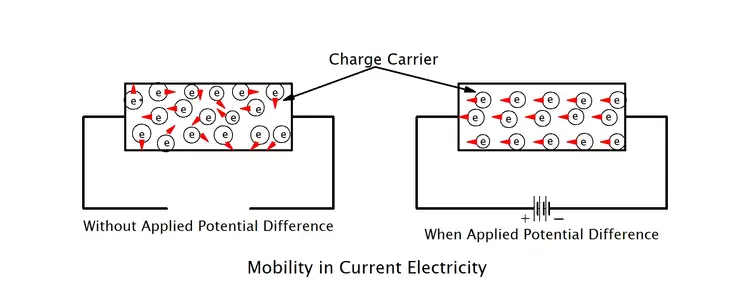
When a voltage is applied across a conductor or semiconductor, an electric field is created that exerts a force on the carriers, accelerating them. However, their path is not a straight line; they constantly collide with atoms and impurities within the material.
Essentially, a higher mobility value indicates that the charge carriers can move more freely and quickly, leading to better charge transport and, consequently, higher electrical conductivity.
Understanding mobility in current electricity is crucial because it directly connects the microscopic behavior of electrons to the macroscopic electrical properties of a material, like its resistivity and overall efficiency in conducting current.
Formula for Mobility in Current Electricity
To mathematically quantify the concept of mobility in current electricity, we look at the relationship between how fast a charge carrier moves and the force pushing it. The mobility ( \( mu \) ) is defined as the magnitude of the drift velocity ( \( v_d \) ) per unit electric field ( \( E \) ). The standard formula is:
Where:
- \( mu \) (Mu): Represents the mobility of the charge carrier.
- \( v_d \): Is the drift speed (or drift velocity) acquired by the charge carrier.
- \( E \): Is the strength of the applied electric field.
Mobility and Drift Velocity Relationship
The relationship between mobility and drift velocity is foundational to understanding how current flows through a conductor. At a glance, they seem like two terms for the same phenomenon, but they describe distinct aspects of particle movement.
Drift velocity is the actual average speed at which charge carriers—like electrons or holes—move through a material. Mobility, on the other hand, is the inherent ability of those carriers to move.
Think of it this way: drift velocity is the result, while mobility is the efficiency factor. When an external electric field is applied to a material, it exerts a force on the charge carriers, pushing them to move.
However, the speed they eventually reach (drift velocity) isn’t just about how hard they are pushed; it’s heavily dependent on how “mobile” they are within that specific material.
This relationship is linear and direct. If you double the electric field strength, the drift speed of the carriers will generally double, assuming the mobility remains constant.
This proportionality is what makes electron mobility such a critical parameter in semiconductor physics. High electron mobility means that even a small electric field can generate a significant drift velocity, leading to faster switching speeds in transistors and more efficient electronic devices. Conversely, in low-mobility materials, charge carriers struggle to accelerate even under an applied field, leading to higher resistance and slower performance.
SI Unit of Mobility
Just as every physical quantity has a standard unit for measurement, mobility does too. The SI unit of mobility is derived directly from its defining formula, which relates the drift velocity to the electric field. Understanding this unit is essential for accurately comparing the performance of different materials in electrical applications. The standard SI unit of mobility is equal to square meters per volt-second (m²/Vs).
Difference Between Mobility and Conductivity
While mobility and conductivity are both crucial for describing how a material behaves electrically, they are not the same thing. Mobility refers to the individual performance of charge carriers, whereas conductivity describes the collective outcome for the entire material. Understanding their distinction is key to grasping the full picture of electrical flow.
- Mobility is a property of the individual charge carriers (like electrons or holes).
- Conductivity (σ), on the other hand, is a macroscopic property of the material as a whole.
- A high electron mobility means that electrons can achieve a high drift velocity with relative ease.
- It depends not only on the mobility of the charge carriers but also on their concentration
- Mobility is an intrinsic property of the carrier within its environment.
- Conductivity is dependent on both mobility and the number of charge carriers per unit volume.
- formula σ = n * q * μ, where ‘n’ is the charge carrier concentration, ‘q’ is the charge of the carrier, and ‘μ’ is the mobility.
- Conductivity is a product of mobility and carrier density.
- The inverse of mobility doesn’t have a common physical term.
- while the inverse of conductivity is a well-known property called resistivity (ρ), which measures how strongly a material opposes the flow of electric current.
Factors Affecting Mobility of Charge Carriers
how easily the charge carriers can move; it is highly dependent on both the material’s internal structure and its external environment. Several key factors can significantly impact the mobility of current in a material, influencing its overall conductivity. Understanding these elements is crucial for designing and optimising electronic components. Several primary factors affect the mobility of charge carriers:
- Temperature: In conductors, higher temperatures cause more intense lattice vibrations, increasing collisions with free electrons and reducing mobility. In semiconductors, the effect is more complex: while higher temperature increases scattering, it also excites more electrons into the conduction band, increasing the number of charge carriers.
- Impurity Concentration: The purity of a material plays a critical role. The presence of foreign atoms (impurities) disrupts the regularity of the crystal lattice. These impurity atoms act as scattering centres, increasing electron collisions and reducing their mobility. This is why highly pure materials, such as silicon, are essential for the manufacture of high-performance semiconductor devices.
- Crystal Defects: Imperfections in the crystal structure act as obstacles to the movement of charge carriers. Electrons and holes scatter off these defects, which impedes their flow and lowers their overall mobility. A well-ordered, uniform crystal structure generally allows for higher mobility.
- Applied Electric Field: While mobility is often considered constant for a given material, this is true only at low electric field strengths. At very high electric fields, the charge carriers gain so much energy that their velocity no longer increases linearly with the field. This phenomenon, known as velocity saturation, effectively reduces the observed mobility in current electricity because the drift speed approaches a maximum limit.
Mobility in Conductor vs Semiconductor
The behaviour of charge carriers varies significantly between conductors and semiconductors. While both materials allow current to pass, the underlying mechanisms governing their mobility are quite distinct. This difference is fundamental to why copper is used for wiring while silicon is the backbone of computer chips.
Conductor
such as copper or aluminium, the charge carriers are strictly free electrons. These materials are flooded with free electrons even at room temperature. However, this high density comes with a trade-off.
When temperature increases, these atoms in the conductor vibrate more vigorously. These intensified lattice vibrations act like a crowded dance floor, causing the free electrons to collide more frequently with the atomic structure.
This increase in scattering mechanisms reduces the average time between collisions, thereby decreasing the overall mobility. Consequently, in conductors, electron mobility generally decreases with increasing temperature, leading to higher electric resistance.
Semiconductor
Semiconductors such as silicon and germanium have two types of charge carriers: negatively charged free electrons and positively charged “holes.” At very low temperatures, semiconductors behave almost like insulators. However, as the temperature rises, two competing effects occur:
- Similar to conductors, increased lattice vibrations tend to impede movement.
- Thermal energy breaks bonds, releasing more electrons and creating more holes.
While scattering still limits mobility at high temperatures, the unique structure of semiconductors allows for manipulation. By introducing impurities (doping), engineers can specifically tailor the material to favour either holes or electrons.
Interestingly, electron mobility in semiconductors is typically higher than hole mobility because electrons move freely through the conduction band. In contrast, holes move via a slower, “stepping-stone” process of bond exchanges between atoms. This inherent difference is a key design consideration in high-speed electronic devices, where faster switching speeds are required.
Conclusion
From its fundamental definition to its practical implications, understanding mobility is essential for anyone interested in the flow of electricity. The distinction between mobility in conductors and semiconductors highlights why certain materials are chosen for specific electronic applications, from simple wires to complex microchips. Mobility in current electricity is a concept that underpins advancements in electronics and materials science, driving the development of faster, more efficient technologies.
FAQ
-
What is mobility in Electronics Simple Terms?
Mobility is a property that measures how easily a charge carrier, like an electron, can move through a material when an electric field is applied. A higher mobility means the carrier moves more freely, resulting in better electrical conductivity.
-
How is Mobility Different from Drift Velocity?
Mobility is the inherent ability of a charge carrier to move, while drift velocity is the actual average speed the carrier achieves due to an electric field. Think of mobility as the efficiency factor and drift velocity as the resulting speed. The two are directly related: higher mobility leads to a higher drift velocity for the same electric field.
-
Does Higher Temperature always Reduce Mobility?
Not always. In conductors (like metals), increasing the temperature causes more atomic vibrations, which leads to more collisions and reduces electron mobility. However, in semiconductors, while higher temperatures also increase collisions, they simultaneously create more free charge carriers, which can increase overall conductivity.
-
What is the SI Unit of Mobility?
The SI unit of mobility is square meters per volt-second (m²/Vs). This unit is derived from its formula, which is the ratio of drift velocity (m/s) to the electric field strength (V/m).
-
Why is Mobility Important in Electronics?
Mobility is a crucial factor in designing electronic components. Materials with high electron mobility, like certain semiconductors, allow for faster switching speeds in transistors. This leads to more efficient and higher-performance devices, from computer processors to high-frequency communication systems. Understanding mobility in current electricity is key to developing next-generation technology.
-
Are Mobility and Conductivity the Same Thing?
No. Mobility is a microscopic property related to individual charge carriers. Conductivity is a macroscopic property of the entire material that describes its overall ability to conduct current. Conductivity depends on both the mobility of the carriers and how many of them are available to move (their concentration).

I am an electrical engineer and also a blogger. I write informative blog posts on topics related to electrical and electronics engineering. If you are interested in these topics, you are welcome to my site to read these articles.