DC Power Supply: A Complete Guide
A DC power supply is an electrical power supply that delivers direct current (DC). DC power supplies are widely used in engineering laboratory testing and electronics operations because they provide direct current outputs at stable levels or over variable ranges. DC power supplies are basic devices that support the testing and operation of devices that ideally require a constant-voltage, adjustable-current supply. This article explains the fundamentals of DC power supplies, discusses how variable- and digital-type DC supplies work, and addresses residential reasons for avoiding DC power use.
What is a DC Power Supply?
The electronic device commonly used to power systems and devices through constant directional electricity flow in one direction is a Direct Current (DC) power supply. A DC regulated power supply provides a continuous flow of electricity, unlike AC power, which reverses direction repeatedly.
DC supplies are indispensable because they provide a steady energy source, enabling smartphones, computers, LED lighting solutions, and electronic testing instruments to operate correctly. DC supply derives its energy from two sources: rectifier and filter conversion of AC power, and raw power from batteries. A DC Variable power supply allows users to adjust the output voltage and current levels to accommodate various connected devices.
Its safety features include overvoltage protection, current limiting, and thermal shutdown. Automated and programmable DC power supplies are widely used in laboratories and manufacturing facilities for precise control during testing. DC power supplies are essential components of modern electronics, providing stable power for reliable device operation.
Types of DC Power Supply
DC adjustable power supply come in a wide variety because they differ in design, function, and specific application requirements. The most common types are:
Linear DC Power Supplies
A linear DC supply converts AC power into DC output using a combination of a transformer, rectifier, a filter, and a voltage regulator. These devices generate a continuous DC output stream with very low ripple noise. However, the need for a transformer reduces the energy efficiency of this power supply and increases the device’s size. The linear power supply DC technology is an excellent choice due to its analog sensitivity and low noise characteristics.
Switching DC Power Supplies (SMPS)
The conversion of AC to DC in Switching Mode Power Supplies is achieved through high-frequency switching circuits. These power supplies come as small, lightweight systems that deliver efficiency rates greater than 85%. The electrical noise output from switching supplies exceeds that of linear supplies. Yet, these power converters find broad industrial, computer, and charger applications because they deliver high efficiency while maintaining a reduced size.
Unregulated DC Power Supplies
Providers of unregulated power supplies maintain a continuous direct current supply at a set voltage level, lacking any feedback system for corrective action. This device displays the voltage level when the load in the supply system changes or fluctuates. These devices are basic and inexpensive, but they may not be safe to use with sensitive electronic systems.
Programmable DC Power Supply
Risk-controlled output voltage and current control are achievable through manual or computer interface (USB, GPIB, etc.) settings supported by these supplies. These power supplies are used in research labs and automated testing environments, and they also serve laboratories because they deliver high accuracy and adaptability for their operations.
Battery-Based DC Supplies
The portability of batteries enables the transportation of DC power sources. Portable devices, emergency systems, and independent power-consumption projects use battery-based DC power supplies. Three standard battery types are available in the market: lithium-ion, lead-acid, and nickel-cadmium.
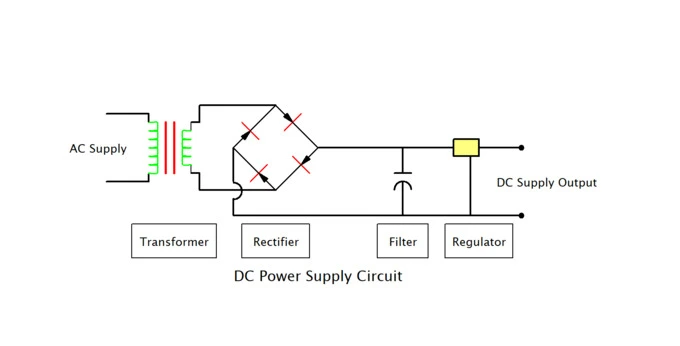
DC power supply block diagram.
A DC regulated power supply circuit illustration shows the components and wiring that convert AC power to DC power. The diagram illustrates the interconnection of electronic supply components, including the transformer, rectifier, capacitor, and voltage regulator, resulting in a smooth direct current output.
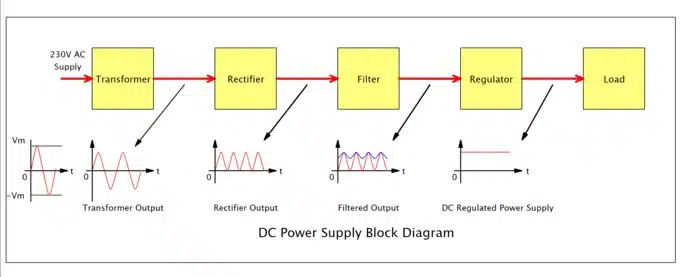
The conversion of alternating current (AC) from power outlets into direct current (DC) for electronic appliances is performed using a DC supply. A sequence of multiple blocks carries out the entire operation, as shown in the diagram above.
DC Supply Components
Power supply DC contains these main elements:
- Transformer
- rectifier
- filter
- regulator
- control circuit
AC Input
According to regional standards, the DC supply machine draws power from an AC power source at 230V or 110V.
Step-down Transformer
According to regional standards, the DC supply machine draws power from an AC power source at 230V or 110V. The transformer converts high-voltage AC to a lower voltage suitable for the operation of electronic equipment. The voltage step-down transformers step down 230V to 12V.
Rectifier
The rectifier function converts standard AC voltage to DC voltage. A bridge rectifier is a standard component consisting of four diodes that enable unidirectional current while generating a pulsating DC voltage.
Filter
The rectifier output maintains electrical ripples on its DC voltage. The DC output voltage becomes more stable because filters, primarily capacitors, eliminate voltage ripple in the system.
Voltage Regulator
A voltage regulator is the final stage that maintains a constant DC output voltage even when the input voltage and load conditions change. The most common voltage regulators used for 5V and 12V operation are the 7805 and 7812, respectively.
DC Output
The cleaned and stable direct-current outlet powers microcontroller sensors and LED lights.
Digital DC Power Supplies
Digital DC supply are contemporary direct current equipment that provide DC output via digital interfaces and displays, enhancing functional accuracy and control capabilities. Digital DC supplies offer improved accuracy and user-friendliness through built-in programmable features, real-time data display, and digital readouts, surpassing the capabilities of traditional analog DC power supplies.
Key Features:
- Digital Control and Display: Real-time voltage, current, and power readings are displayed on an LCD or LED screen, providing a clear view of the DC supply’s performance. Digital controls, whether via buttons or a touchscreen, allow users to adjust voltage and current to precise levels, offering greater accuracy than analog manual knobs.
- Memory Storage: These power supplies have storage capacity that saves pre-programmed settings for faster testing of repetitive experiments.
- Programmability: Through digital interfaces such as USB, RS-232, and Ethernet, users can program voltage and current settings within many digital DC power supplies. When running automated tests in research facilities and technical laboratories, these functions are particularly valuable.
- Data Logging and Monitoring: Advanced models feature built-in data logging capabilities that automatically monitor voltage and current for extended periods, generating records suitable for experiments and long-term testing operations.
- High Precision and Accuracy: Digital DC power supplies achieve high precision and fine control adjustments through enhanced regulation, meeting the needs of exacting applications.
Applications:
- The research laboratory, the electronics testing facility, embedded system development, and automated manufacturing operations all depend on digital DC power supplies.
- Modern electronics and power systems rely on digital DC power supplies because they deliver precise, stable power via their advanced digital interfaces.
Why is DC Power Not Used in Homes?
The electrical power infrastructure for residential homes uses Alternating Current (AC) instead of the widespread electronic application of Direct Current (DC). Worldwide, residential homes use Alternating Current (AC) as their primary electric power distribution standard. DC power is not typically used in households for several reasons.
- Ease of Voltage Transformation: The use of DC power transmission for long distances is limited because simple transformer conversion is not possible.
- Lack of Efficient Transmission: Long-distance DC transmission requires heavy-duty, costly cables to achieve results comparable to those of AC transmission.
- Appliance Compatibility : Household appliances such as refrigerators, washing machines, fans, and lights operate efficiently on alternating current (AC) power.
- Historical and Infrastructural Reasons: The “War of Currents,” which occurred in the latter part of the 19th century, brought victory to AC power, championed by Nikola Tesla and Westinghouse, due to its superior transmission properties compared to Edison’s DC system.
- Safety and Switching: AC fluctuates at 50-60 Hz, allowing safer circuit breaking through switches and breakers. In contrast, DC power flows continuously, which can create prolonged arcs and pose safety risks when switches are opened.
DC Supply Safety and Best Practices
People must always handle DC power supplies with caution, following safety precautions, whether they work in educational or professional fields. Roles that mishandle these devices expose equipment to destruction and people to severe accidents. To maintain operational and security integrity, several essential security procedures must be followed:
General Safety Guidelines:
- The first required step is to read the manufacturer’s instructions, as operating the power supply requires familiarity with its manual.
- The current limit should be adjusted before connecting the device to prevent dangerous overcurrent conditions that could harm components.
- Before using the testing device, verify that its output parameters match the requirements of the device being tested.
- Check for polarity errors, as improper connection sequences can damage electronic components, and double-check the positive and negative terminals.
- Insulated leads should be considered an essential safety precaution to prevent accidents and short circuits.
- Safety first requires you to turn off the power supply before starting any connection process.
Operational Precautions:
- All connectors require secure attachment to stop arcing and disconnection.
- Consider all exposed conductors under supply voltage, and keep tools and hands at a safe distance from them.
- Omni-directional grounding should be performed correctly to reduce electrical noise and boost operational safety.
- A dry, tidy setup minimizes the risk of electrical shock, including the risk of short circuits.
Maintenance and Monitoring:
- Regular inspections will reveal signs of cable or terminal deterioration, corrosion, and physical harm.
- The real-time voltage and current levels of the DC supply should be monitored using the built-in display system and external meters.
- Adding a fuse along with a circuit breaker in a DC supply provides additional protection against short circuits and overloads.
- These practices enable users to use their DC power supplies effectively while following proper safety measures.
Difference Between DC Power Supply and Variable DC Power Supply
The main distinction lies in their output functionality, adjustable control, and varying flexibility between DC power supplies and variable DC power supplies.
| DC Power Supply | Variable DC power supply |
| Provides a fixed DC output. After initialization, the voltage and current values become fixed and cannot be modified. These power supplies are primarily used to power equipment that operates best at a constant, stable direct current voltage. | This supply system allows users to adjust the output voltage and current within a designated range. Tests and powers numerous devices because it provides adjustable power levels, making it suitable for a wide range of devices. |
| DC Power Supplies provide a fixed electric current output without user adjustment. Users cannot modify the specified output because manufacturers establish stable parameters. | This supply provides users with a control device, either manual through dials or electronic via digital interfaces, to set output voltage values and current parameters suitable for different experimental needs. |
| The simple design of the DC Power Supplies keeps its cost relatively affordable, as it functions solely as an output stabilizer. | A variable DC power supplies adds complexity and expense due to output control features, multiple outputs, digital displays, and current-limiting functionality. |
| It is best suited for devices that require a stable power source, particularly electronic systems that require a reliable power supply to operate correctly. | This power supply primarily operates in research facilities. Still, it also supports laboratory inspections and engineering tests, providing adjustable power outputs essential for diverse projects involving component testing and modeling operational environments. |
Conclusion
A DC power supply is an essential device for electrical engineering and electronics applications. Modern electronics rely on these units because they provide a constant DC power source. Currently, these units are used in the testing processes for designing and improving electronic devices. Home electricity relies primarily on AC distribution systems because they offer efficient transmission, but DC power is essential for renewable energy systems, electronic devices, and electric vehicles. Knowledge about the fundamental properties, application areas, and security aspects of DC power supplies is essential information for all technological professionals.
FAQ
-
What is Regulated Power Supply
A Regulated Power Supply (RPS) is an electronic device that provides a constant and stable output voltage or current, regardless of changes in input voltage or load conditions.
-
What is DC Supply
A DC Supply provides Direct Current (DC) electricity, where the flow of electric charge is unidirectional. It’s commonly used to power electronic devices, batteries, and circuits that require a steady and constant voltage.
-
What is Vartech
The term Vartech can refer to: A company specializing in industrial computers and rugged monitors.
-
What is Variable Power Supply
A variable power supply provides an adjustable output voltage or current, allowing users to set the desired level as needed. It is commonly used in testing, prototyping, and powering various electronic devices.
-
What is Adjustable Power Supply
An Adjustable Power Supply allows users to modify the output voltage or current to suit specific requirements.

I am an electrical engineer and also a blogger. I write informative blog posts on topics related to electrical and electronics engineering. If you are interested in these topics, you are welcome to my site to read these articles.