What is Magnetic Flux? Definition, Formula, and Applications
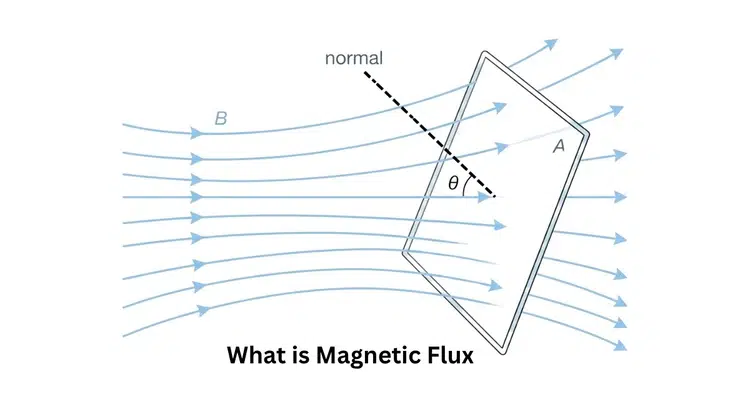
Magnetic flux is the amount of magnetic field passing through a surface. In simple words, it tells us how much magnetic field crosses a given area. This concept is important in physics and electrical engineering because it helps explain how generators, transformers, motors, and electromagnetic induction work.
In this article, you will learn the definition of magnetic flux, its formula, SI unit, diagram, example, and practical applications in a simple and clear way.
What Is Magnetic Flux in Simple Words?
Magnetic flux is a measure of the magnetic field passing through a surface.
Imagine a flat sheet placed inside a magnetic field. If many magnetic field lines pass through that sheet, the magnetic flux is high. If only a few lines pass through it, the magnetic flux is low.
So, magnetic flux helps us measure how strongly a magnetic field interacts with a surface.
Magnetic Flux Definition
Magnetic flux is defined as the total magnetic field passing normally through a given surface.
It depends on:
- the strength of the magnetic field
- the area of the surface
- the angle between the magnetic field and the normal to the surface
Magnetic flux is usually represented by the symbol Φ or ΦB
Magnetic Flux Formula
The formula of magnetic flux is:
Φ = B × A × cos(θ)
Where:
- Φ = magnetic flux
- B = magnetic flux density
- A = area of the surface
- θ = angle between the magnetic field and the normal to the surface
This formula is used when the magnetic field is uniform and the surface is flat.
What Each Term in the Formula Means
Magnetic flux (Φ)
This is the total magnetic field passing through the surface.
Magnetic flux density (B)
This represents the strength of the magnetic field. Its SI unit is tesla (T).
Area (A)
This is the area of the surface through which the magnetic field passes. It is measured in square meters (m²).
Angle (θ)
This is the angle between the magnetic field direction and the normal to the surface.
When Magnetic Flux Is Maximum or Zero
- When θ = 0°, cos 0° = 1, so the magnetic flux is maximum.
- When θ = 90°, cos 90° = 0, so the magnetic flux is zero.
This means magnetic flux is greatest when the magnetic field passes straight through the surface and zero when the field does not pass through it.
SI Unit of Magnetic Flux
The SI unit of magnetic flux is Weber (Wb).
1 Weber = 1 Tesla × 1 square meter
So:
1 Wb = 1 T·m²
In the CGS system, the unit of magnetic flux is Maxwell.
1 Weber = 10⁸ Maxwell
Dimensional Formula of Magnetic Flux
The dimensional formula of magnetic flux is ML²A⁻¹T⁻².
It can be derived from the formula of magnetic flux:
Φ = B × A × cos(θ)
Since cos(θ) is dimensionless, the dimensional formula depends only on magnetic flux density and area.
- The dimensional formula of magnetic flux density B is MA⁻¹T⁻²
- The dimensional formula of area A is L²
So,
[Φ] = [B] × [A] = (MA⁻¹T⁻²) × (L²) = ML²A⁻¹T⁻²
This dimensional formula is useful in physics for checking equations, understanding unit relationships, and solving numerical problems related to electromagnetism.
Magnetic Flux Diagram Explained
A magnetic flux diagram shows magnetic field lines passing through a surface.
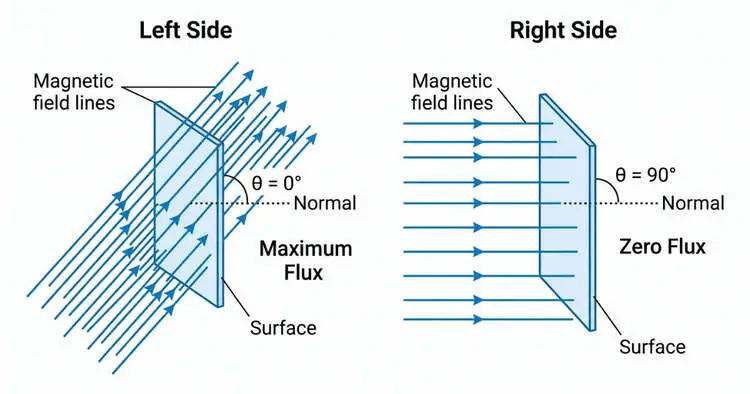
If the magnetic field lines pass directly through the surface, the flux is high. If the surface is tilted, the amount of flux changes. If the field lines are aligned in such a way that none pass through the surface, the flux becomes zero.
This diagram helps students understand why angle matters in the magnetic flux formula.
Magnetic Flux Example
Suppose a uniform magnetic field of 2 T passes through a flat surface of area 0.5 m² at an angle of 0°.
Using the formula:
Φ = B × A × cos(θ)
Φ = 2 × 0.5 × cos(0°)
Φ = 2 × 0.5 × 1
Φ = 1 Weber
So, the magnetic flux through the surface is 1 Wb.
Applications of Magnetic Flux
Magnetic flux is used in many areas of physics and electrical engineering.
1. Electric generators
In a generator, rotating a coil in a magnetic field changes the magnetic flux through the coil. This produces electricity.
2. Transformers
Transformers work on changing magnetic flux between primary and secondary windings.
3. Electromagnetic induction
According to Faraday’s law, a change in magnetic flux induces an electromotive force (EMF).
4. Electric motors
Motors use magnetic fields and changing flux to produce motion.
5. Magnetic circuits
Magnetic flux is also used to analyze magnetic circuits in electrical machines.
Magnetic Flux and Faraday’s Law
Magnetic flux is closely related to Faraday’s law of electromagnetic induction.
Faraday’s law states that when magnetic flux linked with a conductor changes, an EMF is induced in that conductor.
This is the basic principle behind:
- generators
- transformers
- induction coils
- many electrical devices
So, magnetic flux is not just a definition in physics. It is a practical concept used in real electrical systems.
Magnetic Flux vs Magnetic Flux Density
Although these two terms are closely related, they do not mean the same thing. Magnetic flux tells us the total magnetic field passing through a surface, while magnetic flux density tells us how strong the magnetic field is over a unit area.
| Basis | Magnetic Flux | Magnetic Flux Density |
| Symbol | Φ or ΦB | B |
| Formula | Φ = B × A × cos(θ) | B = Φ / A |
| Meaning | Total magnetic field passing through a surface | Magnetic field strength per unit area |
| Depends On | Magnetic field, area, and angle | Magnetic flux and area |
| Use | Measures total magnetic effect through a surface | Measures the strength of the magnetic field |
| Example | Total flux passing through a coil | Strength of the magnetic field at a point |
| SI Unit | Weber (Wb) | Tesla (T) |
| Type of Quantity | Scalar quantity | Vector quantity |
Magnetic flux tells us the total field through a surface, while magnetic flux density tells us how strong the magnetic field is at a point or over an area.
Concepts Closely Related to Magnetic Flux
Magnetic flux is often studied along with a few closely related concepts. Understanding these terms can help you build a stronger foundation in electromagnetism and make topics like electromagnetic induction easier to understand.
Magnetic Flux Density
Magnetic flux density describes the strength of the magnetic field over a unit area. It is represented by B and measured in tesla (T). Since magnetic flux depends on magnetic flux density, students often study these two concepts together.
Magnetic Flux Intensity
In some basic explanations, the term magnetic flux intensity is used informally for the strength of the magnetic field. However, in most physics and engineering contexts, magnetic flux density is the more accurate and commonly used term. We will discuss this subject separately and in detail.
Electric Flux and Magnetic Flux
Electric flux and magnetic flux are similar in mathematical form because both describe how a field passes through a surface. However, electric flux is related to an electric field, while magnetic flux is related to a magnetic field. Because both concepts are important in electromagnetism, they are often compared side by side.
Dimensional Formula of Magnetic Flux
Students preparing for exams may also need the dimensional formula of magnetic flux. While it is related to this topic, it is usually better explained separately so that the main concept of magnetic flux remains simple and easy to understand.
Conclusion
Magnetic flux is a basic but very important concept in physics and electrical engineering. It measures how much magnetic field passes through a surface and depends on the magnetic field strength, area, and angle. Understanding magnetic flux makes it easier to learn electromagnetic induction, generators, transformers, and many related topics.
FAQ
What is magnetic flux?
Magnetic flux is the amount of magnetic field passing through a surface.
What is the formula of magnetic flux?
The formula of magnetic flux is:
Φ = B × A × cos(θ)
What is the SI unit of magnetic flux?
The SI unit of magnetic flux is Weber (Wb).
What does magnetic flux depend on?
Magnetic flux depends on the magnetic field strength, the area of the surface, and the angle between the field and the surface normal.
Where is magnetic flux used?
Magnetic flux is used in generators, transformers, motors, electromagnetic induction, and magnetic circuits.

I am an electrical engineer and also a blogger. I write informative blog posts on topics related to electrical and electronics engineering. If you are interested in these topics, you are welcome to my site to read these articles.