Electric Fuse: Working Principle, Types, and Characteristics
Can you tell me which component is used to protect the electrical circuits and devices in the house we live in? While many components are used for protection these days, the one we are talking about is cheaper than others. Yes, we are talking about the electric fuse—a simple yet highly effective safety device that has been safeguarding our homes and appliances for decades. This article will provide you with complete information about electrical fuses.
What is Electric Fuse
What is a fuse? Engineers and electricians know this, but should everyone be aware of this information? Today, fuses are used in every home, which shows how important they are. A fuse is a safety device that protects electrical circuits and devices. A fuse consists of a metal wire, also called a fuse wire. When the current flowing through the circuit exceeds a specific limit, this fuse element heats up and melts, breaking the circuit.
A fuse is connected in series with the circuit to prevent excessive current during a fault. The fuse wire is made up of copper, silver, or an alloy of lead and tin, as these are low-melting-point materials suitable for fuse devices.
Typically, lead, tin, and zinc are used as fuse materials. However, a good fuse element should possess specific properties such as a low melting point, low ohmic loss, electric resistance to deterioration, high conductivity, and low resistivity. Now, all these properties are not found together in any single fuse element. For example, a lead element has a low melting point but a high specific resistance. A copper element has high conductivity but is also expensive and oxidises quickly.
In circuits carrying 15 A, lead-tin alloy fuse elements are commonly used. This alloy typically contains 40% lead and 60% tin, making it ideal for low-current applications. For circuits carrying more than 15 A, various types of fuses are used.
Working Principle of Electric Fuse
Before understanding how an electric fuse works, let’s consider a related concept. A candle gives us light by burning; similarly, a fuse protects the circuit and the devices connected to it by melting. It shows that an electrical fuse works on the heating effect of current. The fuse element is designed to protect the circuit by allowing normal current to pass through without melting.
During this process, the heat generated in the fuse remains below its melting point. At the same time, current flows normally, and the heat generated in the fuse wire is dissipated into the surrounding environment. However, when the circuit current becomes exceed safe levels, the fuse element heats up and melts, interrupting the flow of electricity. This way, the appliances in the circuit are protected from damage.
Now you might be wondering how long it takes for a fuse to blow and break the circuit. It depends on the magnitude of the excessive current. The higher the current, the faster the fuse wire will melt. That’s why fuse wires have an inverse time characteristic.
History of Electrical Fuse
In the 19th century, the commercial use of electricity began to revolutionise the lives of ordinary people. However, at this time, electrical systems faced constant challenges due to frequent short-circuits and overload fires. To address these problems, Thomas Edison invented the fuse during the 1890s.
At that time, the fuse design was quite simple, using a thin wire or strip. In the 20th century, it became widely used in industrial and commercial applications. Gradually, fuse design improved, leading to the development of types such as cartridge and rewirable fuses.
Construction of Fuse
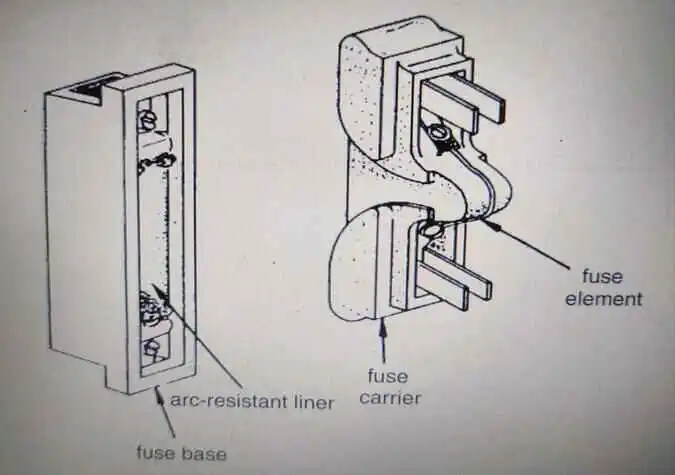
A fuse is connected in series with a light circuit to protect any circuit or appliance. The fuse continuously monitors the current flowing through the circuit. As soon as the current exceeds the fuse’s rating, the fuse blows, breaking the circuit and interrupting the current flow. The construction of a fuse is quite simple; here, you will learn about all the components used in its construction in detail.
Fuse Element
- It is the central part of the fuse, which plays a crucial role.
- It is a thin strip of metal wire called a fuse wire.
- It is made from specific materials such as tin, copper, silver, and aluminium, depending on where it will be used.
- This element heats up due to an abnormal current and melts, interrupting the circuit current and thus protecting the devices.
Fuse Body
- The fuse body is an insulating material that covers the fuse element.
- The insulation of the fuse body is designed so that neither heat nor electricity can pass through.
- The fuse body also provides support to the end terminals on both sides.
- Another key feature of the fuse body is its transparency, which makes it easy to determine whether the fuse has blown.
- The fuse body is mainly made of ceramic, glass, bakelite, or plastic.
End Terminals
- The end terminals are connected to both ends of the fuse element.
- The fuse is connected to the circuit through these end terminals.
- These are made of copper, brass, or gunmetal, which are good conductors.
Filler Material
- This special material used inside the fuse is made of quartz sand or silica.
- This is an optional material that is used in some specific types of fuses.
- It absorbs the heat by controlling the arc when the fuse element blows.
Fuse Symbol
The symbol for a fuse is typically a drawing of an electrical fuse. This symbol indicates the location of the fuse in a circuit diagram.
- Rectangular shape: Fuses are represented by a rectangle or square shape with a diagonal line inside, which indicates the fuse element.
- Cylindrical shape: In some cases, the fuse is also depicted in a cylindrical shape.
Electric Fuse Diagram
An electric fuse diagram is a complete circuit diagram that shows how a fuse is incorporated into a real-world circuit. This diagram illustrates how the fuse is installed in an electrical circuit and how it provides overcurrent protection. An electrical fuse diagram shows several appliances connected, such as:
- Power Source (Battery): The power supply that provides energy to the circuit.
- Fuse: A fuse is connected in the circuit and is represented by a fuse symbol.
- Load (Appliance): The device that consumes power (e.g., a bulb, fan, etc.).
- Connections (Wires): Wires that connect the power source, fuse, and load.
Charecteristics of Fuse
Fuse wires are generally used in high voltage up to 66 KV and low voltage up to 220 V. To understand the design, working principle, and applications of a fuse, it is essential to understand its characteristics. The characteristics of a fuse indicate how the fuse will function and in what type of circuit it will be used.
Current Rating
- The current rating of an electrical fuse is the maximum current it can continuously carry without being damaged. When the current exceeds this limit, the fuse blows.
- The circuit’s load determines a fuse’s current rating. If the current flowing through the circuit exceeds the current rating, the fuse element melts due to the heat generated.
Example: A 20-amp fuse will only allow a current of up to 20 amps to pass safely. If the current exceeds 22 amps, the fuse will blow. If the wrong current rating is selected, the fuse will either blow prematurely or fail to protect the circuit.
Voltage Rating
- The voltage rating of a fuse is the maximum voltage at which the fuse can operate safely.
- The voltage rating ensures the fuse can control electrical arcing in the event of high voltage.
Example: If a fuse has a voltage rating of 250V, it can be used in circuits up to 250V. If it is installed in a 400V circuit, the fuse will fail. It is essential to match the fuse’s voltage rating to the circuit’s operating voltage; otherwise, it will not blow.
Breaking Capacity
- The breaking capacity of a fuse is the maximum fault current that the fuse can safely interrupt without being damaged.
- When a short circuit or overcurrent occurs in the circuit, the fuse breaks the circuit at that current level. The breaking capacity ensures that the fuse can safely handle high fault currents.
Example: If a fuse has a breaking capacity of 10kA, it can safely interrupt fault currents up to 10,000A. High-breaking-capacity fuses are used in circuits with high fault currents, such as in industrial and power distribution systems.
Fusing Current
- The fusing current is the minimum current required to melt the fuse element.
- The fusing current is always greater than the fuse’s rated current.
Fusing Current Formula
The fusing current is calculated based on Preece’s law.
Where
- If = Fusing current is the minimum current required to melt the fuse element. Its unit is Ampere (A).
- (k): Material Constant, which depends on the properties of the fuse element material, such as resistivity, melting point, and thermal conductivity. Each material has a different value of (k).
- (D): Diameter of the fuse element. Its unit is millimetres (mm) or centimetres (cm). The larger the diameter, the higher the fusing current.
- (n): The exponent (constant) typically has a value between 1.5 and 2. It depends on the fuse element’s material and its heat-dissipation properties.
Example: If the rated current of a fuse is 10A, its fusing current can range from 12.5A to 15A. The fuse current needs to be accurate so the fuse functions correctly in the event of an overload or short circuit.
Fusing Factor
The fusing factor is an important concept that defines the design and performance of fuse protection devices. The fusing factor indicates how much excess current a fuse can handle before it blows. The fusing factor is a ratio between the fuse’s rated current (normal operating current) and the fusing current. This factor represents the strength and current-carrying capacity of the fuse.
Fusing Factor Significance
- The higher the fusing factor, the more excess current the fuse can handle without damage. This means there will be a greater safety margin in the system.
- If a fuse has a low fusing factor, it can blow quickly, which is essential in short-circuit or overload situations. This helps protection devices respond faster.
Prospecting Current
The basic function of a fuse is to protect the system when there is a current overload. For example, if your appliance draws too much current (an overload condition), the fuse tries to handle that extra current. The prospecting current is the limit up to which the fuse can handle an overload for a short period without blowing. If the current increases slightly beyond this, the fuse performs its protective function and melts.
Example: Let’s say a fuse has a rating of 10 A. If the fuse’s prospective current is 1.25 times the rated current, it means the fuse will safely handle a current up to 12.5 A without tripping. When the current exceeds 12.5 A, the fuse will break and protect the circuit.
Importance of Prospecting Current:
- When the current is slightly higher than normal (overload situation), the fuse has some time to handle it. But when the overload is very high, the fuse will start to trip.
- If the prospecting current is higher, the fuse will not trip unnecessarily due to temporary high currents, such as the momentary surge when a motor starts. This is a normal condition that the fuse can handle.
Calculation of Prospecting Current:
Let’s say a fuse has a rated current of 10 A, and the prospective current is 1.25 times that. In this case:
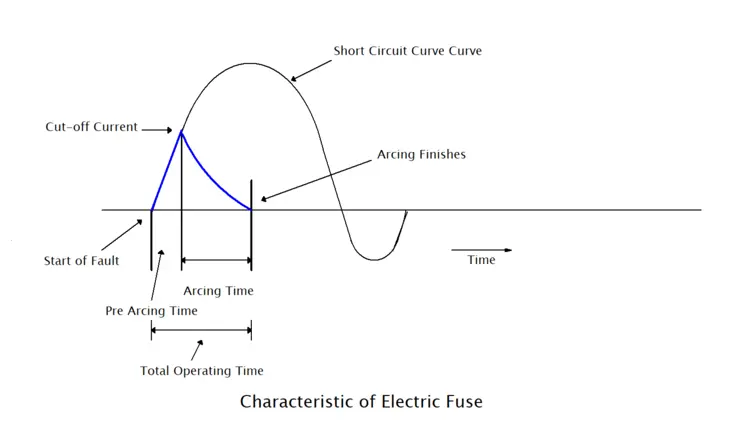
Cut-Off Current
The fuse’s cut-off current is an important concept. This current level is the point at which the fuse is designed to carry current safely. When the current exceeds this cut-off level, the fuse melts to protect the circuit.
Example: Let’s say a fuse has a rated current of 10 A. If the current exceeds 10 A (due to overload or short-circuit), the fuse performs its function and breaks the circuit to cut off the current. When the current is around 10 A, the fuse works normally. When the current exceeds 10 A, it crosses the fuse’s cut-off current, and the fuse trips, thereby protecting the circuit.
Calculation of Cut-Off Current:
The cut-off current is determined by the fuse’s design and rating. The cut-off current is determined by the fuse’s design and rating. For example, if a fuse has a rated current of 10 A, the cut-off current could be 12 A or even 15 A, depending on the fuse type (slow-blow or fast-acting).
- If the fuse has a low cut-off current, it will trip quickly when an overload or short-circuit situation occurs.
- If the cut-off current is high, the fuse will have a chance to tolerate the overload for a short time before tripping.
Time-Current Characteristics
These characteristics indicate how a fuse will react when the circuit current exceeds its rating. This is in the form of a “time-current characteristic curve,” which is a graph showing time (on the horizontal axis) and current (on the vertical axis). Understanding this curve helps you determine how quickly the fuse will cut off current in the event of a short circuit or overload.
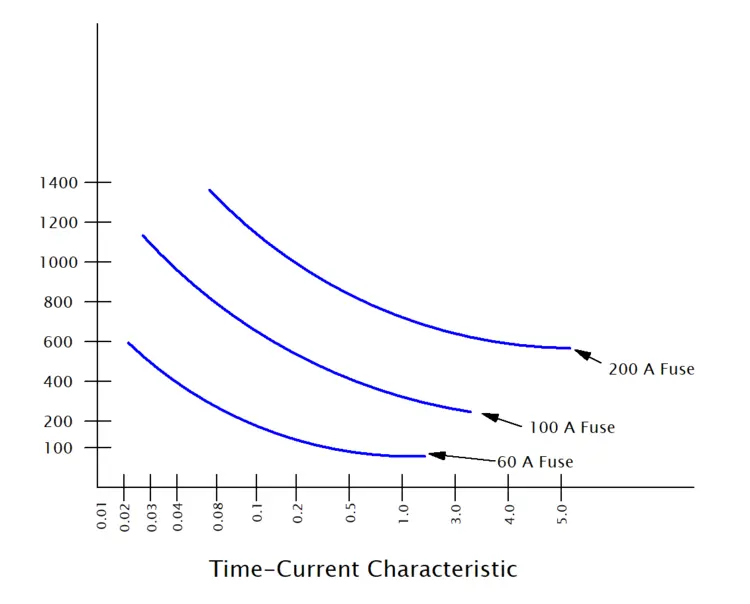
- If the current exceeds a normal level, the fuse takes some time to cut off the current.
- If the current is very high, like in a short circuit, the fuse quickly cuts off the current. If there is an overload, it will take a little time to avoid disturbing normal operation, and then it will cut off the current.
Example: If the fuse’s time-current characteristic curve shows that at 10 times the rated current, the fuse blows after 10 seconds, then if the current increases to 10 times the rated value, the fuse will break the circuit within 10 seconds.
In this way, time-current characteristics define a fuse’s performance and determine how long it can withstand excess current without being damaged.
Temperature Characteristics
The functioning of a fuse depends on temperature, because high temperatures can cause the fuse element to melt quickly. In areas with high ambient temperatures, the fuse rating is set slightly lower to ensure it operates correctly.
Example: If a fuse is rated at 10A and the ambient temperature is high, the fuse might blow at just 8A. The fuse material and design are manufactured with temperature effects in mind.
Pre-Arcing Time
Pre-working time is related to the operation of the fuse protection. Pre-arcing time is the time elapsed after the current exceeds the fuse’s rating but before the arc (short circuit) starts. In other words, when a fuse is in an overload condition, it first builds up heat and pressure for a short period, then melts to create an arc (spark).
Calculation of Pre-Arcing Time
The pre-arcing time is calculated based on the fuse design, material, and overload conditions. Let’s say a fuse has a rated current of 10 A and, in a short-circuit condition, a pre-arcing time of 0.01 seconds. This means that if the current flow exceeds 10 A, the fuse will melt and interrupt the circuit within 0.01 seconds, thus protecting the circuit.
Arcing Time
During arcing, the fuse element melts, and the electric current forms an arc (electric spark).
- When a fuse is overloaded or short-circuited, its element starts to heat up. This heat is generated by excess current flowing.
- As the current increases, the fuse element begins to melt.
- When the fuse element melts, the flow of current is suddenly interrupted, and an arc (spark) is formed.
Total Arcing Time
Total operating time is the total time it takes for the fuse to operate. This is made up of the fuse’s pre-arcing time and arcing time combined.
Total arcing time = pre arcing time + arcing time.
Electric Fuse Type
There are many types of fuses, used for different applications and protection requirements. Fuses are categorised by design, size, and current rating. Here are some common types of fuses:
- Wire Fuse
- Cartridge Fuse
- Blade Fuse
- Thermal Fuse
- Time-Delay Fuse (Slow-Blow Fuse)
- High Rupturing Capacity Fuse (HRC Fuse)
- Resettable Fuse
Difference between Electric Fuse and Circuit Breaker
Both electric fuses and circuit breakers are used as electrical protection devices, and both serve the same purpose: fault protection. However, their working principles, designs, and applications differ. There are several differences between fuses and circuit breakers; let’s understand them point by point:
| Electric Fuse | Circuit Breaker |
| A fuse is a one-time protection device that melts automatically when the current limit is exceeded, breaking the circuit connection. | A circuit breaker is an automatic device that breaks the circuit when current exceeds its rating or a short circuit occurs. It is resettable and can be used repeatedly. |
| The operation of a fuse is a time-dependent process. As soon as the current exceeds the limit, the fuse wire melts, disconnecting the circuit. | A circuit breaker operates using a mechanical or electromagnetic mechanism. If there is a current overload, the circuit breaker automatically trips and opens the circuit. |
| A fuse is a one-time-use device. When a fuse melts, it needs to be replaced; it cannot be reset. | A circuit breaker is resettable. When an overload or short circuit occurs, you can manually reset it. |
| Fuses are generally cheaper and are used for low-cost protection. | Circuit breakers are more expensive because they are resettable and provide a long-term solution. |
| A fuse melts quickly if there is a current overload, but not as fast as a circuit breaker. | Circuit breakers trip quickly and break the circuit rapidly in overload conditions. |
| A fuse typically provides thermal protection. If the current becomes too high, the fuse wire melts due to the heat. | A circuit breaker can be designed for both thermal and electromagnetic protection. It is ideal for both short-circuit and overload conditions. |
| Fuses are generally small and simple in design. | Circuit breakers are comparatively larger and more complex devices. |
| A fuse is mostly used in low-voltage circuits, household appliances, and small electrical devices. | Circuit breakers are used in more complex electrical systems, including industrial applications, power distribution panels, and residential electrical circuits. |
Advantages of Fuse
- Does not require any maintenance.
- The cheapest way to get protection.
- Operation is entirely automatic.
- Operates in both short-circuit and overload conditions.
- Simple and reliable.
- Replacement process is very easy.
Disadvantages of Fuse
- Fuse replacement is done manually, which takes more time.
- The protection of the whole circuit depends on this one fuse. If it fails for any reason, the entire circuit gets damaged.
Conclusion
An electric fuse is an important safety device that protects electrical circuits from overcurrents (excessive current). A fuse works by melting its internal wire or metal element when the current flowing through it exceeds a predetermined limit, thereby breaking the circuit and preventing further damage. Fuses have a limitation: once they melt, they need to be replaced. It can be inconvenient in some situations. Nevertheless, for simple applications that require low cost and straightforward protection, fuses remain an ideal choice.
FAQ
What is the lifespan of a fuse?
The lifespan of a fuse typically depends on its usage. If a fuse is used under normal conditions, its lifespan can be indefinite. However, whenever a fuse experiences an overload or a short circuit, it blows and needs to be replaced. Therefore, a fuse’s lifespan depends on the current load and circuit conditions.
Can the fuse be repaired?
No, a fuse cannot be repaired. When a fuse blows, it needs to be replaced because it is designed for one-time use. Repairing a fuse can be unsafe, so replacement is the best option.
What is a fuse price range?
Typical electric fuse price range (general, varies by type & place):
- Basic small fuses: ~₹10 – ₹100 (India) / ~€0.50 – €2 (Europe)
- Cartridge/automotive fuses: ~₹50 – ₹300 / ~€1 – €5
- Specialty fuses (HRC, time‑delay): ~₹200 – ₹1000+ / ~€5 – €15+
What is the Rating of Fuse Wire
- 1A to 5A → Use small appliances ( lights, fans, chargers)
- 6A to 15A → Use medium appliances ( TVs, refrigerators)
- 16A to 30A → Use heavy appliances ( air conditioners, heaters)
- Above 30A → Use industrial and high-power circuits.

I am an electrical engineer and also a blogger. I write informative blog posts on topics related to electrical and electronics engineering. If you are interested in these topics, you are welcome to my site to read these articles.