What is Voltage Regulation and their types
Have you ever noticed your lights flickering during a storm or worried about a power surge damaging your laptop or computer? These common concerns highlight the critical role of stable electricity in our daily lives. From the smartphone in your hand to the complex machinery in a factory, every electronic device is designed to operate within a specific voltage range. Without voltage regulation, a stable, reliable power supply is not just a convenience; it is also essential for protecting sensitive electronics, ensuring their proper functioning, and extending their lifespan. This unseen force ensures that your appliances and gadgets perform reliably and safely, making it a fundamental pillar of modern electrical systems.
What is Voltage Regulation?
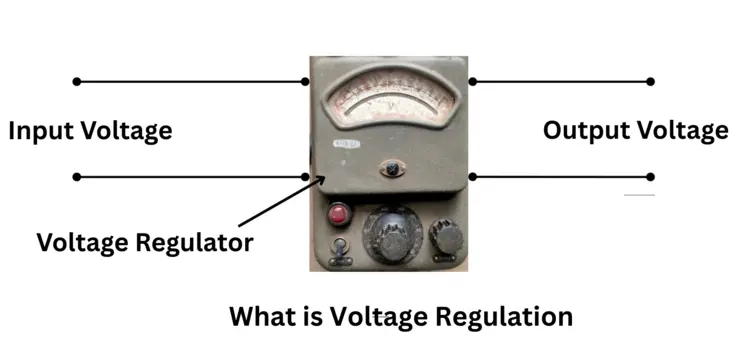
To understand voltage regulation, it helps us to first think about home plumbing. Imagine you are taking a shower, and the water pressure is perfect. Suddenly, someone flushes the toilet or turns on the kitchen sink. Water pressure in your shower drops, making your experience unpleasant. However, if your home had a magical system that instantly adjusted the flow to keep your shower pressure the same, no matter what else was happening in the house, that would be called “regulation.” Similarly, electricity has voltage regulation.
Voltage regulation is essentially that magical system for electricity.
The Basic Definition
In technical but simple terms, voltage regulation is the ability of an electrical system to maintain a fixed voltage level despite changes in input power or the load (devices) connected to it.
Electricity delivered to our homes and businesses isn’t always perfectly steady. It can fluctuate due to storms, high demand on the power grid, or issues at the power plant. Similarly, when you turn on a heavy appliance like an air conditioner or a vacuum cleaner, it draws a sudden surge of power, which can momentarily drop the voltage available for other devices.
A voltage regulator acts like a gatekeeper. Its job is to take this fluctuating, sometimes unstable input voltage—often caused by voltage variations—and convert it into a stable, constant output voltage that your electrical and electronic devices can work safely.
Electricity Voltage Regulation: Cruise Control Like Car
Think of voltage up and down like the cruise control feature in a car, where fluctuations are controlled to maintain a steady speed. When you set your cruise control to 60 mph, you expect the car to stay at that speed. However, the road isn’t always flat.
- When Going uphill: The engine has to work harder to maintain speed.
- When Going downhill: The engine eases off to prevent the car from speeding up.
In this scenario, the “speed” is the voltage. The “hills” represent changes in electrical demand (load) or changes in the power supply. A voltage regulator automatically detects these “hills” and adjusts the energy flow instantly—adding a boost when voltage dips and trimming it back when voltage spikes—so your electronic devices always “drive” at a safe, steady speed.
Why Does Voltage Control Concept Matter?
Most modern electronics are incredibly sensitive. Your computer, television, and smartphone charger are designed to operate within a very specific voltage range. If the voltage drops too low (a “brownout”), the device might shut down or struggle to run, potentially causing data loss. If the voltage spikes too high (a “surge”), it can overheat the internal components and permanently fry the device. Load regulation bridges the gap between the chaotic nature of the power grid and the delicate needs of your electronics. It ensures that whether the power company is sending too much or too little electricity, your devices receive precisely what they need to function smoothly and last longer.
Why Voltage Regulation is Important
In our modern world, we rely on a constant stream of electricity to power everything from our morning coffee maker to the servers that run the internet. We often take this power for granted, simply plugging in our devices and expecting them to work. However, the quality of that power is just as significant as its availability. This is where voltage regulation plays a critical role, acting as a silent guardian for all our electrical and electronic equipment.
Ensuring a Stable Power Supply for Devices
Imagine trying to read a book while someone is constantly dimming and brightening the lights. It would be frustrating and nearly impossible to focus. Your electronic devices feel the same way when they receive an unstable power supply. A consistent voltage is essential for them to perform their tasks correctly. Voltage stabilization is the process of ensuring this consistency. Without it, a device might malfunction, reset unexpectedly, or fail to operate at all.
Effective voltage control also involves managing how the system responds to changes in demand. This is where load regulation becomes crucial. When you turn on a power-hungry appliance, such as an air conditioner, the circuit’s total electrical load increases. A well-performing system maintains a steady voltage for connected devices, preventing dips in performance and ensuring everything runs smoothly.
Protecting Sensitive Equipment from Voltage Fluctuations
The most vital function of voltage regulation is protecting delicate electronics. The power grid is susceptible to various disturbances that cause voltage fluctuations, leading to either a surge (a sudden increase in voltage) or a sag (a sudden voltage drop). These events can be catastrophic for sensitive equipment like computers, smart TVs, and medical devices.
A sudden voltage spike can instantly overload and fry internal components, rendering a device useless. Conversely, a sustained drop in voltage can cause components to work harder than they should, leading to overheating and premature failure. A dedicated voltage controller acts as a gatekeeper, shielding your equipment from this electrical chaos. It absorbs the impact of any voltage fluctuation, ensuring that only a clean, safe, and steady stream of power reaches your valuable electronics. This protective measure is the difference between a device that lasts for years and one that fails unexpectedly.
Enhancing Efficiency and Lifespan of Electrical Systems
Every electrical device is designed to operate most efficiently at its specified voltage. When the voltage is too high or too low, the device is forced to operate outside its optimal range. This not only wastes energy but also puts unnecessary stress on its internal parts.
By maintaining a constant voltage, regulation allows devices to run at peak efficiency. This means they consume less power to perform their functions, which can lead to lower electricity bills. Furthermore, this stable operating environment reduces wear and tear on motors, circuits, and other components. By preventing the strain caused by constant-voltage fluctuation, effective voltage control significantly extends the lifespan of your appliances and electronic systems, saving you money on repairs and replacements in the long run.
Voltage Regulation Formula
The formula for Voltage Regulation is used to measure the change in voltage from no-load to full-load conditions in electrical systems like transformers or alternators. It is expressed as a percentage and calculated as:
Types of Voltage Regulation
When we talk about keeping electricity stable, it’s not just about fixing one single problem. Voltage regulation addresses two very different challenges: changes from the power source and changes from devices that consume power. Understanding these two types—Line Regulation and Load Regulation—is key to mastering effective voltage management in any electrical system.
Line Regulation: Handling Input Changes
Line regulation measures a system’s ability to maintain a constant output voltage despite changes in the input voltage.
Think of the power coming from the primary grid or a battery. It is rarely perfect. A battery loses charge over time, causing its voltage to drop. The power grid might fluctuate during a storm. Line regulation ensures that these external fluctuations don’t reach your sensitive electronics. It acts as a shield, providing precise voltage control by filtering out the chaos from the source.
Suppose the input voltage jumps from 110V to 120V. In that case, a system with good line regulation will keep the output steady at exactly 5V (or whatever the target is), ensuring effective power regulation regardless of how unstable the source becomes.
Load Regulation: Handling Demand Changes
Load regulation measures a system’s ability to maintain a constant output voltage despite changes in load (the amount of current drawn by connected devices).
Line regulation looks at the “supply” side, while load regulation looks at the “demand” side. Imagine you are charging your phone, and suddenly you plug in a tablet and a laptop into the same power strip. The system’s demand (load) has just tripled. Without proper regulation, this sudden demand could cause the voltage to sag (drop), potentially resetting your devices.
Good load regulation ensures that the voltage regulator adjusts instantly to this increased demand, keeping the voltage steady whether the system is idling or running at full capacity.
How Voltage Regulation Works
Have you ever wondered why your lights don’t flicker every time the air conditioner turns on? The answer lies in voltage regulation, an advanced process that works continuously behind the scenes. Although this concept may seem complicated, its primary function is simple: to control unpredictable electricity and provide a smooth, stable supply to your devices. Let’s understand how this essential process works.
The Working Principle
At its heart, voltage regulation is a dynamic balancing act. The goal is to take an unstable input voltage, which can fluctuate due to grid issues or changes in demand, and produce a constant, reliable output voltage. The system continuously monitors the electricity flowing out and compares it to a predetermined, ideal voltage level.
If the output voltage starts to drift too high or low, a phenomenon often described as voltage up or down, the regulation circuit immediately takes action. It makes a precise voltage adjustment to counteract the change, either boosting or reducing the voltage. This happens so quickly that, for the end user, the power appears perfectly steady, preventing issues such as light fluctuation and protecting sensitive electronics.
Components of Voltage Regulator
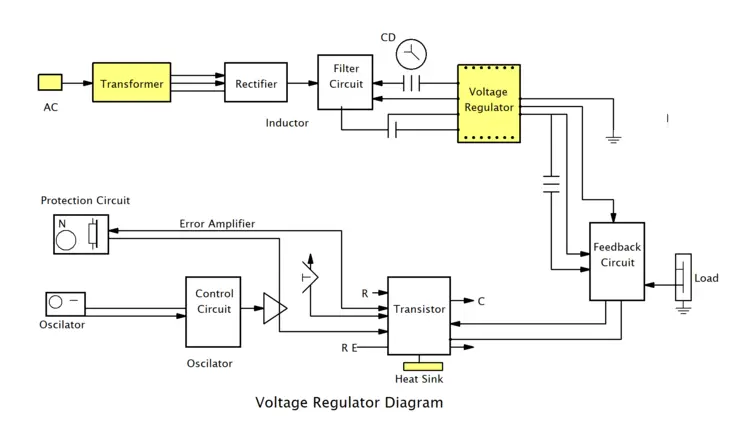
A single component cannot achieve voltage regulation, but a team of components working together can. Although designs vary, most systems rely on a few key elements:
- Transformers: These are often the first line of defense. A transformer can step the voltage up or down to a more manageable level before the fine-tuning process begins. In some regulators, tapped transformers allow the system to switch between different coils to make coarse voltage adjustments.
- Rectifier: Rectifier: A rectifier is an electronic component used to transform alternating current (AC) into direct current (DC). It is an essential part of voltage regulation systems used in power supply circuits. The main types of rectifiers are: Half-Wave Rectifier, Full-Wave Rectifier, and Bridge Rectifier.
- Filter circuit: A filter circuit is an electronic circuit that removes ripples (voltage fluctuations) from the output of a rectifier, providing a smooth DC voltage. This circuit consists of capacitors, inductors, or a combination of both, which block AC components and allow only DC components to pass through. Common filter types include RC, LC, and Pi filters. Its function is to ensure a stable and ripple-free DC voltage in power supply circuits.
- Zenor diode: A Zener diode is a special-purpose diode that operates in reverse bias mode and breaks down at a fixed voltage (Zener voltage). It is used for voltage regulation and to provide a reference voltage. It is also used for overvoltage protection and to ensure a stable DC output.
- Regulators (The Brains): The voltage regulator integrated circuit (IC) or controller is the core of the operation. It contains the reference voltage and the logic needed to make decisions. It’s the component that actually executes the voltage control strategy.
- Capacitors: Think of capacitors as small, ultra-fast batteries. Input capacitors help smooth out ripples and noise from the power source. Output capacitors provide a temporary reservoir of energy, helping to handle sudden changes in demand. This is particularly important for good load regulation, as the capacitor can supply instant current while the regulator adjusts to a heavy new load.
- Inductor: An inductor is a passive component that stores energy in the form of a magnetic field as electric current passes through it. It is used to filter AC signals, smooth out current, and transfer energy in switching power supplies. The function of an inductor is to oppose sudden changes in current and provide stability in a circuit.
- Amplifier: An error amplifier is a high-gain operational amplifier that detects and amplifies the difference (error) between the reference voltage and the output voltage. Its function is to process the feedback signal in a voltage regulator and provide a control signal to adjust the pass element, thereby maintaining a stable output voltage.
- Feedback circuit: A feedback circuit is a system that continuously monitors the output voltage and feeds its signal to an error amplifier. Its function is to detect the difference between the output voltage and the reference voltage and help adjust the voltage regulator so that the output voltage remains stable and at the desired level.
- Protection circuits: Protection circuits prevent voltage regulators and connected devices from being damaged. These circuits protect the system from issues such as overvoltage, overcurrent, and overheating.
- Oscillator: An oscillator is an electronic circuit that generates continuous periodic waveforms (such as sine waves, square waves, etc.) without any external input. It is used to generate AC signals, provide clock signals, and in high-frequency switching circuits (such as inverters and SMPS).
- Heat sink: A heat sink is a thermal device that absorbs and dissipates heat from electronic components (such as transistors and voltage regulators) to prevent them from overheating and ensure they operate efficiently. It is typically made of metal (usually aluminium or copper) and transfers heat to the surrounding environment. Heat sinks are used for thermal management in high-power circuits.
- Switching Elements (Transistors): In modern regulators, transistors (like MOSFETs) act as high-speed switches. They can turn on and off thousands of times per second to precisely chop and reform the electrical signal, enabling highly efficient voltage adjustment.
Working Mechanisms
The key to precise and automatic voltage control is the feedback mechanism. It is a closed-loop system that continuously monitors its own performance to ensure accuracy. Here’s how it operates:
- Sampling: A portion of the output voltage is “sampled” by a resistor network. This sample is a proportional representation of the actual output.
- Comparison: The sampled voltage is fed into a comparator (or error amplifier) inside the voltage controller. The comparator’s other input is connected to a highly accurate, stable internal reference voltage.
- Correction: The comparator looks at the difference (or “error”) between the sampled voltage and the reference voltage. If the output voltage is too high, the comparator sends a signal to the control element (like a transistor) to reduce it. If the output is too low, the control element signals a boost.
This feedback loop of sampling, comparing, and correcting happens continuously and almost instantaneously. It’s this constant vigilance that allows a regulator to respond immediately to any voltage up or down event, whether it’s caused by a power fluctuation from the grid or a change in the electrical load, ensuring your devices always receive the clean power they need.
Methods of Voltage Regulation
Controlling voltage is crucial to ensuring the safety and efficiency of any electrical system. Some methods used to achieve this stability range from simple, manual adjustments to advanced, automated systems. The two primary methods are Manual Voltage Regulation and Automatic Voltage Regulation (AVR).
Manual Voltage Regulation
Manual voltage regulation is the basic method of voltage control. It involves a human operator physically adjusting the equipment to maintain the desired voltage level. In this method, a human operator monitors a voltmeter and, when the voltage drifts outside the acceptable range, manually turns a dial, flips a switch, or moves a lever.
This action physically changes the transformer’s configuration to either increase or decrease the output voltage. While cost-effective and straightforward for specific applications, this method is slow, imprecise, and requires constant supervision. It is primarily found in laboratory settings, test benches, or older industrial plants where instantaneous adjustments are not critical.
Automatic Voltage Regulation (AVR): Smart and Seamless Control
Automatic Voltage Regulation, or AVR, is a far more advanced and reliable method used in virtually all modern applications. An AVR system uses a dedicated voltage controller to monitor and automatically adjust voltage levels without human intervention.
How Does an AVR Work?
An Automatic Voltage Regulator works on a feedback loop principle.
- Sensing: The AVR continuously senses the output voltage.
- Comparing: It compares this real-time voltage to a stable, pre-set reference voltage.
- Adjusting: If there is a difference between the actual and reference voltages, the AVR control circuitry immediately sends a signal to its internal components (such as transistors, relays, or tap-changing mechanisms) to correct the difference.
This process happens in milliseconds, ensuring the output voltage remains incredibly stable even with fluctuating input power or changing load conditions.
Advantages of AVR:
- Speed: AVRs react almost instantly to voltage changes, offering superior protection.
- Precision: They provide highly accurate voltage control, keeping the output within a very tight tolerance.
- Reliability: By automating the process, they eliminate the risk of human error and the need for constant monitoring.
- Efficiency: They ensure devices run at their optimal voltage, improving efficiency and extending their lifespan.
Devices and Technologies for Voltage Regulation
Ensuring a stable power supply is challenging, but in the modern era, it is achieved through specialized devices and advanced technologies. From the tiny components inside your phone charger to the large systems that manage a city’s power grid, these tools are crucial to effective voltage control. They play a vital role in regulating unpredictable power fluctuations and protecting our valuable electronics. Let’s explore some of the most essential devices and technologies used in voltage regulation.
Voltage Regulators (Linear and Switching)
Voltage regulators are the fundamental building blocks of modern electronics. These are typically small integrated circuits (ICs) designed to provide a precise and steady output voltage. They are found in almost every electronic device. There are two main types:
- Linear Regulators: These are the simplest form of voltage regulator.
- Switching Regulators: These are more complex and much more efficient.
Uninterruptible Power Supplies (UPS)
An Uninterruptible Power Supply (UPS) is a comprehensive power protection device that goes beyond simple regulation. Its primary job is to provide backup power from a battery during a complete outage. However, most modern UPS systems also offer excellent voltage regulation. They act as a buffer between the wall outlet and your sensitive equipment, like computers and servers.
Stabilizers and Transformers
Stabilizers and transformers were the most commonly used voltage regulation devices in the old days.
- Voltage Stabilizers: Commonly used for home appliances like refrigerators and air conditioners, a stabilizer is designed to handle a wide range of input voltage fluctuations.
- Constant Voltage Transformers (CVTs): These transformers use a special design that automatically provides a stable output voltage over a wide range of input voltages. They utilize the principle of ferroresonance to automatically regulate power.
Smart Grid Technologies for Voltage Regulation
Smart grid technologies represent a revolutionary approach to large-scale voltage management. Using a network of sensors, automated switches (reclosers), and advanced control systems, utilities can obtain a real-time view of voltage levels across the entire grid. If they detect voltage drops in one neighborhood due to high demand, they can automatically reroute power or adjust output at a substation to compensate. This centralized, intelligent approach not only improves power quality for everyone but also enhances grid efficiency, reduces energy losses, and helps integrate unpredictable renewable energy sources, such as solar and wind power, more smoothly.
Applications of Voltage Regulation
Voltage regulation is a fundamental concept that ensures that steady, reliable voltage is delivered, protecting equipment and optimizing performance. Let’s explore key areas where effective voltage control is indispensable.
Use in Household Appliances
Your home is filled with appliances that rely on stable power to function correctly and live a long life. Devices like refrigerators, air conditioners, and modern smart TVs contain sensitive electronic circuits that voltage fluctuations can easily damage. An AC voltage controller, or a dedicated stabilizer, continuously adjusts the voltage to protect these appliances.
In Industrial Machinery and Equipment
Industrial environments are chaotic. The start-up and shutdown of heavy motors, welding equipment, and large furnaces can place immense electrical stress on the power grid. This is where robust voltage control becomes critical. Factory productivity depends on machinery running uninterrupted. Excellent load regulation is necessary to prevent voltage drops when starting a massive machine. This could affect other sensitive equipment, such as CNC machines or robotic arms. Poor power quality can lead to costly downtime, production errors, and equipment damage. Industrial-grade regulators and power conditioners provide the stability needed to keep operations running smoothly and safely.
In Renewable Energy Systems
Renewable energy sources like solar and wind are intermittent and unpredictable. Solar panels produce voltage that varies dramatically with cloud cover, while a wind turbine’s output changes with wind speed. To make this fluctuating power usable for homes and the power grid, sophisticated regulation is essential. Solar inverters and wind turbine controllers are advanced power electronics systems that perform two critical tasks.
Voltage Regulation of Transformer
Voltage regulation of a transformer is a critical performance metric that indicates how well it maintains a constant output voltage under varying load conditions. Ideally, a transformer should provide a steady voltage regardless of how much equipment is connected to it. However, in reality, as the load increases, the internal impedance causes a voltage drop, reducing the output voltage. A lower regulation percentage indicates the transformer is better at maintaining stability, which directly affects its efficiency.
Voltage Regulation of Alternator
An AC generator’s primary job is to generate power, but that power is useless if its voltage isn’t stable. Effective voltage regulation counteracts this by adjusting the alternator’s field current, ensuring consistent voltage stability. This is vital for protecting sensitive electronics in vehicles or maintaining grid integrity during power generation. An effective load regulation directly enhances alternator efficiency and guarantees reliable power output, preventing damage and ensuring all connected systems function correctly.
Conclusion
From the smallest microchip in your smartphone to the massive grid that powers entire cities, voltage regulation stands as the unsung hero, ensuring our technological world runs smoothly. It is the invisible force that stabilizes an inherently fluctuating power supply, serving as a constant guardian for our valuable devices. Whether through the simple elegance of a linear regulator or the complex intelligence of innovative grid technologies, the goal remains the same: to deliver clean, stable, and reliable power. As we rely more on sophisticated electronics and renewable energy sources, the importance of effective voltage regulation will only grow, cementing its role as a fundamental pillar of modern technology. It ensures that the power we depend on is not just present, but perfect.
FAQ
How to Check Voltage Fluctuation at Home
To check voltage fluctuation at home, follow these steps:
- Use a Multimeter: Set it to measure AC voltage.
- Test an Outlet: Insert the probes into a power outlet.
- Observe Readings: Monitor the voltage. A stable reading (e.g., ~120V in the US or ~230V in many other countries) indicates no fluctuation. Significant changes suggest voltage fluctuation.
- Repeat: Test multiple outlets to ensure consistent results.
What is the reason for voltage fluctuation?
Voltage fluctuation occurs due to:
- High Demand: Sudden increase in electricity usage, like during peak hours.
- Faulty Wiring: Loose or damaged electrical connections and house wiring insulation.
- Overloaded Grid: Power grid struggling to meet demand.
- Weather Conditions: Storms or lightning affecting power lines.
- Equipment Issues: Malfunctioning transformers or generators.
How do you fix voltage fluctuations?
To fix voltage fluctuations:
- Use a Voltage Stabilizer: Protect appliances from unstable voltage.
- Install a UPS: Ensure consistent power during fluctuations.
- Upgrade Wiring: Replace old or faulty electrical wiring.
- Check Load Distribution: Avoid overloading circuits.
- Contact Utility Provider: Report persistent issues for grid-level fixes.

I am an electrical engineer and also a blogger. I write informative blog posts on topics related to electrical and electronics engineering. If you are interested in these topics, you are welcome to my site to read these articles.