What Is AC Current? How Does it Work?
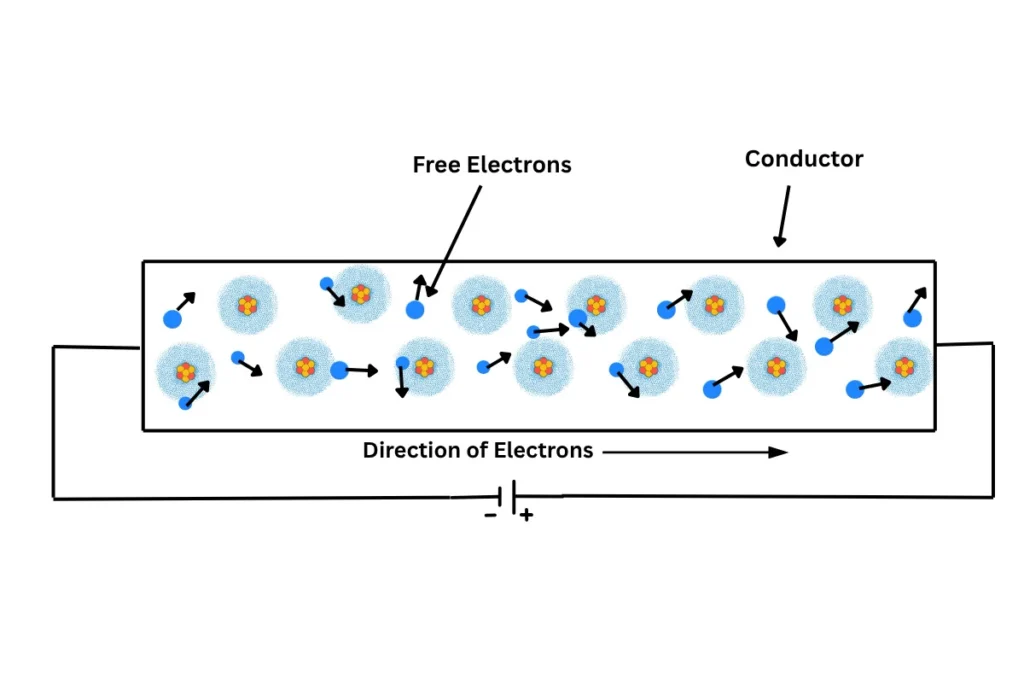
AC full form alternating current, whose amplitude and direction periodically reverse with reference to time. It means that in AC circuits, the flow of free electrons first occurs in one direction and then in the opposite direction. Currently, 95% of power plants and power grids worldwide are based on AC (Alternating Current). In all countries, power grids, power transmission lines, and distribution lines operate on AC power, which is why it is sometimes referred to as power grid current. In this blog post, we will explore in detail what is AC (Sinusoidal Current), how it works, and some interesting facts about it that you might not have known before.
What is AC (Alternating Current)
Have you ever wondered where the electricity comes from when you switch on a fan in your house or charge your mobile phone, and how it flows through the wires? In reality, the electricity that flows through our homes and offices is AC (Alternating Current). The foundations of the modern world are based on this.
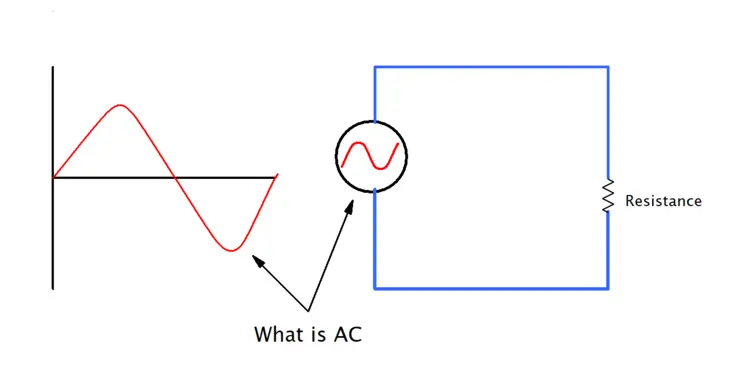
An AC power supply is a type of electrical current in which the current regularly changes its direction. In an AC circuit, the AC is actually the flow of electrons. In AC, the electrons don’t flow continuously in a single direction. They are pushed forward and then pulled backward. This process happens so quickly that we don’t even notice it.
Working Principle of AC Power Supply
The principle of electromagnetic induction is used to generate a sinusoidal current. When a magnetic field rotates, and a wire is placed near it, a voltage is induced across the wire’s terminals. Now, if a load is connected to these wire terminals, an AC current flows through the circuit. This is the process that occurs in alternators or AC generators used in power stations to generate AC power.
How does an AC generator generate AC power?
The places where electricity is generated are called power plants, such as steam, hydroelectric, or nuclear power plants. AC generators are used in these plants.
- A generator contains a coil of wire and a powerful magnet.
- When this magnet rotates, the magnetic field also changes.
- According to Faraday’s law, when a coil of wire is subjected to a changing magnetic field, an AC power is induced in the coil.
- Because the magnet is constantly rotating, it first generates current in one direction, then in the other. This means the direction of the current changes every moment—which is why it’s called “alternating” or dynamic current.
The form of an AC wave resembles a sinusoidal wave. This wave alternates between positive and negative half-cycles. This means that at one moment the current flows in one direction, and at another moment in the opposite direction. The frequency, amplitude, and time period of this wave determine how many times this cycle is completed and how strongly the current flows.
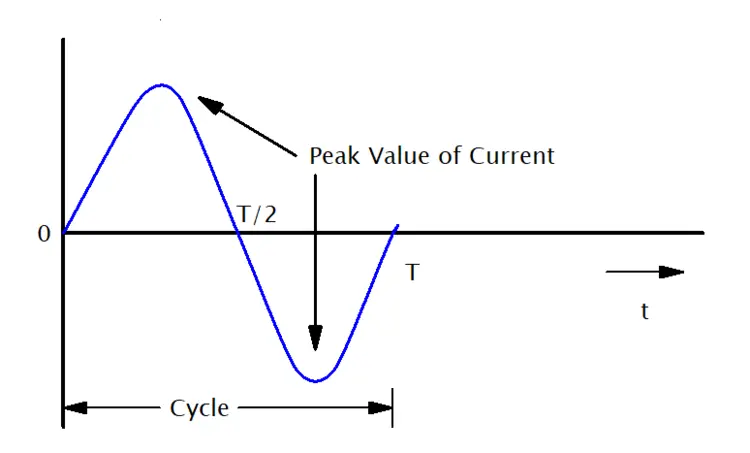
Let’s understand this in more detail. The way AC (alternating current) works is based on a sinusoidal wave or sine wave. To understand this, we need to understand some main things:
- If you plot AC voltage or current against time, it will appear to go up and down like a wave, which is called a ‘sine wave’.
- Each upward and downward movement of this sine wave is called “one cycle”.
Alternating Current Formula
The Sinusoidal Current (AC) is
The Sinusoidal e.m.f is
The Sinusoidal Voltage is
Where
- I0 = Peak value of Alternating Current
- E0 = Peak value of Alternating e.m.f.
- V0 = Peak value of alternating voltage
- \(\omega\) = Angular Velocity
To better understand the working of AC, it is essential to know its two main characteristics—frequency and amplitude—in detail.
Frequency of AC
Frequency indicates how many times the AC reverses direction per second. It is measured in Hertz (Hz).
Example: The frequency of electricity in India is 50 Hz, meaning that the AC reverses direction 50 times per second.
Important significance:
- High-frequency electricity is used in certain industrial equipment and wireless transmission.
- In India, household appliances such as fans, TVs, and refrigerators are designed to operate only on 50 Hz AC power.
- In the United States, household appliances such as fans, TVs, and refrigerators are designed to operate only on 60 Hz AC power.
Amplitude of AC
Amplitude refers to the maximum strength or height of an AC voltage or current.
Example: The supply voltage for AC units used in Indian homes is 220V (RMS), but its peak value is approximately 311V. This means the highest point of the sine wave reaches 311V.
Important significance:
- High-amplitude power supplies help transmit electricity over long distances and power powerful machines.
- Low amplitude is considered safe in small devices and electronics.
Peak Value of Alternating Current
The peak value is the highest point in an AC sine wave cycle, where the current or voltage reaches its maximum.
Importance Fact:
- The AC voltage displayed by most meters or instruments is the RMS (Root Mean Square) voltage, not the peak value.
- The standard household supply we receive is 220V (RMS), while its actual peak value is approximately 311V.
- In electronic design, such as in power supply circuits, the peak value is always considered to determine the insulation and safety levels of the equipment.
- In communication and power electronics, the ratings of diodes, capacitors, and transformers are determined by the peak voltage.
- The peak value also indicates the maximum stress the circuit will experience at any given time, helping ensure the equipment’s safety.
Rms Value of Alternating Current
RMS stands for Root Mean Square. It is the value of AC that can produce the same amount of heat as an equivalent DC voltage.
For sine wave AC
Example: If the peak value is 311V, then the RMS value = 311 / 1.414 ≈ 220V
Significance and Use:
- The 220V, 50Hz supply indicated in your home is the RMS value, not the peak value.
- All household and industrial appliances are designed based on the RMS value.
- Most voltmeters and ammeters available in the market display the RMS value of AC.
- The RMS value tells us how much “true” energy the AC supply delivers to our devices.
- When checking the capacity of an electric fuse, wire, or transformer, the RMS value is always used as the basis.
Average Value of Alternating Current
The average value represents the average value of the AC current or voltage flow over any given period of time. Since AC is in the form of a sine wave, where the current continuously changes direction, if we take the average over a complete cycle (both the positive and negative parts), the value comes out to be zero, because the positive and negative parts are equal in magnitude.
However, in practice, the average is often calculated using only half of the cycle (the positive half-cycle) to obtain the true average value. The formula for the average value of a pure sine wave AC is:
Practical example:
If an AC device has a peak current of 10A, then its average current is
Average Value = 0.637 × 10 = 6.37A
Importance
- The average value is used in rectifier circuits that convert AC to DC. Measuring this average value is essential for calculating the DC output.
- Battery charging, electroplating, and many electronic devices involve designs based on average values.
AC Symbol
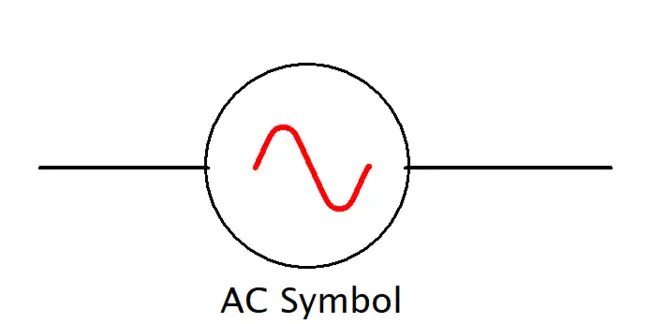
The symbol for AC (Sinusoidal Current) distinguishes it from other types of electric current, particularly DC (Direct Current). This symbol is extremely important in electronics and electrical engineering.
- The symbol for a sine wave (sinusoidal wave) is ~ or sometimes a rounded, undulating line.
- Often paired with voltage or current, such as 220V or 50Hz~ Short form: ‘A.’
- AC is clearly indicated in the circuit diagram as alternating current.
AC Circuit Diagram
AC circuits use alternating current (AC), in which the current regularly changes its direction. In this circuit, the AC is supplied by connecting it to an AC source. In AC circuit diagrams, several components such as resistors (R), inductors (L), and capacitors (C) are connected to an AC source. These AC components are connected in series and parallel combinations within the circuit.
A resistor is an electronic device that resists the flow of current. In an AC circuit, the voltage and current remain in phase. If the voltage sine wave is at its peak, the current will also be at its peak at the same time. Both waves (voltage and current) rise and fall together.
An inductor is a device that produces a magnetic field which stores energy. In an AC circuit, the current lags the voltage by 90 degrees. When the voltage waveform is at its peak, the current waveform will be either increasing or decreasing, but not at its maximum value. The voltage leads, and the current lags.
A capacitor is an AC component that stores energy in an electric field. In an AC circuit, the current is ahead of the voltage by 90 degrees. This means the current rises before the voltage. When the voltage waveform starts to rise above zero, the current waveform has already reached its peak. The current leads, and the voltage lags.
Difference Between AC Current and DC Current
- A sinusoidal current is one that continuously changes its direction and magnitude over time. Example: The electricity used in our homes.
- DC in a circuit that always flows in the same direction and whose magnitude remains constant. Examples: batteries, cells, mobile chargers.
- A sinusoidal current continuously changes its direction at a fixed frequency.
- DC current does not change direction—it flows only from the positive to the negative terminal or from the negative to the positive terminal.
- AC can be easily transformed or transmitted over long distances.
- Sending DC power supply over long distances is difficult.
- AC power can be in the form of a sine wave or other waveforms.
- DC is a straight (line) wave.
- AC power is used in homes, factories, and offices for electricity supply, electric motors, fans, heaters, and transmission lines.
- DC current is used in mobile phones, flashlights, laptops, electronic circuits, battery-operated devices, and electroplating, among other applications.
- AC power sources: generators, power plants, inverters.
- DC sources: batteries, dynamos, solar cells, fuel cells.
- The symbol for AC is (~ or ∿).
- The symbol for DC is (⎓ or ─).
Advantages of AC Over DC Current
- The voltage of an AC power supply can be easily and inexpensively increased or decreased using a transformer. Doing the same with DC is much more difficult and expensive. This is why high-voltage AC transmission is possible, which minimizes line losses.
- AC power can be transmitted over very long distances with minimal losses (low line loss). When the transmission voltage is increased, the current decreases, preventing the wires from overheating and reducing power waste.
- AC motors, transformers, and other such devices have a simpler, more robust, and less expensive design compared to DC machines. AC machines are more widely used, from household appliances to large industrial applications.
- AC systems can easily incorporate safety devices, such as circuit breakers and fuses, to protect the system in the event of overload or fault.
- In AC systems, we can easily provide both single-phase and three-phase power supplies, whereas in DC systems, this is very difficult or almost impossible.
Conclusion
Alternating current (AC) is not just a type of electricity; it’s the power that made the Industrial Revolution and the digital age possible. Nikola Tesla‘s vision and AC’s ability to easily change voltage have made it the world’s preferred energy source. Whether it’s a small light bulb in a home or the massive machinery in a factory, AC waves are what power them.
FAQ
Why AC Supply is Used in Homes
AC power is used in homes because it results in less energy loss during transmission and is easy to step up or step down in voltage. It is also safer and more economical for appliances.
Which Supply comes in Home AC or DC
Homes receive an AC (Alternating Current) supply.
How to Convert AC to DC Supply
A rectifier converts AC to DC power supply and consists of diodes and filter circuits.
How much Frequency is in AC Power Supply?
The frequency of AC power supply is 50 Hertz (Hz) in India and 60 Hertz (Hz) in the United States.
What is Single Phase AC Supply
A single-phase AC supply has only one live wire and one neutral wire, making it suitable for small appliances and household use.

I am an electrical engineer and also a blogger. I write informative blog posts on topics related to electrical and electronics engineering. If you are interested in these topics, you are welcome to my site to read these articles.