What is Electric Current and Its Effects
From the moment you wake up to the sound of an alarm to the time you switch off the lights at night, your day is powered by an invisible force. This force is electric current, and its effects are woven into nearly every aspect of modern life. Think about the warmth from your toaster, the screen of your smartphone, or the music playing through your headphones.
Each of these is a direct result of harnessing the power of electric current and its effects. Understanding this fundamental concept is not just for scientists or engineers; it’s for anyone who wants to grasp how our world works. This article will explore how electric current shapes our daily experiences, from heating our homes to powering complex technologies.
Basics of Electric Current and Its Effects

The importance of electricity in our lives has become so great that it’s difficult to imagine modern life without it. But have you ever noticed how it actually works? When we flip a switch or plug in a device, we often take the resulting flow of energy for granted. However, electric current is a dynamic force that does far more than light up a bulb or spin a fan motor. Beyond the well-known industrial applications, the flow of electricity interacts profoundly with biological systems. It demands a high level of respect regarding safety. Understanding these broader impacts is crucial for anyone living in our electrified world.
Physiological Effect: Electricity and the Human Body
One of the most critical yet often overlooked effects of electric current is its physiological impact on living tissue. Our bodies are complex bio-electrical systems; our nerves send signals to the brain using tiny electrical impulses. Because the human body is composed mainly of water and dissolved ions, it acts as a conductor.
When an external electric current passes through the body, it can disrupt these natural internal signals. This interaction creates the “physiological effect.” The severity of this effect depends on the magnitude of the current, the duration of exposure, and the path it takes through the body.
- Sensation and Reaction: At very low levels, current might cause a mild tingling sensation. This acts as a warning sign. However, as the amperage increases, it can cause involuntary muscle contractions. This is why a person gripping a live wire might be unable to let go; the current forces the muscles to clench tight.
- Critical Hazards: Higher currents can disrupt the heart’s natural rhythm, potentially leading to fibrillation or cardiac arrest. This underscores why electrical safety is not just about preventing burns, but about protecting the body’s vital functions.
The Significance in Daily Life
The effects of electric current define the rhythm of modern existence. While we often focus on the specific outputs—like heat or motion—the underlying phenomenon is the movement of charge itself. This movement is the lifeblood of communication networks, medical diagnostics, and computing.
Every time a doctor reads an ECG (Electrocardiogram), they are observing the heart’s physiological electrical activity. Every time a safety switch trips in your home, it responds to the behaviour of the electric current. Recognising these broader impacts helps us appreciate electricity not just as a utility but as a powerful force that requires understanding, caution, and respect.
When electricity flows through a wire or device, it doesn’t just transfer energy; it also leaves behind various effects. Understanding these effects is crucial for our lives, technological advancements, and safety. Let’s know, in simple terms, the different effects of electric current and how they work.
Main Effects of Electric Current
- Heating Effect of Electric Current
- Chemical effects of electric current
- Magnetic effects of electric current
Heating Effects of Electric Current
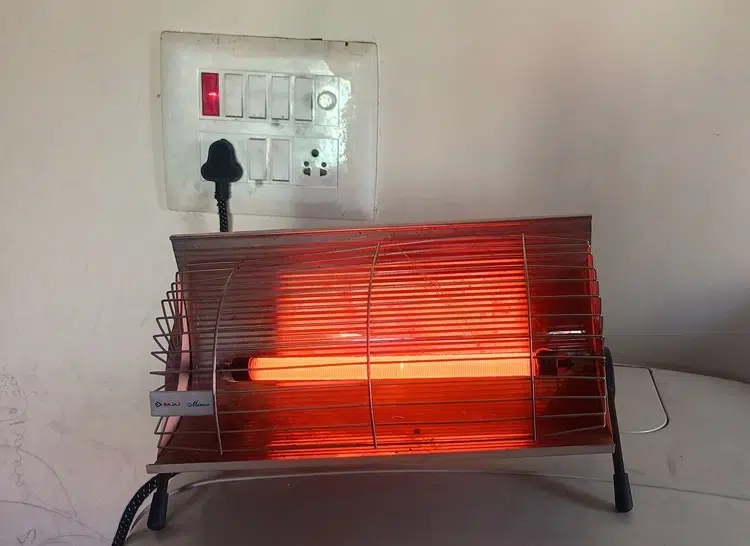
Whenever we use an electrical appliance, such as an electric heater or a water-heating rod, we are actually experiencing a specific effect of an electric current—the heating effect. This is a fundamental principle that underlies many of the devices we use in our daily lives. Let’s understand it in simple terms.
What is the thermal effect of electric current?
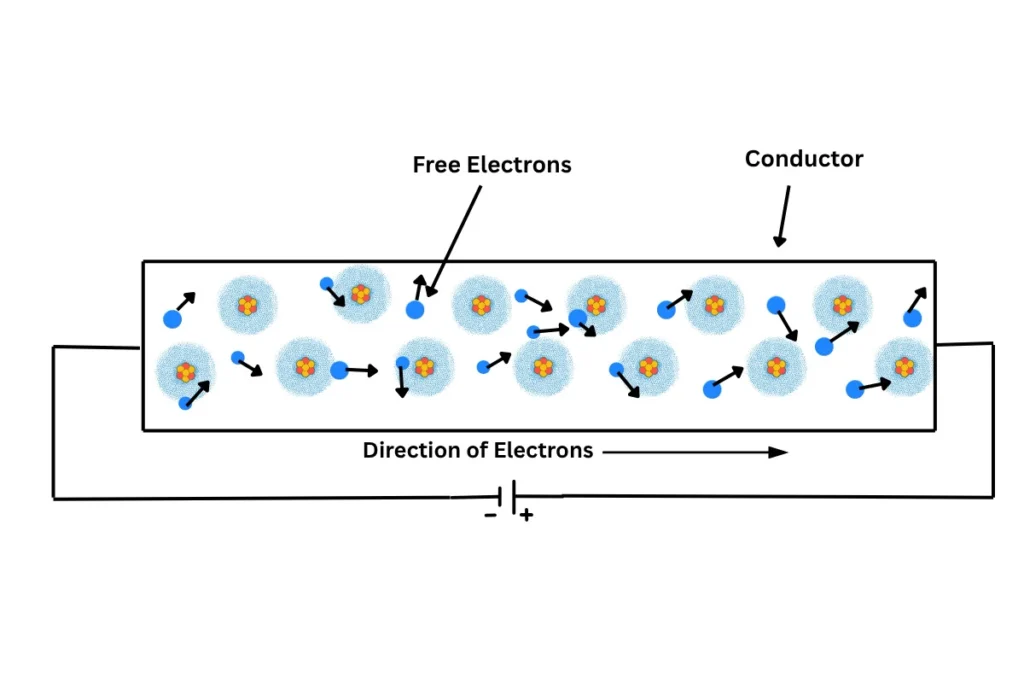
When an electric current passes through a conductor, such as a copper wire, the wire heats up. This phenomenon is known as the heating effect of electric current. Why does this happen? When electrons (which are charged particles) flow through a wire, they collide with the atoms of the wire. This collision converts the electrons’ kinetic energy into heat energy. This is the heat that we feel as the wire gets hot.
Joule’s Law of Heating
In the 19th century, the scientist James Prescott Joule studied this effect and formulated a law, known as Joule’s heating law. This law describes the factors that determine the amount of heat generated in a conductor.
The formula for Joule’s law is:
Where
- H (Heat): The amount of heat generated, measured in Joules.
- I (Current): The electric current flowing through the conductor, measured in Amperes.
- R (Resistance): The resistance of the conductor, measured in Ohms. Resistance is the property of a conductor that resists the flow of current.
- T (Time): The time for which the current flows through the conductor, measured in seconds.
This formula clearly shows that the heat generated is directly proportional to the current, resistance, and time.
Factors affecting the thermal effects of Electric Current
Magnitude of Current
According to the formula (H ∝ I²), the heat generated is proportional to the square of the current. This means that if you double the current, the heat generated will increase fourfold (2² = 4). Similarly, tripling the current will result in nine times the heat. This is why thicker wires are used in high-current devices to prevent them from melting due to excessive heat.
Conductor resistance
The heat generated is directly proportional to the current flowing through it(H ∝ R). The higher the resistance of a material, the hotter it will become. This is why appliances like heaters, toasters, and electric irons use high-resistance alloys such as nichrome, while electrical wires use copper or aluminium, which have low resistance, to minimise energy loss as heat.
Time Duration
The heat generated is directly proportional to the time (H ∝ T) for which the current flows. The longer you operate an appliance, the hotter it will become. For example, running a water heater for a few minutes will make the water lukewarm, but running it for longer will cause it to boil.
Applications of Heating Effect of Electric Current
Use of Household Appliances
- Electric Iron: It contains a coil of nichrome wire placed between sheets of mica. When the switch is turned on, the nichrome coil heats up. This heat is transferred to the heavy metal base plate, allowing us to iron clothes.
- Electric toasters and ovens: These also contain heating elements. When current flows through them, these elements become red-hot, toasting the bread or cooking the food.
Industrial Applications
- Electric Furnaces: Melting metals (such as iron, steel, and copper) requires very high temperatures. Electric furnaces generate temperatures of thousands of degrees Celsius using the thermal effect of electric current, allowing metals to be melted and cast.
- Welding: Welding machines also work on the same principle. They generate intense heat at the joint of two metals, causing the metal to melt and fuse. This is very important for construction and repair work.
Lighting
- Incandescent Bulb: Traditional yellow light bulbs work on this principle. They contain a skinny wire called a filament.
Protection
- Electric Fuse: The heating effects of electric current is utilised in electric fuses to protect electrical circuits when excessive current flows. The fuse wire heats up and melts, breaking the circuit and preventing damage to appliances.
Advantages of Heating Effects of Electric Current
- The thermal effect allows us to control the amount of heat produced easily. By adjusting the electric current or electric resistance, we can generate precisely the amount of heat we need. This feature is crucial for maintaining accurate temperatures in electric kettles, ovens, and industrial furnaces.
- Unlike burning wood, coal, or gas, generating heat with electricity produces no smoke, ash, or harmful gases. This makes it a clean and environmentally friendly option for domestic use (such as heating and cooking).
- Devices based on the thermal effect are very efficient at converting energy into heat. Almost all of the electrical energy is directly converted into heat, resulting in minimal energy loss. For example, an immersion rod heats water very quickly and efficiently.
- Electric heating appliances are straightforward to operate—you press a button. They don’t pose the risk of open flames, making them safer than traditional methods. Safety features such as fuses and circuit breakers make them even more secure.
Disadvantages of Heating Effects of Electric Current
- The most significant disadvantage of the thermal effect is that when electricity passes through a wire, some of the energy is wasted as heat.
- Many electrical devices (such as computers, TVs, and mobile phones) heat up with continuous use. This unwanted heat can damage sensitive electronic components.
- If a wire generates too much heat, the plastic or rubber insulation covering it can melt. When the insulation melts, the bare wires can come into contact with each other, causing a short circuit and increasing the risk of fire.
- Continuous exposure to heat reduces the lifespan of machines and electronic parts.
- The heat generated by machines such as electric generators and transformers reduces their efficiency. The hotter the machine gets, the more its performance is affected.
Magnetic Effects of Electric Current
There is a deep connection between electricity and magnetism. For a long time, scientists believed that electricity and magnetism were two separate phenomena, but an experiment in 1820 changed this perception. Let’s understand, in simple terms, what the magnetic effect of electric current is and what factors it depends on.
What is the Magnetic effects of electric current?
When an electric current passes through a conductor, such as a copper wire, a magnetic field is created around that wire. This is known as the magnetic effect of electric current. The fundamental principle of the magnetic effect of electric current is that a moving charge produces a magnetic field.
- Magnetic Field Lines: When current flows through a straight wire, a magnetic field is produced around it in the form of concentric circles.
- Right-Hand Thumb Rule: This rule helps us determine the direction of the magnetic field.
Factors Affecting Magnetic Effects of Electric Current
The strength of the magnetic field created around a wire depends on several factors.
Magnitude of Current
- The greater the current flowing through the wire, the stronger the magnetic field will be.
- If you increase the current, the compass needle’s deflection will also increase, indicating that the magnetism has become stronger.
- Relationship: Magnetic Field ∝ Electric Current.
Distance from the Conductor
- The closer you are to the wire, the stronger the magnetic field will be. As you move away from the wire, the magnetic effect weakens.
- This is why getting too close to high-voltage wires can be dangerous.
- Relationship: Magnetic Field ∝ 1/Distance.
Number of Turns in the Coil
- If we wrap the wire into a coil or solenoid instead of keeping it straight, the magnetic effect increases many times over.
- The greater the number of turns, the stronger the magnetic field, because the magnetic fields of each turn add up.
- Relationship: Magnetic Field ∝ Number of Turns.
Nature of Core Material
- If we place a soft iron rod inside the coil, the magnetic field increases significantly. Soft iron provides an easy path for the magnetic field lines to pass through. Electromagnets are constructed based on this principle.
Advantages of Magnetic Effects of Electric Current
- The biggest advantage of this is that we can create and switch off the magnet at will. The magnetism exists only as long as current flows through the wire; as soon as the current is switched off, the magnetism disappears. This property is used in electromagnets, such as those in cranes that lift heavy iron objects.
- Electrical energy can be converted into mechanical energy using magnetic effects. Electric motors work on this principle. Countless devices, such as fans, washing machines, blenders, water pumps, and toy cars, operate because of electric motors.
- This effect also works in the opposite direction. If we rotate a coil of wire in a magnetic field, an electric current is generated in the wire. Electric generators, which produce electricity on a large scale, work on this same principle.
- Magnetic forces can exert force without any physical contact. This force can be both attractive and repulsive. This property is used in high-speed maglev trains, which levitate slightly above the tracks.
- The magnetic effect is used in relays and sensors to control larger circuits with small electrical signals. This is very useful in automatic door locks, security systems, and industrial automation.
- Loudspeakers and headphones convert electrical signals into sound waves using magnetic effects. Similarly, microphones also use the same principle to convert sound waves into electrical signals.
Disadvantages of Magnetic Effects of Electric Current
- A magnetic field can interfere with the functioning of sensitive electronic devices. This is known as electromagnetic interference (EMI). Devices such as computer hard drives, credit cards (which have magnetic strips), and pacemakers can malfunction or be damaged if placed near strong magnetic fields.
- Electromagnets require a continuous electrical supply to maintain their magnetism. For example, the large electromagnets used in cranes or MRI machines consume a significant amount of electricity, which can be expensive.
- Transformers and electric motors often produce a humming sound due to magnetic effects of electric current. This noise is caused by the magnetic core’s vibration, a phenomenon known as magnetostriction. This not only contributes to noise pollution but can also loosen the machine’s components.
- In devices that produce magnetic effects, such as motors and transformers, energy is wasted as heat due to hysteresis and eddy currents. This heat reduces the efficiency of the machine and necessitates a cooling system to keep it from overheating.
Chemical Effects of Electric Current
Electric current not only heats things and generates magnetism, but can also cause chemical changes. When we pass an electric current through certain types of liquids, chemical reactions occur. This is called the chemical effects of electric current.
What is the chemical effects of electric current?
When an electric current passes through a liquid or solution that can conduct electricity, chemical changes occur in that solution. This process is also called electrolysis. The liquid through which the electricity passes and in which the chemical reaction takes place is called an electrolyte. Examples include salt water, lemon juice, or a copper sulfate solution.
The chemical effect of electric current is based on the movement of ions. When a salt, acid, or base dissolves in water, it dissociates into small charged particles called ions. Those with a positive (+) charge are called cations, and those with a negative (-) charge are called anions. To pass current through the solution, we insert two metal rods or plates, called electrodes.
The positive ions (cations) in the solution migrate towards the negative electrode (cathode), and the negative ions (anions) migrate towards the positive electrode (anode). Upon reaching the electrodes, these ions release their charge and undergo chemical reactions.
Factors Affecting Chemical Effects of Electric Current
The speed and outcome of a chemical reaction depend primarily on the following three factors:
Quantity of Electric Current
- The more current that is passed through the solution, the faster the chemical reaction will be.
- In electroplating, the amount of substance deposited is proportional to the amount of charge flowing through the solution.
Time Duration
- The longer the current flows, the greater the chemical reaction will be.
- If you pass even a low current for a long period of time, the amount of metal deposited on the electrode will increase.
Nature of Electrolyte
- Different solutions produce different reactions.
- The solution’s concentration also matters. If the solution is concentrated (strong), it will contain more ions, and the reaction may be faster. A dilute (weak) solution will result in a slower reaction.
Advantages of Chemical Effects of Electric Current
- Iron objects are protected from rusting by coating them with a layer of chromium or zinc.
- Inexpensive jewellery is made to look beautiful and valuable by plating it with gold or silver.
- Some machine parts are protected from wear and tear by a chromium coating.
- This process is used to purify impure metals extracted from ores.
- Many important chemicals are produced on a large scale through electrolysis.
- Rechargeable batteries (such as those in mobile phones or inverters) work on the principle of chemical effects. During charging, electrical energy is converted into chemical energy, and during discharging, the chemical energy is converted back into electrical energy.
Disadvantage of Chemical Effects of Electric Current
- Corrosion is the most significant and common form of damage caused by chemical effects. It occurs when metals undergo a natural electrochemical reaction in the presence of moisture (water) and air, leading to deterioration or decay.
- These processes are quite expensive because they require a continuous supply of high electric current to operate.
- The waste (wastewater) generated from electroplating and metal refining industries is highly harmful.
- Sometimes, a white or blue powder accumulates on the battery terminals. This is also a result of a chemical reaction, which weakens the connection and reduces the battery’s performance.
- During electroplating, if the current or the solution temperature is incorrect, the metal layer will not deposit evenly.
Conclusion
Electric current is not merely energy flowing through wires; it is a powerful force that drives our world through three main effects: thermal, magnetic, and chemical. These three effects, working together, make modern life possible. These effects of electric current are not separate phenomena, but rather three facets of the same force. One effect provides comfort and warmth, another provides motion and power, and the third provides the ability to transform and create materials. Without electric current and its effects, our homes, factories, and medical equipment—almost everything—would be vastly different from what they are today. Understanding these effects of electric current is fundamental to understanding modern technology.
FAQ
Name any two Effects of Electric Current
- Heating Effect: When an electric current flows through a resistive conductor, it generates heat.
- Magnetic Effect: An electric current creates a magnetic field around the conductor.
Who Discovered the Magnetic Effect of Electric Current
Hans Christian Ørsted discovered the magnetic effect of electric current in the year 1820.
Who Discovered the Heating Effect of Electric Current
James Prescott Joule is credited with discovering the heating effect of electric current.
Who Discovered the Chemical Effect of Electric Current
Michael Faraday discovered the chemical effect of electric current.

I am an electrical engineer and also a blogger. I write informative blog posts on topics related to electrical and electronics engineering. If you are interested in these topics, you are welcome to my site to read these articles.