Which Type of Lightning Arrester used in Substation
Substations constitute the most critical component of any power network. Safeguarding the expensive equipment housed within, such as transformers, is of paramount importance. This is precisely where a lightning arrester acts as a robust gatekeeper. These devices instantly and safely divert excess and hazardous voltage into the ground, thereby protecting the entire system from burnout and catastrophic damage. If you want to understand why lightning arresters are crucial in electrical systems, be sure to read my article on understand lightning arrester importance in electrical
However, no ordinary arrester can be used for the complex protection of a substation. Selecting the right type of arrester is crucial to ensure the stability of the entire electrical grid. In this article, we will discuss in depth “which type of lightning arrester is used in substations” and how these specific devices function.
What is Lightning Arrester in Substation
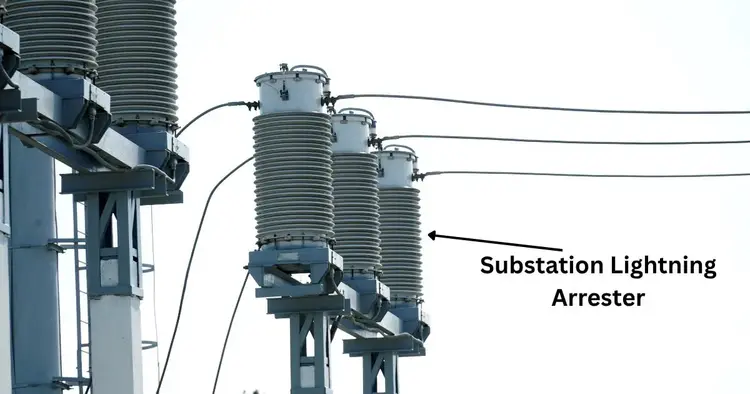
A lightening arrester in a substation is a dedicated protective device designed to shield electrical equipment from abnormally high voltage surges. These units are installed near critical infrastructure to intercept major power surges before they reach sensitive components. These constitute the primary safety system of the power grid, actively guarding against sudden voltage surges—for without such protection, these surges would devastate the entire network.
Function of Lightning Arrester in Substation
The way a lighting arrester operates is straightforward yet incredibly effective. Under normal operating conditions, the device acts as an insulator. It prevents the regular electrical current from escaping to the ground, allowing power to flow normally through the substation circuits.
When a high-voltage surge hits the system—whether from an external lightning protector or an internal switching event—the arrester changes its behaviour instantly. The extreme voltage causes the device to act as a highly efficient conductor. It creates a safe, direct path for the excess electrical energy to flow straight into the earth.
By diverting this massive energy away from the main circuits, the arrester neutralises the threat. Once the surge safely dissipates into the ground, the arrester immediately returns to its insulating state, ensuring the normal power supply continues uninterrupted.
Why Lightning Arrester is used in Substation
Lightning protection arresters device several crucial tasks to keep our power networks safe, stable, and efficient:
- Protection Against Voltage Surges: Lightning arresters safeguard electrical equipment from high-voltage surges caused by lightning strikes or switching operations.
- Prevent Equipment Damage: They protect expensive substation components like transformers, circuit breakers, and substation busbars from being damaged by sudden voltage spikes.
- Ensure Grid Stability: By preventing localised failures, lightning arrestors help maintain the stability and reliability of the entire power grid.
- Reduce Fire Hazards: Arresters safely discharge excess energy, minimising the risk of electrical fires from uncontrolled surges.
- Protect Personnel Safety: By neutralising dangerous voltage spikes, they create a safer working environment for engineers and technicians.
- Minimise Downtime: Preventing damage to critical equipment reduces repair time and ensures an uninterrupted power supply.
- Handle Multiple Surge Types: They manage both external surges (lightning strikes) and internal surges (switching operations), ensuring comprehensive protection.
Types of Lightning Arrester Used in Substation
Substations house valuable assets, including power transformers, circuit breakers, and busbars. Robust overvoltage protection is required to safeguard these assets. Engineers select different arresters based on the voltage rating, location, and the specific level of transformer protection required. Let us look at the specific types of thunder arresters used to secure these critical environments.
Traditional Gap-Based Lightning Arresters
Rod Gap Arrester
It is a simple and inexpensive type of surge diverter, consisting of two metal rods, which are square or round in shape, facing each other. One metal rod is connected to the line while the other is connected to the Earth.
The diameter of the rod is about 12mm. Both the rods fit across a big insulator. There is a gap between the two rods, which is called a spark gap. The rod gap is adjusted to a value 20% below the breakdown strength of the insulator so that the insulator does not get damaged.
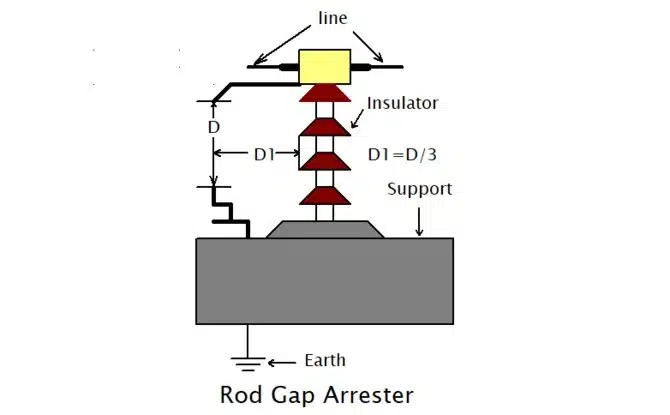
A standard formula adopted to protect the insulator from arcing is to maintain a distance between the road gap and the insulator that is more than one-third of the length of the road gap. Its value should be lower than the voltage.
There is no flashover in the road gap during regular power supply. However, during a lightning surge, a very high voltage discharge occurs, leading to a sparkover in the road gap. There is a difficulty in this once the spark starts, it continues even at standard voltage. To avoid this, current-limiting resistance is used in series with the road.
Spherical Gap Arrester
In this type of surge arrester, there is an air gap between two similar metal spheres, which is very small compared to the diameter of the sphere, which is measured with the help of a gauge. In this scenario, one sphere is connected to the line, and the other to the earth.
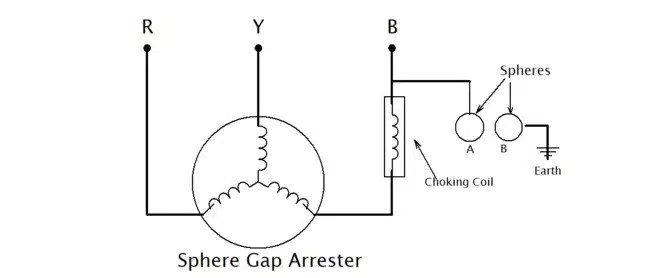
This lighting arrester is used to protect the winding of the transformer. A checking coil is connected in series with the transformer winding to the sphere attached to the line, as per the image. This coil prevents the overvoltage surge from entering the transformer winding.
At normal operating voltage, the air gap does not discharge; it is set up in the same way, but at high voltage, an arc is set up. This arc travels to the top of the sphere and moves upwards. When the length of the arc increases, it gets interrupted automatically.
Horn Gap Arrester
This lighting arrester uses two horn-shaped metal rods, which are separated at a small air gap. One metal rod is connected to the line through a resistance, and the other is directly linked to earth. The resistance prevents normal current from flowing. The horn gap of the rod is designed in such a way that the gap distance gradually decreases towards the top. The horn gap rod is fitted on top of a porcelain insulator to insulate it from the ground.
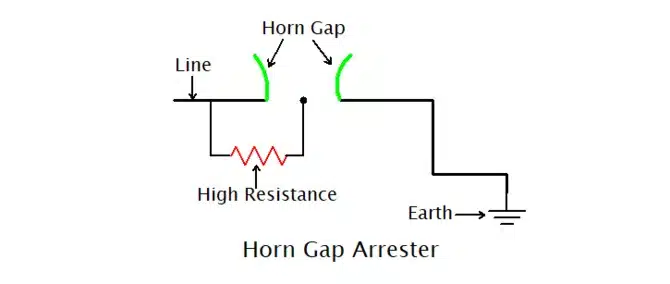
In this, a choke is connected in series with the equipment, which protects against any transients. Horn gap offers a small reactance at regular frequency, while a high reactance at transient frequency. The gap in the horn is such that the arc does not initiate at the standard supply voltage.
Hence, in normal conditions, the gap is non-conducting. However, in the case of overvoltage, the gap breakdown occurs, and an arc initiates, which is flexible. This arc moves from bottom to top as shown in the figure. At the c position, the length of the arc becomes so much that sufficient voltage is not available to maintain the arc, and it ends.
Multi-Gap Arrester
This arrester is made up of many metallic cylinders made of zinc alloy connected in series. All the cylinders are insulated from each other and are separated by a small air gap. As per the image, cylinder A is connected in series with the line, and cylinder D is connected to earth through a series resistance.
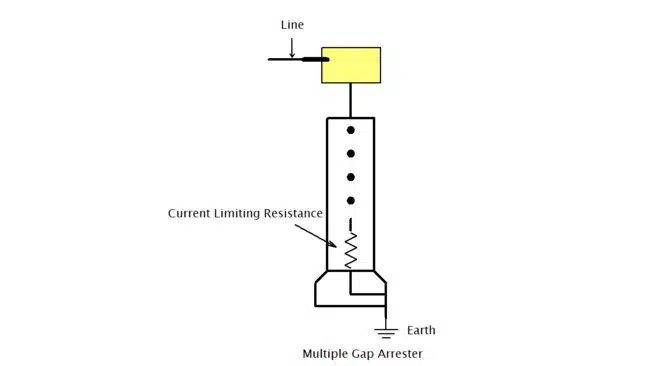
Since the series resistance reduces the arc, it also reduces the protection against traveling waves. To avoid this problem, shunt resistance is used in the gap between some cylinders.
At normal operating voltage, cylinder B remains at earth potential, due to which breakdown is not possible. However, when overvoltage, such as lightning, occurs, the gap between cylinder A and B breaks down. During this, the large current is discharged to earth through the gap instead of through the shunt resistance.
When the surge ends, there is no arc between cylinder B and D because the current flow is limited by the shunt and series resistance, which are connected in series with each other. In this way, there is not enough current to maintain the arc between A and B, and normal conditions are restored.
Advanced Lightning Arresters for Heavy Surges
As power grids grew in capacity, the need for faster, more reliable arresters became obvious. Engineers developed new technologies to safely handle massive energy dumps.
Expulsion Type Arrester
The expulsion-type arrester, also known as a protector tube, represents a significant step up from simple gap devices. It features a spark gap enclosed in a fibre tube.
- Operation: When a surge occurs, an arc forms inside the tube. The intense heat of the arc vaporises a small amount of the fibre lining, creating a high-pressure gas.
- Arc blowing: This gas rapidly expands and blasts out of the bottom of the tube. The violent expulsion of gas physically blows out the arc, stopping the flow of normal current to the ground.
- Application: While highly effective at interrupting arcs, they are mainly used on distribution lines and rural networks rather than large-scale substation enclosures.
Valve Type Arrester (Silicon Carbide)
For many decades, the valve-type arrester was the standard for high-voltage substation safety. This device uses a non-linear resistor made of Silicon Carbide (SiC) placed in series with a set of spark gaps.
- Non-linear resistance: The SiC material has a unique property. At normal operating voltages, its resistance is extremely high. At high surge voltages, its resistance drops close to zero.
- The process: The spark gap isolates the SiC blocks during normal operation. When a surge hits, the gap sparks over, and the SiC block instantly conducts the energy to the ground. Once the surge voltage drops, the SiC resistance spikes back up, cutting off the follow-current and extinguishing the arc in the gap.
- Reliability: These arresters offer excellent transformer protection and were the dominant choice for station-class arresters before the introduction of modern metal-oxide variants.
Metal Oxide Surge Arrester (MOSA)
Today, the metal oxide surge arrester (MOSA) is the undisputed king of substation protection. Also known as a gapless arrester, this device has completely revolutionised insulation coordination in electrical grids.
This arrester is made up of many metallic cylinders made of zinc alloy connected in series. All the cylinders are insulated from each other and are separated by a small air gap. As per the image, cylinder A is connected in series with the line, and cylinder D is connected to earth through a series resistance. Since the series resistance reduces the arc, it also reduces the protection against traveling waves. To avoid this problem, shunt resistance is used in the gap between some cylinders.
At normal operating voltage, cylinder B remains at earth potential, due to which breakdown is not possible. However, when overvoltage, such as lightning, occurs, the gap between cylinder A and B breaks down. During this, the large current is discharged to earth through the gap instead of through the shunt resistance.
When the surge ends, there is no arc between cylinder B and D because the current flow is limited by the shunt and series resistance, which are connected in series with each other. In this way, there is not enough current to maintain the arc between A and B, and normal conditions are restored.
Instead of Silicon Carbide, a MOSA uses zinc oxide blocks. Zinc oxide exhibits such extreme nonlinearity that it eliminates the need for internal spark gaps.
Why MOSA is the Standard for Modern Substations:
- Instantaneous Response: Because there is no air gap to break down, a MOSA responds to overvoltage surges in nanoseconds. This protects sensitive electronics perfectly.
- No Follow Current: The transition from conducting to insulating happens so rapidly and completely that normal power current never follows the surge to the ground.
- Compact Design: Eliminating the gap structures makes the MOSA smaller, lighter, and easier to install on substation gantries and transformers.
- Exceptional Energy Handling: Station-class arresters built with zinc oxide can safely absorb and dissipate the immense thermal energy generated by massive lightning resistor and heavy switching surges.
Conclusion
Electrical networks rely heavily on robust substation safety measures to prevent catastrophic failures during lightning strikes and heavy switching events. Substations no longer predominantly use traditional gap-based devices; instead, they have adopted modern Metal Oxide Surge Arresters (MOSA), which offer superior performance.
Choosing the correct station-class arrester is much more than a technical formality—it is essential for protecting expensive infrastructure such as power transformers. A high-quality surge protection device acts as an invisible shield, instantly diverting massive amounts of destructive energy safely into the earth.
FAQ
-
What is a lightning arrester?
A device that protects substation equipment from high-voltage surges by diverting them to the ground.
-
Types of lightning arresters used in substations?
(a) Station Class: For high-voltage systems.
(b) Intermediate Class: For medium-voltage systems.
(c) Distribution Class: For low-voltage systems.
(d) MOV Arresters: Highly efficient and reliable. -
How does an MOV arrester work?
It conducts excess voltage to the ground during surges and becomes non-conductive afterward.
-
Factors for selecting a lightning arrester?
System voltage, surge protection needs, environment, equipment type, and standards.
-
Difference between surge and lightning arrester?
Lightning arresters protect against lightning surges; surge arresters protect against all voltage surges.
-
Advantages of polymer-housed arresters?
Lightweight, pollution-resistant, durable, and less prone to breakage.
-
Standards for lightning arresters?
(a) IEC 60099-4: For metal-oxide arresters.
(b) IEEE C62.11: For AC power systems.

I am an electrical engineer and also a blogger. I write informative blog posts on topics related to electrical and electronics engineering. If you are interested in these topics, you are welcome to my site to read these articles.