How Inverter Works
Have you ever wondered how your home’s lights and Wi-Fi keep running during a sudden power outage? That silent helper is your inverter. That silent lifesaver is your inverter.
Today, uninterrupted power is no longer a luxury—it is an absolute necessity. From keeping critical servers online in bustling businesses to ensuring your home appliances keep running smoothly, Inverters are playing a significant role in our everyday lives.
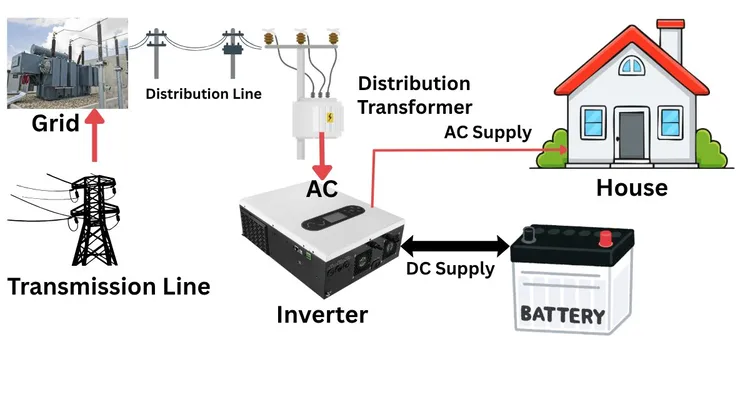
But what exactly does an inverter do? Think of it as a smart translator for your electricity. It takes the stored backup energy sitting in your batteries and transforms it into a format that your standard plug-in devices can actually use.
Without this clever device, battery power would be completely useless to your ceiling fans, laptops, and refrigerators. Let’s dive into how this essential machine works behind the scenes to keep your life moving without interruption.
Basic Principle of an Inverter
To understand how an inverter works, we need to look at its core job: energy conversion. The fundamental principle of an inverter is straightforward. It changes Direct Current (DC) into Alternating Current (AC).
The Conversion of DC to AC
When the power grid in your area goes down, your home’s power backup system relies on heavy-duty batteries. These batteries store electrical energy as Direct Current (DC). In a DC system, the electrical current flows steadily in just one direction. While this is the perfect way to store energy, there is a major catch: your house cannot use it directly.
This is where the inverter solves this problem. It takes that one-way DC power and rapidly switches its direction back and forth. By doing this dozens of times per second, the inverter transforms flat DC power supply into the wavy Alternating Current (AC) that your home electrical system expects.
Why AC Power is Essential for Household Appliances
You might wonder why we need this conversion in the first place. Why not just build appliances that run straight off battery power?
The answer comes down to how our global power grids are designed. Alternating Current is much easier and cheaper to transmit over long distances from power plants to neighborhoods.
Because our cities run on AC power, manufacturers design nearly all standard household appliances—from your air conditioner and microwave to your television and mixer—to run exclusively on AC.
If you tried to feed DC power directly into your AC appliances, they simply would not turn on, and you would likely fry their internal components.
By converting DC to AC, your inverter acts as the perfect middleman. It ensures your appliances receive the exact same safe, reliable power they normally pull from the main city grid.
Key Components of an Inverter
If you want to understand how an inverter actually works, you first need to take a look inside it. A reliable power backup system relies on several moving parts working together in perfect harmony.
When you break it down, the magic of uninterrupted electricity comes from four primary inverter components. Let us explore what each part does to keep your home running smoothly during a power outage.
The Battery: Your Source of Stored DC Power
The battery is the foundation of any backup setup. While the inverter itself does the heavy lifting of converting energy, it cannot actually store power. That is where the battery comes in.
When your main power grid is active, the system charges the battery. The battery holds onto this electrical energy in the form of Direct Current (DC).
Think of the battery as a large reservoir of stored DC power, waiting patiently for the moment your local grid fails. The capacity of your battery determines how long your appliances will stay on during an outage.
The Inverter Circuit: Converting DC to AC
If the battery is the reservoir, the inverter circuit is the engine. This is the core component that gives the device its name.
As we covered earlier, your household appliances cannot use the flat, one-way DC power stored in the battery. The inverter circuit handles this exact problem. It takes the steady flow of DC power and rapidly switches its direction back and forth.
This constant switching transforms the unusable DC energy into the Alternating Current (AC) that your ceiling fans, televisions, and refrigerators require to function.
The Transformer: Stepping Up the Voltage
Converting the type of current is only half the battle. Your battery usually stores power at a very low voltage, typically 12V or 24V. However, your home appliances need a much higher voltage to turn on—usually 110V or 220V depending on where you live.
This is where the transformer steps in. Once the inverter circuit changes the current from DC to AC, the transformer takes that low-voltage AC power and “steps it up” to a usable level. By boosting the voltage, the transformer ensures your devices get the exact amount of energy they need to run safely without burning out or underperforming.
The Control Circuit: Managing Power Flow and Safety
Every great machine needs a brain, and in a power backup system, that brain is the control circuit. This component constantly monitors the entire power flow process.
The control circuit handles several vital tasks:
- Automatic Switching: It detects when the main grid loses power and instantly tells the battery to start discharging, ensuring you barely notice the outage.
- Voltage Regulation: It keeps the output voltage steady, protecting your sensitive electronics from dangerous power surges or drops.
- Safety Monitoring: It watches out for short circuits, overheating, and battery overcharging. If it detects a problem, it shuts the system down to prevent damage or fire hazards.
Together, these four essential parts take raw, stored energy and turn it into the safe, reliable electricity that powers your daily life.
Step-by-Step Process of How an Inverter Works
When the electricity suddenly go out, your home does not have to come to a grinding halt. We rely on our inverter—to keep food cool, rooms cool, and our devices connected. But how exactly does a quiet metal box turn stored battery power into the electricity your house needs?
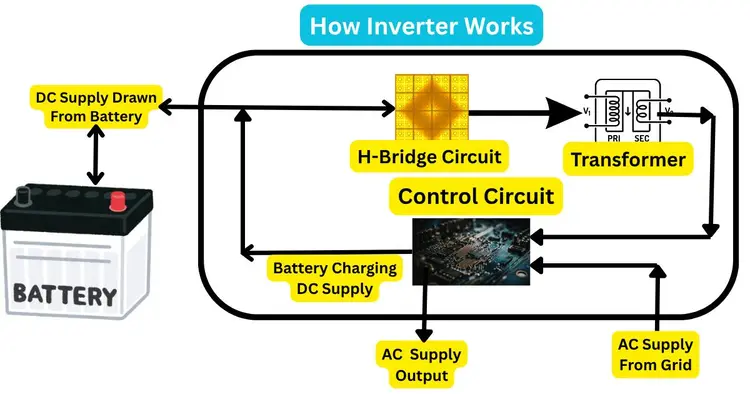
Understanding the inverter process is easier than you might think. You do not need an engineering degree to grasp how your power backup system keeps your life running smoothly.
We are going to walk through the exact journey electricity takes, from the moment the grid fails to the second your television flickers back to life.
Let us Break Down the Entire Cycle into Four Simple Steps.
Step 1: DC Power is Drawn from the Battery
The journey of uninterrupted electricity begins the moment your main power grid fails. When your system detects an outage, it immediately signals the battery to spring into action. This is the starting point of the entire backup cycle.
Your inverter battery stores energy in the form of Direct Current (DC). Think of DC power as a straight, narrow road where traffic only flows in one direction. It is the perfect format for storing energy over long periods.
When the blackout hits, the system begins pulling this stored DC power out of the battery to keep your home running. However, there is a catch.
Your household appliances cannot use this straight-line DC power directly. If they tried, they simply would not turn on. This brings us to the next critical phase.
Step 2: The Inverter Circuit Converts DC to AC
Once the DC power leaves the battery, it enters the heart of the machine: the inverter circuit. This is where the crucial DC to AC conversion takes place.
Since your home appliances expect Alternating Current (AC). The circuit takes that one-way DC power and forces it to rapidly switch directions back and forth.
By reversing the direction of the electric current dozens of times every second, this circuit successfully converts power into alternating current. This precise switching mechanism is the defining action that gives the inverter its name. Let us know in details how to convert DC to AC.
The H-Bridge Circuit: The Core Mechanism
The heart of most modern inverters is a clever layout called an H-bridge circuit. Imagine a circuit shaped like the capital letter “H.” At the center of the crossbar sits your appliance (the load). On the four legs of the “H,” you have four electronic switches.
how the H-bridge creates alternating current:
- Step 1: The inverter closes the top-left and bottom-right switches. Electricity flows through the load from left to right.
- Step 2: The inverter opens those switches to stop the flow.
- Step 3: The inverter then closes the top-right and bottom-left switches. Now, electricity flows through the load from right to left.
By rapidly repeating this process—usually 50 or 60 times every single second (50Hz or 60Hz).
The Heavy Lifters: MOSFETs and IGBTs
Mechanical switches cannot open and close 60 times a second without breaking down. Instead, inverters use solid-state semiconductor switches. You will commonly see two types:
- MOSFETs (Metal-Oxide-Semiconductor Field-Effect Transistors): These handle lower voltage applications. They are incredibly fast and efficient, making them perfect for smaller electronics.
- IGBTs (Insulated-Gate Bipolar Transistors): These handle high-voltage heavy lifting. You will find them in industrial equipment or large-scale solar inverters.
Think of these components as high-speed traffic cops. They control exactly when the electricity flows and in which direction, executing the H-bridge switching flawlessly without any moving mechanical parts.
Step 3: The Transformer Adjusts the Voltage
Even though the electricity is now in the correct AC format, it is still not ready to be used. The power coming from your battery has a very low voltage, usually around 12 or 24 volts.
If you try to power a standard household appliance with only 12 volts, nothing will happen. Your devices require much more force, typically 110 or 220 volts, depending on your region.
To fix this, the newly converted AC power moves into the transformer. The transformer’s job is to take that low-voltage electricity and step it up to meet standard appliance requirements. You can find detailed information on how a transformer works in my article, “Working Principle of a Transformer“.
This step involves precise voltage regulation. The transformer ensures the voltage is not just increased, but also perfectly stabilized. This protects your sensitive electronics from sudden spikes or drops in power, ensuring they receive the exact amount of energy they need to operate safely.
Typically, single-phase transformers are used in home inverters. If you would like to learn more about this, you can read my article on the single-phase transformers principle.
Step 4: AC Power is Supplied to Connected Devices
Now that the electricity has been properly converted to AC and stepped up to the correct voltage, it is finally ready for the final delivery. The inverter routes this safe, stable power out to your home’s electrical panel.
From there, the electricity travels through the wiring in your walls straight to your connected devices. Your refrigerator continues to hum, your ceiling fans keep spinning, and your Wi-Fi router stays connected to the internet.
Because this entire four-step process happens in just a fraction of a second, you might only notice a brief blink of the lights before your power backup seamlessly takes over.
Wrapping Up the Backup Cycle
The next time a sudden storm or grid failure leaves your neighborhood in the dark, you will know exactly what is happening behind the scenes.
By continuously drawing DC energy, mastering the DC to AC conversion, executing flawless voltage regulation, and delivering clean power to your outlets, your inverter works tirelessly to keep your daily routine completely uninterrupted.
Types of Inverter Technologies: Choosing the Right Power Fit
Not all power is created equal. When you plug your laptop into a wall outlet, you expect a smooth, consistent flow of electricity. But when a power outage forces your home to rely on a battery backup, the quality of that electricity depends entirely on the brain of your system: your inverter.
Understanding how an inverter works means looking at the exact type of electrical wave it produces. As your system converts stored DC power into the AC power your house needs, it can do so in a few different ways. The method it uses determines what appliances you can safely run and how efficiently they will operate.
Let us break down the three main types of inverter technology so you can understand exactly what is powering your life behind the scenes.
Pure Sine Wave Inverters: The Gold Standard
If you want the absolute best for your devices, a pure sine wave inverter is your top choice. This inverter technology produces an electrical wave that perfectly matches the smooth, rolling wave of power supplied by your city grid.
Because the power flows in a seamless, continuous curve, it is incredibly safe for sensitive electronics. Devices like laptops, modern televisions, smart refrigerators, and critical medical equipment require this high-quality power to function correctly.
Using a pure sine wave inverter offers several major benefits:
- Maximum power efficiency: Your appliances run cooler and consume less power.
- Zero interference: You will not hear any annoying humming noises from fans or fluorescent lights.
- Equipment protection: It prevents the internal damage that choppy power can cause to delicate microprocessors.
While they come with a higher price tag, pure sine wave models are the ultimate investment for keeping your modern electronics safe and running smoothly.
Modified Sine Wave Inverters: The Balanced Workhorse
If you do not need to power highly sensitive equipment, a modified sine wave inverter offers a fantastic middle ground.
Instead of a perfectly smooth curve, this inverter technology creates a wave that looks more like a staircase. The power steps up and down in blocks rather than flowing seamlessly.
This blocky wave is perfectly fine for basic household items. If your main goal is keeping the lights on, running a basic ceiling fan, or powering simple kitchen appliances like a toaster, a modified sine wave inverter gets the job done at a fraction of the cost.
However, there is a trade-off when it comes to power efficiency. Because the wave is not perfectly smooth, motors might run a bit hotter and use slightly more battery power.
You might also notice a slight buzz from audio equipment or certain fans. Despite these minor quirks, modified sine wave inverters remain incredibly popular for basic, budget-friendly power backup options for home. .
Square Wave Inverters: The Simple Pioneer
At the very bottom of the performance ladder sits the square wave inverter. This is the oldest and simplest form of inverter technology.
Instead of trying to mimic a curve or create small steps, a square wave inverter simply flips the power straight up and straight down, creating a harsh, boxy wave.
Today, square wave inverters are rarely used for home backup power systems. They offer the lowest power efficiency and can actually damage modern electronics over time.
If you connect a television or a computer to a square wave inverter, the device may refuse to turn on, or worse, suffer permanent damage.
Their only real advantage is their incredibly low cost. You might still find them used in very basic applications, like running simple tools or older, heavy-duty motors that do not require clean power. For modern homes, however, this technology is largely a thing of the past.
Making the Right Choice for Your Home
The type of inverter technology you choose dictates exactly how well your backup system performs. If your home relies on smart devices, computers, and modern appliances, pure sine wave is the clear winner.
For a simple cabin setup with basic lights and older fans, a modified sine wave might be all you need. By understanding how these different waves interact with your electronics, you can build a power backup system that keeps your life running without a hitch.
Real-World Applications of Inverters: Electricity Without the Grid
Understanding the internal mechanics of a device is fascinating, but the true magic happens when you see that technology in action.
Now that we know the basic principles of how an inverter works—taking stored Direct Current (DC) and transforming it into usable Alternating Current (AC)—it is time to look at where this technology actually lives.
Inverters are not just metal boxes sitting quietly in a utility closet. They are the driving force behind modern energy independence.
By applying that core DC to AC conversion process to different scenarios, manufacturers have created solutions for almost every power problem imaginable. Let us explore three primary applications where inverters keep our daily lives moving.
Power Backup for Homes and Offices
The most common place you will find an inverter is right inside your home or workplace. When a severe storm hits or the local utility grid experiences a sudden failure, standard power backup systems act as your immediate safety net.
In a home or office setup, large batteries store electrical energy as DC power. The moment the main electricity drops, the inverter takes over. It pulls that DC energy, rapidly converts it into the AC power your building requires, and pushes it out to your electrical panel.
- At home: This continuous conversion process keeps your refrigerator cold, your ceiling fans spinning, and your Wi-Fi router connected.
- In the office: It prevents sudden server crashes, keeps desktop computers running long enough to save critical work, and maintains security systems.
By managing this transition seamlessly, the inverter ensures that a grid failure outside does not cause chaos inside.
Use in Renewable Energy Systems
As we shift toward greener energy solutions, the role of the inverter has expanded massively. If you have ever looked at rooftop solar panels and wondered how they power a house, the answer lies in the inverter.
Solar panels generate electricity by absorbing sunlight, but the energy they produce is entirely Direct Current (DC). You cannot plug your television directly into a solar panel. To bridge this gap, systems use specialized solar inverters.
These devices perform the exact same core function we discussed earlier, but on a different scale. They take the raw DC energy generated by the sun and convert it into high-quality AC power.
This allows you to use your solar power backup to run heavy household appliances or even feed excess electricity back into the city grid. Without the inverter acting as a translator, renewable energy sources like wind and solar would be entirely useless for standard household needs.
Portable Inverters for Outdoor and Emergency Use
You do not need a massive battery bank strapped to your wall to benefit from inverter technology. Manufacturers have scaled down this exact same DC to AC conversion process to create highly portable power solutions.
If you enjoy camping, traveling in an RV, or working at remote job sites, portable inverters are absolute lifesavers. You can plug a small inverter directly into your car’s 12-volt cigarette lighter or connect it to a standalone portable power station.
- Recreational use: They allow you to run standard AC appliances like coffee makers, laptops, and small air compressors right from your vehicle’s battery.
- Crisis management: During severe weather evacuations or long-term outages, they serve as vital emergency portable power, allowing you to charge phones, run medical equipment like CPAP machines, and power emergency radios.
Whether it is keeping a massive office building online, transforming sunlight into usable energy, or providing a small burst of electricity in the middle of the woods, the application remains the same.
By mastering the simple conversion of DC to AC power, inverters provide safe, reliable electricity exactly when and where you need it most.
Advantages of Using an Inverter
Now that we understand the exact mechanics of how an inverter works, it is important to look at how this technology directly benefits your daily life.
Transforming stored DC power into usable AC power provides significant, real-world advantages that keep your home and business running smoothly during grid failures.
By integrating a reliable power backup system into your setup, you unlock several key benefits:
- Provides an Uninterrupted Power Supply: The most immediate advantage of an inverter is the peace of mind it delivers during a blackout. When the main electricity grid fails, the control circuit detects the drop and instantly switches to battery power. This transition happens in a fraction of a second. By providing an uninterrupted power supply, the inverter ensures that your internet routers, refrigerators, and critical work computers stay on without missing a beat.
- Highly Energy-Efficient and Cost-Effective: Modern inverters feature advanced technology designed for maximum energy efficiency. During the critical DC to AC conversion process, the internal circuits minimize energy loss. This means your home appliances draw the exact amount of power they need without wasting excess electricity as heat. Over time, this efficient performance keeps your utility bills manageable, making the system a highly cost-effective investment.
- Supports Sustainable Energy: Inverters are the essential backbone of the green power movement. If you want to reduce your environmental impact, pairing your system with renewable sources like solar panels is the perfect solution. A solar inverter takes the raw, clean energy harnessed from the sun and translates it into the AC electricity your standard appliances require. This seamless integration plays a vital role in shifting your home toward sustainable energy, helping the planet while granting you total energy independence.
Common Issues and Troubleshooting: Keeping Your Power Flowing
Even the most reliable machines occasionally run into hiccups. Because you now know how an inverter works behind the scenes—seamlessly changing stored DC power into usable AC power—diagnosing problems becomes much easier. When your lights flicker or the backup fails to turn on, the issue usually traces back to a specific part of the conversion cycle.
Let us explore the most common roadblocks your power backup system might face and how you can fix them. By understanding the root causes, you can apply basic inverter troubleshooting to keep your home running safely and efficiently.
The Overloading Impact on Inverter
Every inverter comes with a specific capacity rating. This rating tells you exactly how much AC power the internal transformer and inverter circuit can safely push out at one time.
When you plug in too many heavy appliances—like air conditioners, microwaves, or multiple fans—you demand more electricity than the machine can physically convert. This creates a severe overloading impact.
When overloading happens, the inverter circuit struggles to maintain the rapid switching needed to turn DC into AC power. The transformer works overtime, generating excessive and dangerous heat. Fortunately, modern inverters have built-in safety nets.
The control circuit constantly monitors the power flow. If it detects that you are pulling too much energy, it will intentionally shut the entire system down to prevent electrical fires or permanent damage to the internal components.
If your system suddenly turns off while running multiple devices, you have likely overloaded it. Simply unplug the heavy power-drawing appliances, reset the machine, and stick to running essential items during an outage.
Battery-Related Problems: When the Power Source Struggles
The inverter itself only converts energy; it does not store it. The actual power comes directly from your battery bank. If the battery is struggling, the entire DC to AC conversion process grinds to a halt. Most power failures during an outage stem from a few common battery issues:
- Low Charge Levels: If the main grid drops and your battery is only half-charged, your backup time will shrink drastically. This often happens if the local power cuts out frequently, leaving the system with too little time to pull AC power from the grid and store it as DC power in the battery.
- Aging Batteries: Batteries are chemical powerhouses, and those chemicals degrade over time. An older battery slowly loses its ability to hold a full charge. If your system used to run for five hours but now barely lasts one, the battery has likely reached the end of its lifespan and cannot supply enough raw DC power to the inverter circuit.
- Terminal Corrosion: Take a look at where the thick cables connect to your battery. Do you see a white, crusty buildup? That is corrosion. This buildup acts as a physical roadblock, stopping the smooth flow of DC power from the battery into the inverter. If the energy cannot leave the battery, the inverter has nothing to convert.
Essential Battery Maintenance and System Upkeep
You do not need to be an electrician to keep your system in top shape. A little routine care goes a long way in preventing sudden blackouts. Proper battery maintenance ensures that the core power source remains strong and ready for the next grid failure.
Follow these actionable tips to maintain optimal performance:
- Check the Water Levels: If you use a standard lead-acid or tubular battery, it relies on distilled water to keep its internal chemical reactions balanced. Check the water level indicators every two months. If the markers drop below the recommended line, carefully top them up with fresh distilled water. Never use tap water, as the minerals will destroy the internal battery plates.
- Clean the Terminals: Prevent power roadblocks by keeping your battery connections spotless. If you notice any corrosion, safely wipe it away using an old toothbrush and a mixture of baking soda and warm water. Once clean, apply a thin layer of petroleum jelly to the metal terminals to block future buildup.
- Keep the Area Ventilated: The DC to AC conversion process naturally generates heat. If you lock your inverter inside a cramped, stuffy closet, that heat has nowhere to go. Overheating forces the cooling fans to run constantly, draining your backup power and stressing the internal circuits. Always place your setup in a well-ventilated, dry area where air can circulate freely around the metal casing.
- Perform a Regular Discharge: If you live in an area with very rare power cuts, your battery might sit fully charged for months. To keep the internal chemicals active, intentionally turn off your main power switch once every few months. Let the inverter run your basic home appliances until the battery drops to about half capacity, then turn the grid back on to recharge it.
By managing your appliance load and sticking to a simple battery maintenance routine, you protect the delicate conversion process. A well-maintained system will faithfully translate raw energy into the reliable power your home depends on, year after year.
Conclusion
Understanding basic inverter functionality takes the mystery out of how your home stays lit during a blackout. At its core, the entire process relies on seamless DC to AC conversion. The inverter circuit and transformer work together to pull stored DC energy from your battery and transform it into the safe AC electricity your household appliances need to run.
But knowing how the machine operates is only half the battle. To build the perfect power backup system, you must choose the right technology for your daily needs.
If you run sensitive electronics like modern laptops, smart refrigerators, or medical equipment, investing in a pure sine wave inverter is your safest choice. For basic ceiling fans and standard lights, a modified sine wave model offers a solid, budget-friendly alternative.
By matching the right inverter technology to your household usage, you guarantee safe, uninterrupted power whenever the grid goes down. You now have the knowledge to make an informed decision—go build a system you can truly count on!
FAQ
-
Does an inverter consume battery power when turned on but not actively running appliances?
Yes. We call this idle draw or standby power consumption. The internal control circuit stays awake to monitor the main grid voltage. This constant alertness slowly pulls a tiny amount of energy from the battery, even if every appliance in your house is switched off.
-
Why do ceiling fans sometimes make a loud buzzing noise on battery backup?
This happens due to harmonic distortion. Modified sine wave inverters push out blocky, staircase-like power waves instead of smooth curves. The motors inside fans struggle to process these harsh power steps smoothly, causing the physical parts to vibrate and hum.
-
Does heavy indoor humidity impact how the inverter circuit functions?
High humidity pushes unseen moisture through the cooling vents. This water vapor settles directly on the printed circuit board (PCB). Over time, it causes tiny electrical shorts or accelerates rust on vital metal components, which weakens the entire conversion process.
-
Why does the metal casing get hot even if you only run a few LED lights?
The energy conversion process is never perfectly efficient. Most units lose about 10% to 15% of the battery energy as pure heat during the DC to AC transfer. The system generates this heat simply by doing its basic job, regardless of how small the electrical load is.
-
Does the length of the cable connecting the battery to the inverter matter?
Absolutely. Direct Current (DC) loses electrical pressure very quickly over distance. If you use long cables, the voltage drops significantly before it even reaches the inverter circuit. Keep your battery cables thick and as short as possible to prevent wasted energy.
-
Can the rapid switching mechanism disrupt your home Wi-Fi or radio signals?
It is uncommon, but it happens. The fast switching inside the circuit generates electromagnetic interference (EMI). If you place your internet router or radio directly on top of the machine, this invisible magnetic field might scramble or weaken your wireless signals.
-
Exactly how fast does the inverter flip the current to create AC power?
The internal circuit reverses the electrical flow either 50 or 60 times every single second. We measure this lightning-fast speed in Hertz (Hz). The system specifically mimics this exact speed so the output perfectly matches the rhythm of your local city power grid.
-
What does a “cold start” feature actually do during a complete grid blackout?
A. A cold start lets you turn the inverter on using only battery power, without needing an initial jolt from the main city grid to wake the system up. It forces the internal capacitors to charge instantly, allowing you to activate a completely shut-down unit in the middle of a power cut.

I am an electrical engineer and also a blogger. I write informative blog posts on topics related to electrical and electronics engineering. If you are interested in these topics, you are welcome to my site to read these articles.